This website uses cookies to ensure you get the best experience on our website. Read more

May a Rector Be Spiritual Father to His Own Staff?
 10Apr
10AprSpiritual fatherhood would be simple if it happened in isolation. Instead, it takes place in the middle of parish life, diocesan life, family life, deadlines, misunderstandings, and the occasional liturgical catastrophe. A priest is called to guide souls while also answering to a bishop, working with other clergy, and supervising people who may or may not have read the schedule he sent them.
This section considers how spiritual fatherhood fits into these overlapping roles, and how we can inhabit them without losing our bearings.
Translated from "Notes on Pastoral Ministry" by Archpriest Konstantin Ostrovsky.
WHEN A PRIEST NEEDS A SPIRITUAL FATHER
A priest, no matter how seasoned, sometimes needs pastoral care himself. We face our own temptations: distracting thoughts that pull us off course, sudden surges of passion, and the steady pressure of sinful desires. We can struggle in our relationships with bishops, with brother clergy, or with members of the parish staff. Illness, family burdens, and plain weariness can take their toll as well.
Our prayer life has its storms, too. There are days when everything feels strangely uplifted, though such moments need discernment, because fervour is not the same as grace. And there are days when despondency smothers the heart, and a priest must decide whether to seek refuge in the altar or clear his mind with a quiet walk.
In all of this, it is a real mercy to have a spiritual father: someone who listens with understanding, prays with you, and offers sound, sober counsel.
At times we also need confession precisely as a sacrament. Man is weak. It happens that a generally decent priest may have too much to drink, or allow himself to be drawn into viewing pornographic material. This, of course, calls for repentance in the sacrament of confession before a brother priest.
If a priest does not fall into grave sins, nor into what St Dorotheus calls “sins against one’s inner disposition” (see note below), then he may not need sacramental confession very often.
Yet small, everyday sins can sometimes weigh upon the soul no less than gross falls. This happens when a priest is careless in prayer, merely “reading through” his rule inattentively, or not reading it at all.
The Church’s practice of appointing a diocesan confessor is no formality. Each priest is expected to confess to him at least once a year. For those who already meet regularly with their own spiritual father, this may feel unnecessary, even a little heavy-handed.
Still, it serves a healthy purpose: it reminds all of us that a priest’s life also needs repentance, reflection, and genuine spiritual care.
The diocesan confessor, like every priest, is strictly bound by the seal of confession. Under no circumstances may he report to secular authorities (that goes without saying) or to ecclesiastical superiors anything that has become known to him in confession.
If a priest has committed a grave sin, the confessor may advise him to repent of it before the ruling bishop, or to inform the Church authorities officially about his state; but he can only advise.
If a priest has fallen into a serious sin and sincerely resolves not to return to it, the confessor may give absolution. But if he makes no such resolve and shows no intention of turning away from the sin, the confessor cannot pronounce the prayer of absolution. Even so, the seal of confession remains absolute: the confessor has no right to report the fall to Church authorities or to impose any canonical penalty himself.
SPIRITUAL FATHERHOOD AND THE BISHOP–PRIEST RELATIONSHIP
May a ruling bishop, vicar bishop, dean, or seminary rector serve as the spiritual father of the clergy under his care? Nothing in principle prevents it, and there are well-known examples.
Metropolitan John (Snychev) and Archbishop Ambrose (Shchurov), for instance, were deeply respected by many priests as pastors and spiritual guides, even while they themselves were serving as ruling bishops.
That said, this arrangement should never be imposed. It only works when a priest or deacon asks for it freely. Without that freedom, what should be a living spiritual relationship quickly turns into pretence, and pretence is poison for everyone involved.
Moreover, a superior who resolves to become the spiritual father of his subordinates ought to beware, lest he become the object of their deliberate or involuntary manipulations and find himself entangled in a web of intrigues.
Concrete situations can be very different, but in any case it is good when a bishop is spiritually close to his clergy, and freedom is an essential condition of such closeness.
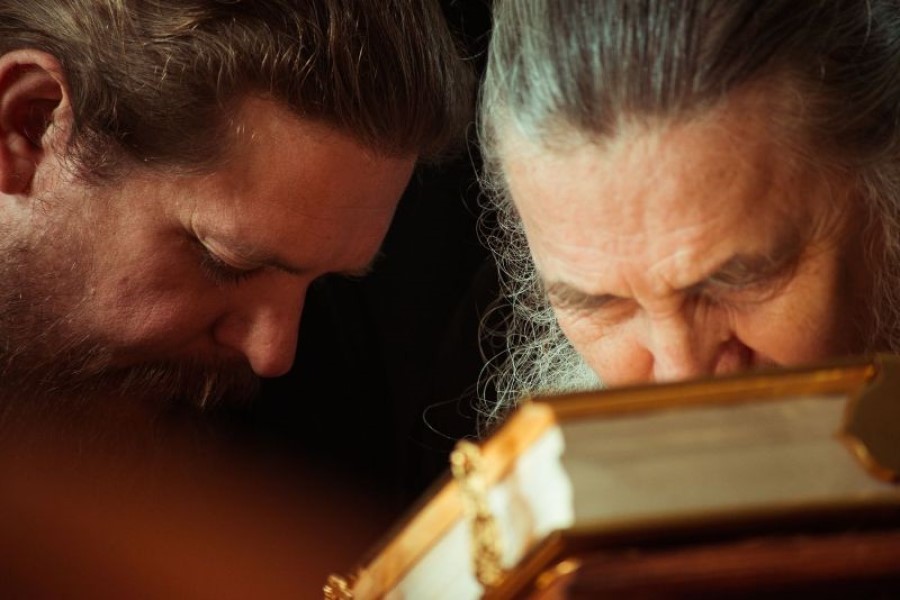
RECTOR AND STAFF: WHEN ROLES OVERLAP
May the rector of a church be the spiritual father of a member of the parish staff?
In a genuine spiritual relationship, a person looks not to rank but to grace. If a priest is seeking real spiritual benefit, even the hard work of setting aside his own will in order to discern God’s, the formal position of his spiritual father matters very little.
For this reason the Church has glorified spiritual guides from every background: abbots of great monasteries, quiet monks unknown outside their cloisters, and even holy fools who lived in poverty.
Their spiritual children were just as varied. One striking example is St Philaret of Moscow, who chose as his spiritual father his own subordinate, St Anthony (Medvedev). In their ordinary work the roles were clear: St Philaret gave instructions in the measured, exacting manner proper to a superior, and Father Anthony carried them out with diligence and respect.
But when St Philaret needed spiritual counsel, the pattern reversed. He received guidance from St Anthony with the same obedience and humility that he expected from him in administrative matters.
So it was, for example, when Emperor Nicholas I intended to be present at the opening in Moscow of the Triumphal Arch шт 1834 adorned with statues of pagan deities, and the Metropolitan refused to take part in this ceremony because his elder, St Anthony, firmly did not bless it.
Ordinarily, most of us do not live at the level of St Philaret and St Anthony, and we have to take our own weaknesses—and those of others—into account. Full, unguarded disclosure of one’s inner thoughts, including thoughts against one’s spiritual father, does not naturally belong in the day-to-day relationship between a rector and a member of the parish staff.
A staff member may well confess to the rector regularly, and that can be entirely appropriate, but full spiritual openness is something different.
Difficulties arise when someone who has long been under a rector’s spiritual care later becomes part of the parish staff. The relationship inevitably shifts. By virtue of his office the rector sometimes has to insist, to correct, and at times to discipline. For people who are not yet strong, this often becomes a breeding ground for resentment and a reluctance to speak openly.
When the rector and the spiritual father are different people, a staff member who has taken offence at the rector can pour out his heart to his spiritual father and receive from him helpful counsel, spiritual and emotional support.
But if the rector at whom he has taken offence and the spiritual father are one and the same person, where is the weak spiritual child to go? For this reason, as a rule, it is safer for a parish staff member not to have the rector as his spiritual father.
If, however, there is a serious attempt to preserve this “rector-spiritual-father” combination, then the subordinate must be especially attentive. He needs always to approach his duties with sincere zeal, and to take the initiative in informing the rector about his failings, preferably not during confession.
He needs to accept possible reprimands or even punishments from the rector with genuine good-naturedness and a firm faith that they have been allowed by God for the benefit of the work and for the salvation of his soul.
A rector should never expect blind obedience from his staff, nor confuse ordinary administrative compliance with spiritual obedience. A sensible leader encourages the initiative of the people who work alongside him. An experienced rector also knows his own limits: he is not a specialist in every aspect of parish life, and he is as capable of misjudgement as anyone else.
For that reason, while a matter is still being discussed, staff should be free to put forward their thoughts and concerns. Once the discussion is over and the decision has been made, however, it needs to be carried out without further debate.
More broadly, a parish priest must be clear about the role he is inhabiting in each situation. At times he is a spiritual father, but only for those who deliberately approach him in that way. At other times he acts as a superior to the staff when he is the rector. At home he is a husband to his wife, a father to his children; among friends he is simply a friend. Keeping these roles distinct is part of healthy pastoral maturity.
Note on “sins against one’s inner disposition”
St Dorotheus of Gaza uses this expression for a very particular kind of fall. He teaches that God especially “leaves” a person when he acts against his own settled moral measure. For example, someone who normally guards himself carefully but suddenly gives way to carelessness, or a meek person who allows himself an outburst of brazenness. The point is not how the action looks from the outside, but how far it drops below the person’s usual inner state.
Each of us knows this from experience. People can stand at very different “levels” with respect to the same passion. One person may fall into fornication from time to time and repent. Another avoids the act but openly flirts. A third does not flirt but habitually views pornography online. A fourth does not go that far but lets impure thoughts linger. A fifth rejects such thoughts as soon as they arise. And there are some who, by God’s mercy, do not entertain such thoughts at all.
These states are relatively stable in a person’s life. To rise to a higher measure requires grace, and to fall to a lower one usually happens gradually. If someone slips beneath his usual measure but immediately repents, the inner measure is preserved. But when he sinks below it and does not repent, he commits a “sin against his disposition”, and this brings a deep inner disturbance.
In such moments a person often feels an urgent need for the sacrament of confession and the quiet, steadying help the Church gives there. It is one of the ways by which the soul finds its footing again when it has slipped below the level at which it is normally held by God’s mercy.
With prayerful wishes for the Lord’s help
and the protection of the Most Holy Theotokos,
Yours OCC
Related Articles
Close
- Someone purchased a
Lestovka Prayer Rope 50 Segments
7 hours ago from Oceanside, USAs low as $23.00 - Someone purchased a
Horologion (The Book of Hours) in Church Slavonic
8 hours ago from New Egypt, US$17.00 - Someone purchased a
Small Gold-Plated Pectoral Cross w/Chain
1 hour ago from Saint Joseph, US$250.00 - Someone purchased a
Medium Triptych with Our Lady of Kazan Icon
7 hours ago from Oceanside, US$16.00