This website uses cookies to ensure you get the best experience on our website. Read more

Guiding Own Children And Spouses
 20Apr
20AprToday we now consider how spiritual fatherhood relates to family life:
✅ to children;
✅ to a priest’s own household
✅ to married couples seeking guidance.
What happens when sacramental bonds and family ties meet?
How do we honour both without damaging either?
The book from which these notes are drawn reads not as a code of rules, but as a collection of sober observations from pastoral experience.
We offer this chapter in that same spirit, hoping that it may help us care for our people, and for those in our own homes, with greater discernment and peace of heart.
Translated from "Notes on Pastoral Ministry" by Archpriest Konstantin Ostrovsky.
CHILDREN AND SPIRITUAL FATHERHOOD
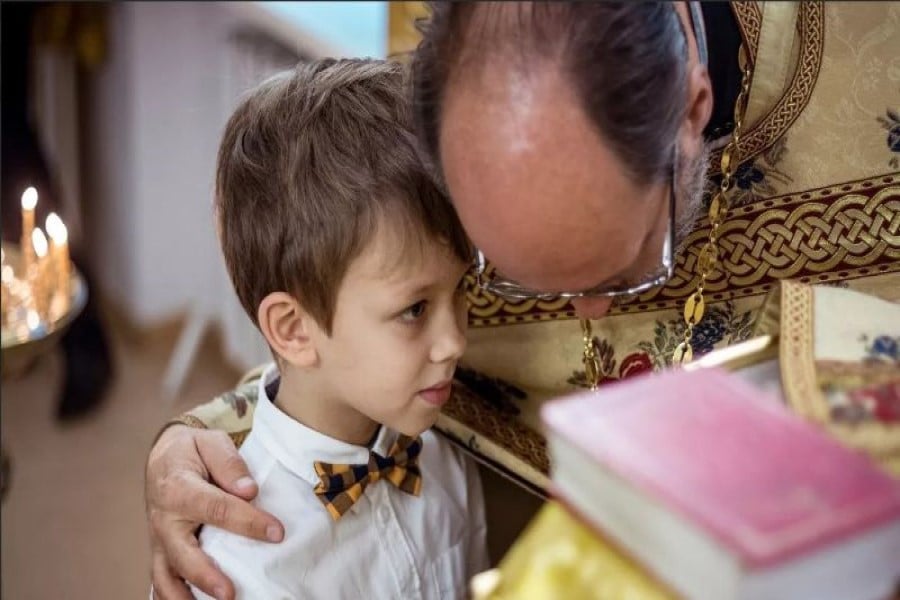
Zealous parents sometimes wish their child to have a spiritual father from as early an age as possible. Here we need caution. Stable spiritual relationships between a child and a priest are rare and do not arise simply because we decide they should.
What appears more often is a pious “game”: children learning to repeat spiritual phrases and copy adult behaviour without understanding. If a child himself asks to speak with a priest, to share something or to ask questions, that is good and should be gently encouraged. What we should not do is artificially “attach” a child to a particular pastor.
In adolescence, communication with parents is often strained, and young people may turn to a priest with questions that are serious and sometimes very heavy. These questions deserve our full attention. The adolescent is not yet an adult, but his or her inner life is real, and the wounds are real.
Younger children can also suffer and struggle, but they usually lack the words and self-awareness to express what is happening inside them. In a reasonably healthy family, while the children are still small, they normally have a warm bond with their parents. Even if one of the parents is not a believer, where there is mutual kindness and the child is loved, the child is at peace with them.
A younger child may sense spiritual things or be troubled in ways he cannot name, but he is not yet in a position to turn this into fruitful conversation with a priest.
Genuine spiritual fatherhood, in the stricter sense of regular counsel and a deliberate effort at obedience, is rare even among adults. In children it is rarer still. We do not need to create an appearance of it where it has not been given. Pretence harms any soul, and especially a young one. Obedience to a spiritual father is a great ascetic work.
For almost all children it is premature and beyond their strength, and so, as a rule, it does more harm than good. If the Lord calls some young person, or even a child, to a higher path, He will make that clear and will Himself arrange what is needed. Our task is not to hurry ahead of His Providence.
THE PRIEST AS SPIRITUAL FATHER TO HIS OWN CHILDREN
Much of what was said about the rector as spiritual father to his staff also applies when we ask whether a priest should be the spiritual father of his own children. Where should the children of a priest confess? To their father?
At first glance, this seems ideal: a father and his children are united both by family ties and by spiritual trust. There is undoubtedly something beautiful in that. Yet there are temptations as well. A father may come to know about his children’s faults chiefly through their confessions. He may take satisfaction in the thought that they have chosen him as their spiritual father. He may feel reassured that if they confess only to him, “everything remains in the family”. Such thoughts are understandable, and in our weakness they arise almost by themselves.
If, on the strength of such outward advantages, we press our children to receive all their spiritual care exclusively from their father, the result is likely to be a kind of polite role-play. The children will say what they think their father can bear to hear, and they will lose the living pastoral help that they actually need.
For that reason, a priest and his wife should not pressure their children to choose their father as their spiritual father. It is important to explain, and here the priest’s wife is often in a particularly good position, that there is nothing wrong in confessing to another priest; that doing so is not a betrayal and is no insult to their father; and that, in any case, children are under no obligation to have a permanent spiritual father at all.
Only when a son or daughter has freely and firmly decided to confess to their priest-father should this arrangement be accepted.
THE PRIEST AS A SPIRITUAL FATHER TO HIS WIFE
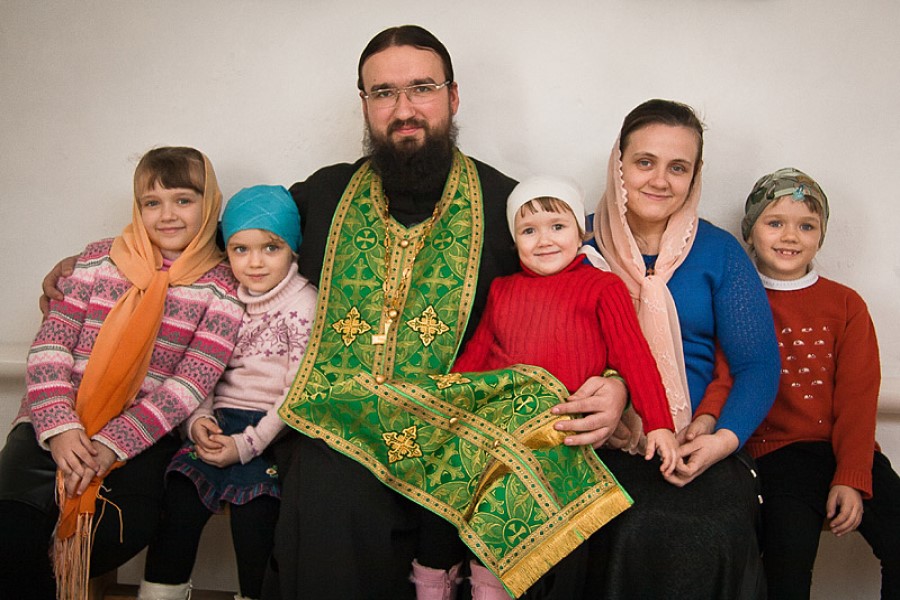
It is not unusual for a priest’s wife to come regularly to her husband for confession. In itself this is not wrong, provided that she truly trusts and respects him spiritually. What must be carefully protected, however, is her freedom. It should be entirely normal, and need no special justification, for a priest’s wife to seek counsel or confession from another spiritual father.
She also needs to remember that her husband, however devout or even holy he may be, shares the frailty common to all human beings. Not every thought and not every fall will be something he can hear without inner damage. Even a sincere and loving Christian wife can be tempted against chastity, or harbour bitter thoughts against her husband. Will he in practice be able to carry such confessions without it harming the marriage? Perhaps, by God’s grace, he will. But should we put that grace to the test unnecessarily?
Here is one painful example, without names. There was a large priestly family which, outwardly, seemed quite stable. The wife remembered an old acquaintance from school, became attached to him in her feelings, and fell in love. At that point there was no adultery in deed, but she felt guilty and brought it all to confession with her husband...
He was deeply wounded, began to reproach her sharply, and quarrels followed. In the end she resolved to break up the family, and did so. The younger children left with their mother; the eldest stayed with his father; another son was sent to a boarding school.
Later the wife repented, and now bears a heavy cross with a second husband who struggles with alcoholism. The priest could not bear solitary life; he left the priesthood and married again.
So a brief confession by a priest’s wife to her husband before Communion, especially in a small parish where there may be few clergy, is entirely normal. But a full and detailed confession of all her thoughts to her husband as to a spiritual father requires great caution and discernment.
We covered this topic more thoroughly in issue #31. You can read it using this link: [Priest Hearing Spouse's Confession?]
ONE SPIRITUAL FATHER FOR HUSBAND AND WIFE
What is better for a husband and wife: to share one spiritual father, or for each to have his or her own? There is no single answer. Much depends on the spiritual measure and maturity of the spiritual father himself. The less his own passions intrude into his pastoral relationships, the fewer the complications are likely to be.
The more clearly he tries to bring people to Christ Himself (and not simply to attachment to “dear Father” in His place), and the more he teaches them to bow before the will of God rather than before his personal preferences, the less it matters whether a married couple confess to him together or to different priests.
The more fragile and inexperienced a spiritual father is, the more weight human emotions and personal attachments will have in his work with people, and the more he will feel the need to know as much as possible about their lives. In such cases, there are arguments in both directions. On the one hand, it can be helpful for husband and wife to share a spiritual father, especially if he is sober about his own weakness and avoids imposing his will on them. On the other hand, when both spouses depend on the same priest, his pastoral mistakes become particularly dangerous.
If I give foolish advice to my own spiritual son, the damage may be limited if his wife’s spiritual father is someone else who sees things more clearly and quietly encourages her to resist the unwise suggestion. But if both husband and wife are guided by the same priest, and that priest behaves like a would-be elder who demands unquestioning obedience, the risk of spiritual harm for both parents and children is very great. The relationship can slip into a kind of spiritual “resonance”, where unhealthy attitudes reinforce one another until the whole family begins to shake apart.
If a couple are choosing a spiritual father, let them think it through carefully, speak with one another, take into account their own circumstances, and pray that God will send the person they need. Whenever we choose solely according to our own will, our passions will play their part. When God gives such a relationship, it is usually more stable and fruitful, because it is received in faith. In that case, whether they have one spiritual father between them or each has his or her own is secondary; both arrangements can be from God.
At the same time, people do in fact choose spiritual fathers. They should therefore act in a way that is practically manageable for them. Having one spiritual father can protect a marriage from a familiar deadlock: one spouse saying, “Father blessed me to go and rest in the Crimea,” and the other replying, “Father blessed me to go to the Caucasus.” In truth, husband and wife should be seeking unity, for they are “one flesh”. Priests should support them in finding unity in all that is genuinely good, and in learning to yield to one another in things that are indifferent. Crimea or the Caucasus is not the issue; what matters is going there in love and agreement.
May one change one’s spiritual father simply in order to have the same one as one’s spouse? If there has not yet been any deep relationship with a particular priest, then such a change may be quite possible and harmless.
But if one of the spouses has already grown into a serious relationship with a spiritual father, something more than standard confession before Communion and the occasional travel blessing, if it is through this priest that God has been leading that person on the spiritual path, then is it wise to set that aside for the sake of outward convenience? Even here there can be exceptions; each situation has its own texture, and we must always look for what will bring the greatest spiritual benefit.
Husband and wife are adults and should behave as adults. The kind of total obedience shown, for example, by St Dositheus to Abba Dorotheus is not the usual path for people living in the world. It is good, and often very helpful, to seek counsel from a spiritual father who is truly experienced in spiritual and practical matters. But spouses must not use his blessing as a weapon in their domestic quarrels.
If a husband or wife sees that a particular piece of advice, carried out literally, is leading to constant conflict, or even threatens to break the family apart, they should go back to their spiritual father and speak with him again. In that specific case they may need not to follow the advice in the form in which it was first given.
If, however, the priest insists on his own opinion and demands that, “for the sake of obedience”, the wife go into open conflict with her husband, then it may be time to think seriously about changing spiritual fathers. We, as priests, are indeed obliged to call people to keep the commandments of God. We have no moral right to insist that all our private recommendations on secondary matters be treated as though they were the Lord’s own decrees.
In reality, no seasoned spiritual father (and here we are not speaking of rare prophets or those specially chosen by God) will behave in that way. A priest with real experience knows very well that he can make mistakes, and he is genuinely grateful when people do not seize upon his every casual word and treat it as infallible.
Better that they ask again and clarify. As Scripture says, “a living dog is better than a dead lion” (Eccl. 9:4). It is better to walk the humbler path of patiently bearing one’s difficulties and seeking advice from a wise and kindly spiritual father than to ruin one’s soul through a counterfeit obedience to a false “elder”.
<< Test First Name >>, a quick note for those who carry the Holy Gifts to the sick:
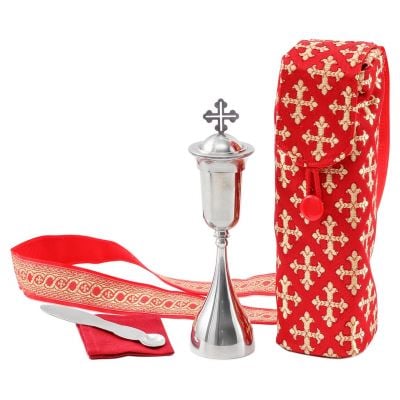
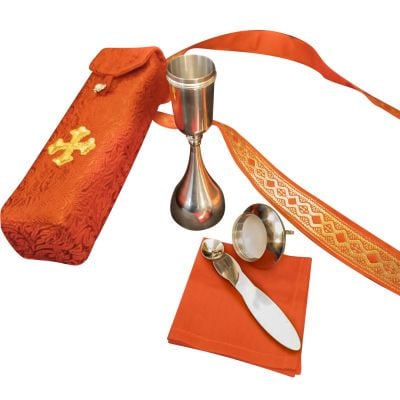
Our small chalice sets (chalice, spoon, and communion cloth in a case) are back in stock and ready to ship right away.
This set was made specially for priests — the chalice is taller to prevent spilling, has a stable base, and a secure screw-on lid with silicone gasket. It is crafted from food-grade stainless steel that keeps the Precious Blood safe with almost no oxidation.
Many of you have already been using it and shared kind words:
“This is the best set I have to use when carrying the Eucharist — it is beautiful and safe. An excellent set.” — Fr. Nick
“This set is absolutely beautiful. Very easy to use and very practical. It offers complete reverence to the Holy Mysteries.” — Very Rev. Nicholas Daddona
“I have needed this for my ministry for many years. I am pleased with this and it will help me to serve my people. Thank you.” — Fr. John
If you'd like one, just reply to this email or visit this page.
With prayerful wishes for God’s blessing,
Your OCC
Related Articles
Related Products
Comment(s)
Close
- Someone purchased a
100-Segment Lestovka Prayer Rope
1 hour ago from Toms River, USAs low as $30.00 - Someone purchased a
Lestovka Prayer Bracelet 25 segments
1 hour ago from Northville, USAs low as $18.00 - Someone purchased a
Horologion (The Book of Hours) in Church Slavonic
1 hour ago from New Egypt, US$17.00 - Someone purchased a
Russian-Style Priest Vestment with an Icon of Christ and embroidery
7 hours ago from Denver, US$1,515.00 - Someone purchased a
Greek-Style Priest Vestment with Embroidery and Medallion
6 hours ago from Washington, US$744.00 - Someone purchased a
Chalice Covers and Veil with Embroidery sh-10-71-7
7 hours ago from Denver, US$315.00