This website uses cookies to ensure you get the best experience on our website. Read more

Baptism Rite – What May Be Shortened?
 30Apr
30AprThe question posed was straightforward and very practical:
❓ “Are abbreviations in the services of the Mysteries permissible when there is an objective need? How does one discern the proper measure of shortening? What must never be omitted, and what is least essential to preserve?”
The Trebnik (Book of Needs) does, of course, provide an exceptionally brief order for Baptism in imminent danger of death. But most pastoral situations are not quite so extreme.
A priest may be constrained by the health of the person to be baptised, his own illness, or genuine limitations of time. In such cases, what may be abbreviated, and what must be guarded as untouchable?
The answer begins with a warning: there must be truly weighty reasons to shorten the rite. Where such reasons are absent, abbreviations should be avoided.
Two sober reminders from our pastoral handbooks are worth placing at the front of mind.
1️⃣ Handbook for Church Servers (by Sergius V. Bulgakov, 1900) warns against treating the Mysteries as mechanical tasks or trimming them without need. It calls any careless, inattentive, “soulless” performance, and any unjustified shortening, a grave sin, and cites the Scriptural admonition: “Cursed is he who does the work of the Lord with slackness” (Jer. 48:10).
2️⃣ Fr. Nicholas Silchenkov, in his Practical Guide to Parish Rites (1994), citing the classic Duties of Parish Priests (§ 88, 1844), warns that the priest must be especially careful with words that pertain to the very essence of a Mystery, so that they are not omitted or altered in any way.
These reminders are not an argument for rigidity. They are a call to sobriety: one may sometimes be forced to make emergency adjustments, but one must never do so lightly, or with the mentality of “service-editing.”
Archpriest Andrey Krivonis also refers to the guidance of Priest Mikhail Zheltov, a prominent contemporary liturgist. Fr Mikhail’s point is sharp:
in principle, shortening is highly undesirable.
It is easy to reduce even the Divine Liturgy to a few absolutely necessary words and still produce something technically valid; the real question is whether such a “minimum” Liturgy, served without extraordinary need, would be spiritually safe for the priest who serves it.
At the same time, without denying that extraordinary pastoral circumstances do arise, Fr Mikhail outlines practical boundaries by which any necessary abbreviation may remain faithful to the rite’s meaning and inner logic.
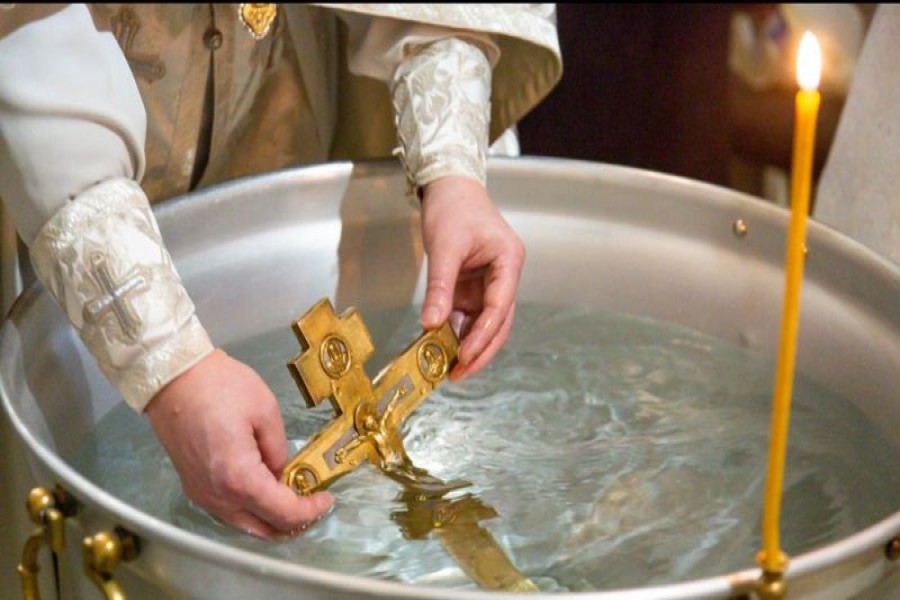
WHAT MUST BE PRESERVED (IN CASE OF REAL NECESSITY)
In Fr Mikhail’s outline, the central elements are these:
☑️ The confession of faith.
☑️ The Baptismal prayer over the water (with its petitions for the person being baptised). If absolutely necessary, the litany may be omitted, but not the prayer itself.
☑️ The sacramental actions: anointing with blessed oil (either blessed within the rite or blessed beforehand), Baptism in water, and anointing with Holy Chrism (Chrismation).
☑️ The Eucharist: at minimum, the Baptismal readings appointed in the Trebnik, and Holy Communion if it is possible.
☑️ One additional element, important not so much in content as in reverence towards Holy Chrism: the washing of the Chrism.
A crucial clarification follows from this: sacramental action without prayer is wrong. Under the pretext that the water may have been blessed beforehand, one cannot omit the Baptismal prayer. Otherwise, the Mystery is reduced to formulas and actions, and the rite is left, in effect, without its principal euchological core.
The prayer for the blessing of the Baptismal water (contrary to a fairly widespread assumption) is not merely a “water blessing.” It is the main prayer of the entire rite, and it includes essential petitions not only for the water, but for the baptisand himself.
For this reason, the Trebnik’s brief order for Baptism in danger of death includes the prayer over the water, even when other elements (such as a full prayer over the oil) are reduced. The logic is clear: oil may be blessed beforehand, and Holy Chrism is always consecrated beforehand; but the principal prayer for the baptisand cannot simply be bypassed.
This leads to a practical conclusion: if anything is shortened in the rite of Baptism, this prayer should be the last thing to touch.
One more nuance is worth noting. Some manuscript traditions preserve a shorter version of the prayer over the Baptismal water, not only for emergencies, but simply as “another” prayer. In a situation of real need, it may be read in place of the longer prayer, provided it is completed properly by returning to the text of the full rite at the appropriate point.
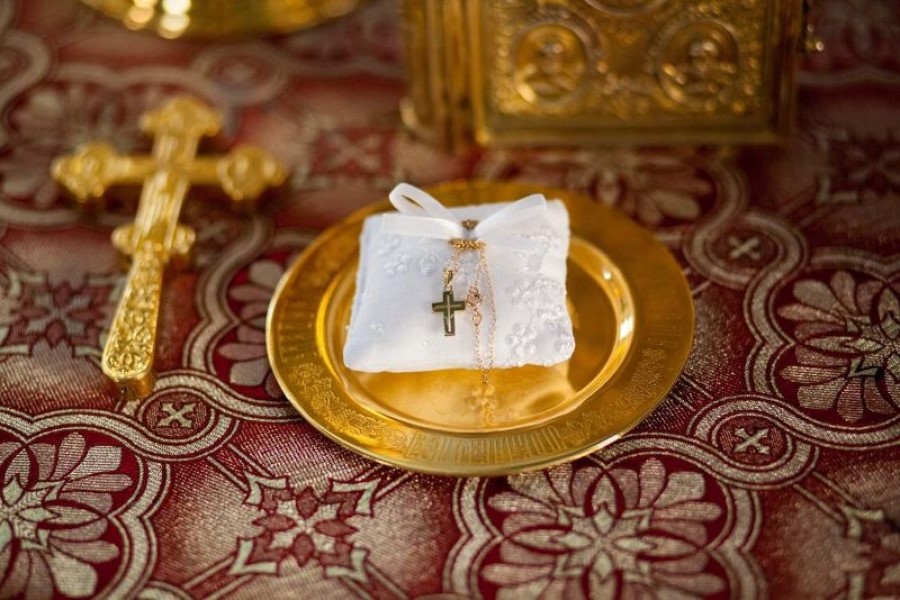
In practical terms, one may read the shorter prayer (beginning “O Lord God Almighty…”) and after the words:
“For we have called upon Thy Name, O Lord, and it is wonderful, and glorious, and awesome even unto adversaries,”
continue immediately with the full rite at:
“Let all adverse powers be crushed beneath the sign of the image of Thy Cross.” (Three times.)
and then proceed to the end of the prayer, including the petitions beginning:
“We pray Thee, O God, that every aerial and obscure phantom may withdraw itself from us…”
This “join” preserves the rite’s inner logic: the water is blessed, and the chief intercessions for the baptisand are not lost.ce.
A note on an omission in certain Trebnik editions
❗️ Please note that a regrettable omission appears in certain printings of the brief order. The principal prayer may be presented as though it ends abruptly after the words “awesome even unto adversaries,” without the continuation that the rite itself requires.
???? After these words one should turn to the full order.
The priest then blesses the water by dipping the fingers of his right hand into it and tracing the Sign of the Cross over the water three times, saying:
“Let all adverse powers be crushed beneath the sign of the image of Thy Cross.” (Three times.)
After this he continues with the prayer’s petitions for the baptisand from the full rite, beginning:
“We pray Thee, O God, that every aerial and obscure phantom may withdraw itself from us…”
Then the oil is poured into the water. (As for the anointing of the baptisand with oil: practice varies, and there is no universal consensus.) After this follow the Baptism in water itself and Chrismation.
We hope you will never be forced by circumstances to make emergency adjustments to the rite of Baptism. Yet if objective conditions arise, may this brief outline help you act with reverence, clarity, and a good pastoral conscience.
With prayerful wishes for God’s blessing,
Your OCC
Related Articles


Related Products


Comment(s)
Close
- Someone purchased a
100-Segment Lestovka Prayer Rope
1 hour ago from Toms River, USAs low as $30.00 - Someone purchased a
Lestovka Prayer Bracelet 25 segments
1 hour ago from Northville, USAs low as $18.00 - Someone purchased a
Horologion (The Book of Hours) in Church Slavonic
1 hour ago from New Egypt, US$17.00 - Someone purchased a
Russian-Style Priest Vestment with an Icon of Christ and embroidery
7 hours ago from Denver, US$1,515.00 - Someone purchased a
Greek-Style Priest Vestment with Embroidery and Medallion
6 hours ago from Washington, US$744.00 - Someone purchased a
Chalice Covers and Veil with Embroidery sh-10-71-7
7 hours ago from Denver, US$315.00