This website uses cookies to ensure you get the best experience on our website. Read more

Men, Women and Pastoral Boundaries
 10May
10MayIn this concluding part of Archpriest Konstantin Ostrovsky’s "Notes on Pastoral Ministry", the focus turns to friendship, mutual “obedience,” and the need for sober boundaries.
❓ What does healthy friendship with a spiritual father look like?
❓ What can Christians do when they deeply desire spiritual growth but lack an experienced guide?
❓ And how should a priest guard his own heart—and the hearts of others—in relationships with women or with those to whom he feels a strong personal attraction?
These pages do not offer rigid rules. They are sober observations drawn from pastoral experience, shared in the hope that they may help us love more truthfully—without placing either ourselves or our flock in unnecessary danger.
FRIENDSHIP WITH A SPIRITUAL FATHER
Is it good to be “friends” with one’s spiritual father, or is it better to keep a certain distance and avoid emotional closeness?
There is no single rule. But one thing can be said: where the relationship is genuinely spiritual, a purely emotional friendship can easily get in the way.
Christ Himself, in certain moments, called His disciples His friends. Yet this was no cosy gathering of companions, no late-night singing with a guitar and trading of personal stories. He opened to them the mysteries of the Kingdom, filled them with grace, showed them the path of salvation, and drew them into a profound unity with Himself. That is the measure of true friendship in Christ. May God grant all of us a share in that kind of friendship, where Christ stands in the midst.
MUTUAL OBEDIENCE AMONG BRETHREN
Sometimes a Christian sincerely desires to walk the spiritual path, to struggle against the passions and to learn to pray, but God has not yet sent him an experienced spiritual guide.
Some of the Fathers, such as St Theophan the Recluse (1815–1894), advise that in such a case two or three like-minded believers may form a kind of brotherly pact: they agree to consult one another about everything, to reveal their thoughts frankly to one another, and to practise a measure of obedience to one another’s counsel.
This path is more difficult than living under the direction of an experienced spiritual pastor, but it is still far safer than relying entirely on one’s own thoughts.
At the same time, such a spiritual union of brothers in Christ, formed for mutual disclosure of thoughts and for discussing the practical questions of fighting the passions and learning to pray, calls for restraint in emotional warmth. If the tone slips into cosy emotional intimacy, the union can quietly decay from within and lose its spiritual meaning.
GOD PROTECTS THE CAUTIOUS
Scripture speaks very plainly about the need for prudence, especially in relationships between men and women. One passage from the Wisdom of Sirach warns:
“Do not linger long with a singer, lest you be captivated by her art.
Do not fix your gaze upon a maiden, lest you be ensnared by her charms.
Do not give your soul to harlots, lest you lose your inheritance.
Do not wander aimlessly through the streets or loiter in lonely places.
Turn your eyes away from a beautiful woman; do not gaze upon another’s beauty.
Many have gone astray because of a woman’s beauty; from it, love blazes up like a fire.
Do not sit alone with another man’s wife, and do not remain with her at table over wine,
lest your heart incline to her and you slip into ruin.”
Our own proverb puts it simply: “God protects the cautious.” Grace does not abolish this wisdom; rather, it confirms it.
This is not an appeal to suspicion or contempt, but to sobriety. The point is not that women are dangerous by nature, but that fallen human nature is weak, and that the heart is easily entangled when we ignore obvious risks. When clergy forget this, the consequences can be particularly bitter.
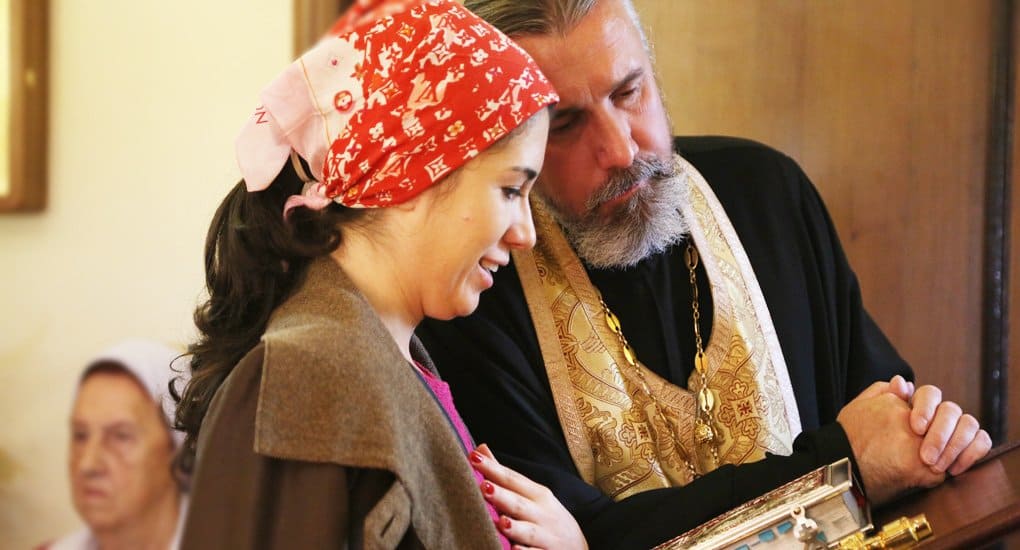
MEN, WOMEN, AND PASTORAL BOUNDARIES
Of course, in Christ we are all brothers and sisters. We can pray for one another, serve together, and support one another in the Church’s life. Yet between men and women who are not husband and wife, or mother and small son, there still needs to be a certain “wall” in their relations—a clear inner boundary. Warm emotional intimacy, even when it appears completely innocent, is never entirely without danger.
Let me offer two painful examples.
1️⃣ In the first case, an intelligent, deeply believing man, the head of a devout church family, was preparing for ordination to the diaconate. Alongside his work and parish life he was involved in charitable care for the sick, and in that context helped a young woman with a very severe illness.
At first, it was self-giving service; but gradually, an emotional attachment grew. Lines became blurred. What began as “kindness” ended in a fall. A good family suffered, and a vocation was gravely wounded.
2️⃣ The second situation was, in some ways, even worse.
A pious, close-knit Orthodox family with several children were helped by a nanny: an unmarried, believing young woman. Eventually she left their household, but contact continued via social media. Nothing outwardly scandalous was happening, yet the father of the family felt uneasy. He turned to a priest he knew and explained that he was not interested in this nanny “as a woman”, that she was “not even particularly attractive”, but that the unease remained.
The priest urged him to cut off the contact, explaining that if it was already hard to break it, then some attachment was clearly there; and that the fact he was “not interested” at present did not mean that a passion could not develop.
The man did not listen. A year later, that same nanny was living with him and caring for the child they had together. He had left his family to live with her. Time has passed; they now have several children together. Yet he has remained a believer and suffers from what he has done and continues to do: from the inability to receive Communion, from his guilt towards his abandoned wife and children. He lives in his new family, while occasionally visiting the old one, which he has destroyed.
Both cases were the fruit of “warm emotional closeness” which believers unwisely allowed themselves. They simply should not have let things go that far.
If, however, we speak of “friendship” in a more superficial sense—ordinary good-natured interaction—many people communicate with one another quite normally, and why not? This includes women: at church, at work, and so on. Families may be friends with other families. In itself this is not bad. But even here, a certain watchfulness is always necessary.
Everything said about the danger of emotional “friendship” between a man and a woman applies in a special way to clergy. Priests usually encounter more occasions for temptation, and the enemy attacks them more fiercely. It is like warfare: snipers aim not at the rank-and-file but at the officers.
Many women, sadly, feel lonely and unsettled in their family life. They may have difficult or even bad relationships with their husbands, or no husband at all. They seek emotional compensation, often without fully realising it.
Then, coming to church, such a woman meets a man who looks respectable— a cassock suits almost everyone—who does not lunge at her, but is ready to listen, with sympathy. If, on top of that, he speaks to her in a warm tone and says kind words, then it can feel like “perfect happiness”. She finds in her contact with the priest what she does not find at home.
For this very reason the priest must be doubly cautious. His task is to offer spiritual care, not to become the emotional centre of someone’s life. There must be inner boundaries that protect both her heart and his.
We are not speaking here primarily about deliberate attempts to seduce a priest. Such cases exist, but they are relatively rare, and their danger is relatively small: a decent priest will recognise open flirting at once and react with a clear inner “no”. Far more dangerous is temptation that comes under the appearance of sincere confession.
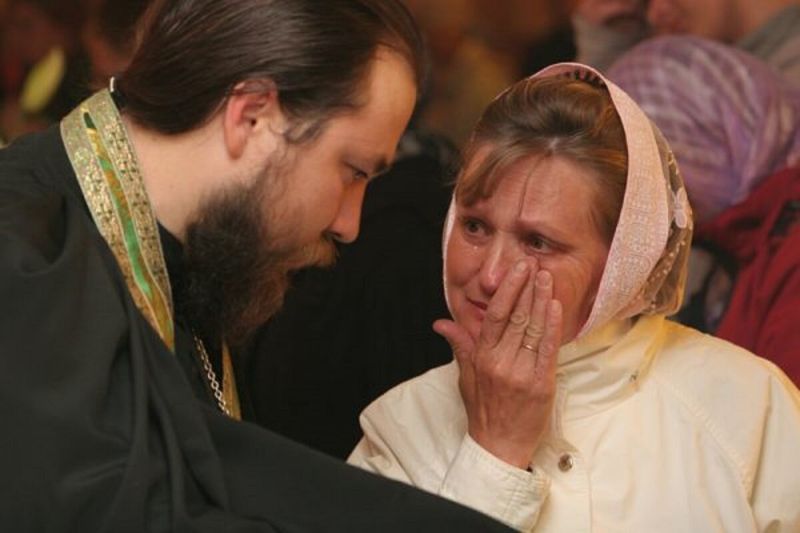
The priest hears a woman’s pain, feels natural compassion, and wants to console her with a warmer tone, a special word, perhaps even a glance that lingers. Both may find this very pleasant. From such small things, which at first seem harmless to the inexperienced eye, serious temptations – and sometimes falls – often begin.
A priest must not be indifferent to his parishioners; he must be a good father to them all – men and women alike. But he is called to be good, not soft and sentimental. In particular, he should beware of a kind of pity that easily turns into physical tenderness. A parishioner is moved, she weeps, and everything in you wants to comfort her, to stroke her head. Better to bless the cross – it is lying there on the analogion – and to say a word from the Gospel – it lies there as well. The other gesture is better left undone.
Some may feel that this sounds excessively suspicious, as though we distrusted both clergy and our good, churchgoing women. In fact, that is not the point. Our priests and parishioners are, for the most part, devout people who genuinely do not wish to do evil.
Their sincerity can usually be trusted. What cannot be trusted is our common weakness. All of us carry sinful passions within us, and they often have more power over us than we imagine. Precisely because of this, we are weak in the struggle with them and must not give temptation any extra help.
SPIRITUAL LOVE AND EMOTIONAL LOVE
There is a difference between emotional love and spiritual love. Emotional love has to be planned, expressed and fed: one has to think how to show it, how to say something “nicely”, how to sustain a feeling. Spiritual love works differently: it acts of itself, by grace. A person does not have to calculate how to manifest it. (May God grant us even a little of such love.)
Once, they brought a sick boy to St Pimen the Great. The brethren knew that, out of humility, the elder would refuse to heal him. So they took turns blessing the child and then said to Pimen, “You bless him as well.” At first the elder began to refuse, but the brethren insisted: “It would be awkward—everyone else has blessed him; you must bless him too.” Pimen gave his blessing—and the boy was immediately healed.
The elder, out of humility, did not want to perform a miracle of healing. Yet by the grace of God he did heal the child. That is an example of true, spiritual love. In other Fathers it might have been manifested in quite different ways—“the Spirit blows where He wills”.
In the Life of St Seraphim of Sarov there is an episode where someone saw him speaking with a woman and thought: “Look at that—an austere monk of the great schema talking with a woman!” St Seraphim answered the man’s thoughts: “Why do you think vain things? I am already dead to all that is carnal.”
If someone is genuinely “dead” in this sense, then he may sit and speak freely with anyone at all — assuming, of course, that he shares the spiritual stature and divine protection of St Seraphim of Sarov. But if he is not, then in dealing with the opposite sex he must be cautious and avoid excessive emotional intimacy. And someone who feels a tendency of attraction towards people of his own sex must be equally careful in his dealings with them.
Spiritual love is not cold. It is warmer and more faithful than any merely emotional attachment. But it is also freer from possessiveness and less easily confused with passion. To learn this love—and to ask God for it—is one of the quiet, essential tasks of any spiritual father, and of every Christian soul.
Related Articles



Related Products







Close
- Someone purchased a
100-Segment Lestovka Prayer Rope
1 hour ago from Toms River, USAs low as $30.00 - Someone purchased a
Lestovka Prayer Bracelet 25 segments
1 hour ago from Northville, USAs low as $18.00 - Someone purchased a
Horologion (The Book of Hours) in Church Slavonic
1 hour ago from New Egypt, US$17.00 - Someone purchased a
Russian-Style Priest Vestment with an Icon of Christ and embroidery
7 hours ago from Denver, US$1,515.00 - Someone purchased a
Greek-Style Priest Vestment with Embroidery and Medallion
6 hours ago from Washington, US$744.00 - Someone purchased a
Chalice Covers and Veil with Embroidery sh-10-71-7
7 hours ago from Denver, US$315.00