This website uses cookies to ensure you get the best experience on our website. Read more

Confession Clarified: Sacrament, Blessing, or Spiritual Conversation?
 10Jun
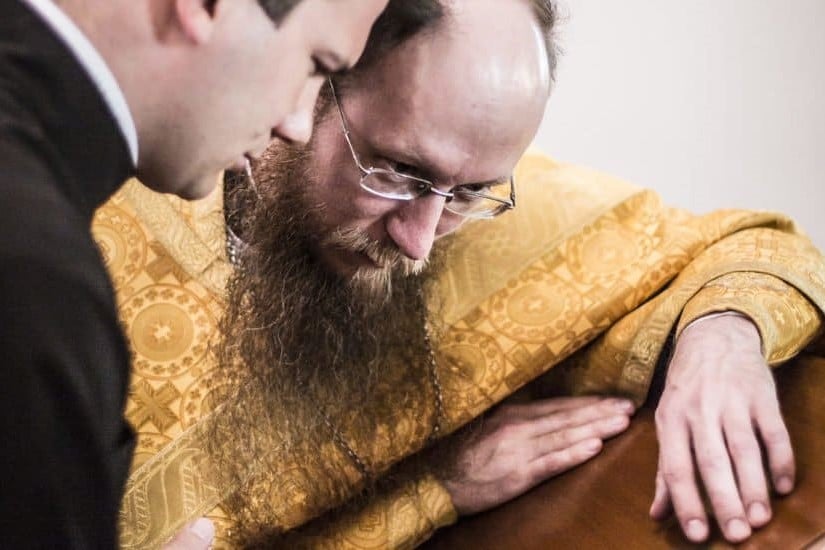
10JunFew aspects of pastoral ministry are as familiar—and as easily misunderstood—as confession. In parish life, what we commonly call “confession” often encompasses several distinct realities:
✅ the sacrament itself,
✅ the blessing for Holy Communion,
✅ and spiritual conversation.
When these are not clearly distinguished, confusion arises—for priests and parishioners alike.
In this chapter from Fr Konstantin Ostrovsky’s Notes on Pastoral Ministry, we are invited to reflect soberly on how confession functions in contemporary parish life.
❓ What distinguishes sacramental absolution from a simple blessing to approach the Chalice?
❓ How should we understand penance in an age when stable parish communities are rare?
❓ Is it possible—or wise—to separate Communion from confession?
❓ And what are we to make of so-called “conveyor-belt confession”?
Father Konstantin Ostrovsky offers not theory, but pastoral realism grounded in the Church’s tradition. He challenges us neither to absolutise local customs nor to treat them lightly. At the heart of confession stands repentance—and the priest’s own spiritual sobriety.
CONFESSION, A BLESSING FOR COMMUNION, AND SPIRITUAL CONVERSATION
In contemporary parish practice—at least as it has developed almost everywhere in Russia—several important ecclesial realities are often gathered under a single rite commonly called “confession.” These realities may coincide, yet they are not identical and must be distinguished.
1️⃣ First, there is the sacrament of confession itself, as established by the Church.
2️⃣ Second, there is the blessing to approach Holy Communion.
3️⃣ Third, there is spiritual conversation.
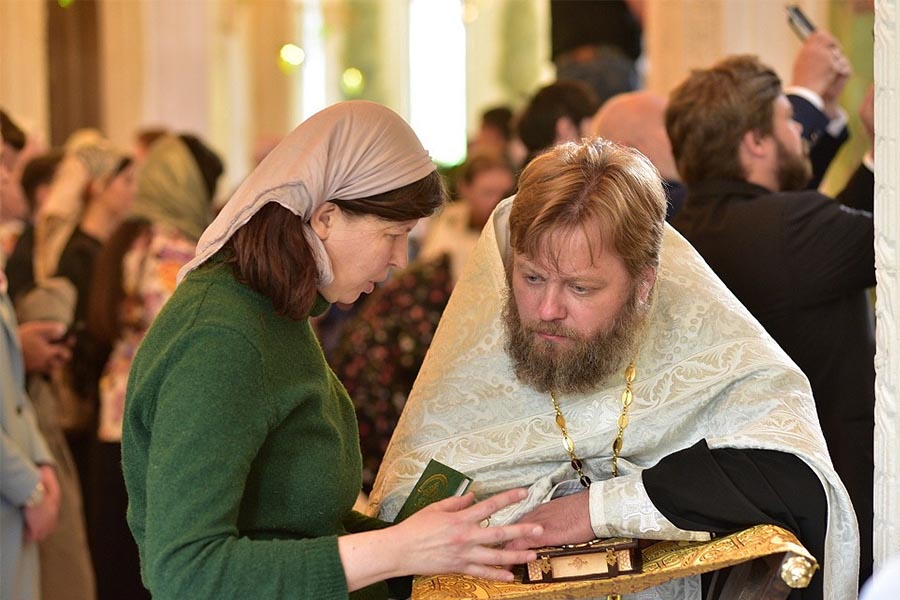
When a Christian has fallen into sins that sever him from communion with the Church, he must first cease from those sins. Only then does he come to the priest, openly confess them and, if necessary, accept a penance. After this, he hears from the Church the words of absolution—“I forgive and absolve”—and is again admitted to partake of the Holy Mysteries.
In this respect, little has changed since ancient times, though penances today are generally less severe. Even now, however, if someone comes to confession and states that he is living with another man’s wife, the priest cannot receive his confession sacramentally so long as that situation continues.
The mystery is not performed, and he is not admitted to Communion. The same applies not only to bodily sins but to spiritual states incompatible with receiving the Body and Blood of Christ—for example, a deliberate refusal to forgive one’s offender.
It is important not to confuse such a prohibition from Communion—while a person persists in grave sin—with a penance imposed upon someone who has repented and ceased voluntarily to fall into serious sins. So long as an adulterer remains in adultery, or a robber in robbery, he cannot be admitted to the Chalice. This is not a “term” to be served, but a matter of spiritual reality.
There are also those who require a thorough confession of their whole life—people who have never confessed, or have not done so for many years. In most cases grave sins will be present; yet even if none are found, such a person is received into ecclesial communion through the sacrament of confession.
PENANCES FOR GRAVE SINS
In our time, long-term penances rarely fulfil the function they once did: the healing of the soul and its reconciliation with God. In Byzantium, this was possible because the entire people—at least outwardly—lived a churchly life. A person who had committed a grave sin remained within a community gathered around the church.
Imagine the scene: everyone enters the service while he remains on the porch—not wandering elsewhere, but standing and praying. Later he may enter the church, yet still without Communion. Year after year, during his penance, he repents prayerfully, conscious of his unworthiness. Repentance was not always sincere even then, but the meaning of penance remained clear.
What would happen today if we were to bar someone from Communion for five years? Not a committed member of a parish community, but a man who has come to confession for the first time at forty, fifty, or sixty. In all likelihood, he will simply drift away.
As he did not attend church before, so he will not attend now. And he will say—quite calmly, even logically: “Father did not bless me to receive Communion, so I stay at home. When the penance is over, I will return.”
In such a case, we would not be healing the soul so much as confirming him in his distance from the Church.
This, of course, must not be confused with the situation of a person who persists in mortal sin and refuses to change his life. Such a person cannot receive Communion in any case. No length of time alters that reality.
But when a person has truly repented and turned away from the sin—when there is genuine contrition and a change of life—then even in the gravest cases, if Communion must be postponed, it should be for a short time, especially when dealing with someone newly returned to the Church.
Consider an elderly woman brought to Communion as a child, later formed by an atheistic culture, who committed abortion in her youth and forty years later begins to seek God. What lengthy penance would heal her soul?
With committed churchgoers, the approach may be stricter. Those who live an active ecclesial life do not often fall into grave sins; but when they do, penance may indeed be appropriate. And one who possesses a living conscience will accept it without complaint.
It should also be remembered that a priest may impose any prolonged penance only with the consent of the penitent. The authority of ecclesiastical judgment properly belongs to the Church court and to the ruling bishop. The parish priest does not act as an independent tribunal.
SINS AGAINST ONE’S INNER DISPOSITION
Besides grave falls, confession may also be particularly necessary in cases of what St Dorotheus calls “sins against one’s inner disposition.” We have addressed this expression in detail earlier in this series.
Each person has a certain prayerful and moral measure—a relatively stable inner state known from experience. To rise to a higher measure requires grace; to fall below one’s established state usually occurs gradually.
When someone slips beneath his usual measure but repents immediately, his inner state is preserved. But when he falls below it and remains there without repentance, a deeper rupture occurs. The soul feels an inward torment and longs for help.
In such moments, sacramental confession restores what has been disturbed—not mechanically, but through grace.
COMMUNION WITHOUT CONFESSION?
Regular parishioners, thanks be to God, do not fall into grave sins—or even into sins against their inner disposition—every single week.
Does it follow, then, that if nothing serious has occurred, everyone should be permitted to receive Communion without confession?
In some circumstances, this may indeed be appropriate. In places where Orthodox Christians are few and the priest personally knows each member of the flock, confession can be arranged as needed rather than tied to every Communion.
The situation is different in a large urban parish. There the clergy cannot possibly know everyone well. Yet this does not mean that all who are less known must therefore be barred from the Chalice.
At the same time, if we were simply to open the way to Communion without confession across the board, many would gradually lose their sense of reverence before the Holy Mysteries. For that reason, in present conditions the custom of confessing before Communion should be regarded as pastorally sound.
It is important, however, to remember that this remains a custom—not a canon, and certainly not a dogma.
Creating separate rules for a supposed “inner circle” risks fostering pride in some and envy in others. It is better that one general order remain, applied with pastoral discernment in concrete cases.
If a well-known parishioner asks for a blessing to receive Communion, acknowledging only her usual daily sins, the priest may bless her without altering the general order. But if someone visits another parish with stricter local custom, he should follow it without dispute. The depth of repentance does not depend on external format.
“CONVEYOR-BELT CONFESSION”
In recent years, one increasingly hears the expression “conveyor-belt confession.” Some pastors consider only unhurried, individual conversation to be proper, unlike what often occurs in city parishes where dozens wait in line.
Certainly, a quiet conversation is preferable. But what is to be done with those who are waiting?
It resembles two nurses carrying a wounded man from the battlefield. One says, “It would be good to get him an X-ray.” Yes—but first the bleeding must be stopped, and the man brought to safety.
A film director once observed that what matters is not so much how something is done, but who is doing it. A good director will work well even in poor conditions; a poor one will fail even in ideal circumstances.
So it is with us. We must minister within the conditions given to us. The spiritual benefit people receive depends less on external arrangement than on the inner state of the priest.
With prayerful wishes for the Lord’s help
and the protection of the Most Holy Theotokos,
Yours OCC
Related Articles

Close
- Someone purchased a
Lestovka Prayer Rope 50 Segments
7 hours ago from Oceanside, USAs low as $23.00 - Someone purchased a
Horologion (The Book of Hours) in Church Slavonic
8 hours ago from New Egypt, US$17.00 - Someone purchased a
Small Gold-Plated Pectoral Cross w/Chain
1 hour ago from Saint Joseph, US$250.00 - Someone purchased a
Medium Triptych with Our Lady of Kazan Icon
7 hours ago from Oceanside, US$16.00