This website uses cookies to ensure you get the best experience on our website. Read more

Should Royal Doors Open at Funerals? Key Exceptions for Cremation, Suicide & More (Part 3)
 30Mar
30Mar
THE FUNERAL SERVICE (Part 3)
Today we will consider a few aspects related to the Orthodox funeral service that are frequently of interest to clergy.
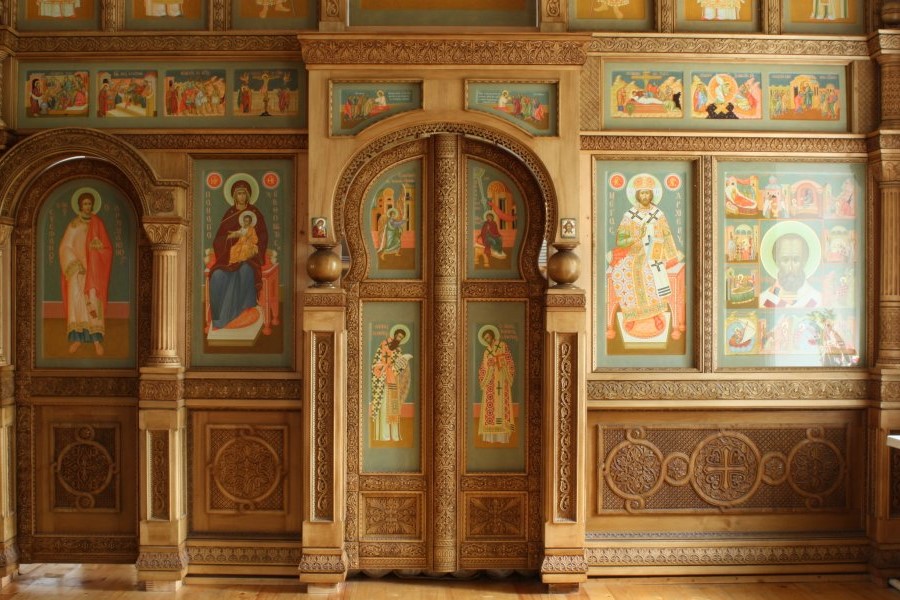
SHOULD THE ROYAL DOORS BE OPENED DURING THE FUNERAL SERVICE?
If we follow the Trebnik (Book of Needs), it gives no such direction.
This is because the funeral rite reflects the customary practice at the time it was composed: performing the service in the narthex of the church, or even on the porch (papért’)[^1] outside.
This is confirmed by certain rubrics in the Great and Small Trebniks[^2], as well as by the testimony of St. Symeon of Thessalonica (†1429):
“Those departed who were abbots or who were sanctified are buried inside the church, but simple monks or laypeople in the narthex, as we still see in some holy monasteries. However,” the saint adds, “now, through negligence, all this propriety is disregarded and this rite has been abandoned. In fact, now it is not so: all are laid in the middle of the church—I suppose because it is more spacious there and so that everyone may see the deceased and stand before him.” (St. Symeon, The Wisdom of Our Salvation (On the Sacred Rites and Mysteries of the Church), ch. 8, §328)
In the Russian context, the original practice likewise did not take root, since churches were generally small, with small narthexes, and for much of the year conducting a funeral on the open porch was practically impossible.
“Obviously, if one were to perform the funeral service according to the Trebnik on the church porch, then there is no sense in opening the Royal Doors. But when the funeral is served in the church, this rite is already equated in status to the church services of the daily cycle, which according to the Typikon are celebrated with the curtain open, and on feast days with the Royal Doors opened (Typikon, ch. 23).”
Later liturgical literature—such as Archpriest Nikolai Silchenkov’s Practical Guide to Performing Parish Rites and Sergius V. Bulgakov’s Handbook for Church Servers—already contains direct instructions to open the curtain and the Royal Doors during a funeral.
Archpriest Konstantin Nikolsky describes this practice as standard: “Usually the Royal Doors are opened when celebrating marriages and when performing the funeral of the departed. At these services the Gospel is read.” (Guide to the Study of the Church Typikon)
An additional argument comes from the very character of the funeral service itself—it is composed after the model of a solemn Matins (as we noted in a previous issue), and it presupposes a communal concelebration of clergy.
Archpriest Andrei Krivonis: “So, despite the absence of directions in the Trebnik, the practice of opening the Royal Doors not only does not contradict the logic and meaning of the funeral rite being performed, but even underscores its significance and imparts the necessary solemnity to this rite.”
Archpriest Konstantin Ostrovsky: “It seems to me that performing the funeral with the Royal Doors open also has a symbolic meaning. The body of the person in the coffin lies opposite the open doors of the altar, and the person himself now stands before the open gates of the Heavenly Kingdom, to which we send him off with our prayers. Therefore,
I think that opening the Royal Doors at a funeral is not only permissible but even desirable.
QUESTION FROM READERS
We received a request to address current practices regarding funerals for certain special cases, such as those who have been cremated, those who committed suicide, stillborn babies and infants who died without Baptism, and apostates whose relatives request an Orthodox funeral.
Each of these cases could certainly warrant its own separate OCC issue, but that would likely be impractical. These questions have already been discussed at length over time, and the various Local Orthodox Churches have taken one position or another on them.
Since readers are presumably aware of the official stance and directives of their own hierarchs, we will limit ourselves here to stating the situation in the Russian Orthodox Church (ROC) on these questions.
CREMATION
The ROC does not bless cremation as a method of burial, but in practice it also does not categorically forbid it (since it does not impose any formal ecclesiastical censure on those who choose it).
The deceased are not deprived of a funeral service (except perhaps in extremely rare cases). The document “On the Christian Burial of the Deceased” (approved by the Holy Synod in 2015) states the following:
“The Church believes that the Lord is able to resurrect any body from whatever element (cf. Rev. 20:13). ‘We fear no detriment from any manner of burial, but adhere to the ancient and better custom of committing the body to the earth,’ wrote the early Christian author Marcus Minucius Felix.
…In the event that interment in the earth is not provided for by local civil law or is associated with the necessity of transporting the deceased over great distances, or is impossible for other objective reasons, the Church—regarding cremation as an undesirable phenomenon and not approving it—may nevertheless treat the fact of a body’s cremation with condescension.
After cremation, the ashes must be committed to the earth. At the same time, pastors should remind the relatives of the deceased and those responsible for arranging burials of the Church’s attitude toward cremation.
The Church prays for the repose of the souls of those of her children whose bodies, by force of various circumstances, turned out to be buried in the watery depths, left on the field of battle, burned in fire, became food for animals or fish, or disappeared without a trace as a result of earthquakes and various disasters.
Many of Christ’s holy martyrs, both in ancient and in recent times, did not receive a Christian burial, including a prayerful send-off—yet this did not deprive them of eternal salvation and the glory of the Heavenly Kingdom. Bearing this in mind, the Russian Orthodox Church does not deprive of prayerful commemoration those Christians who, for various reasons, did not receive a burial in accordance with church tradition.”
Depending on the diocese, certain particulars may be officially not blessed—for example, performing the funeral service in a crematorium (in practice, many priests themselves avoid this). If the cremation has already taken place, the clergy usually limit themselves to a funeral service in absentia, i.e. performing the funeral rite without the body present[^3].
SUICIDE
It is permitted to perform the funeral service for someone who has taken his own life only if it is proven that the person was mentally ill and thus not accountable for his actions.
To obtain a blessing for this, one must apply to the diocesan authorities of the diocese where the tragedy occurred, and gather the necessary documents—especially medical certificates attesting to the person’s psychiatric state. The diocesan bishop and an ecclesiastical commission will review the case, on the basis of which a blessing for the church funeral is either given or refused.
We should note that sometimes a tragedy befalls a person in a borderline state, when their behavior grows increasingly irrational, but they were not yet under any medical supervision. It can be very difficult to reach any definitive decision in such cases.
If a mentally sound person ends his own life, it is only blessed to commemorate him in private (at-home) prayer—for example, using the words taught by St. Leo of Optina: “Seek out, O Lord, the lost soul of Thy servant [Name]; if it be possible, have mercy on him. Thine judgments are unsearchable. Impute not this prayer of mine to me as sin, but let Thy holy will be done.”
On July 27, 2011 (Session Journal No. 87), the Holy Synod of the ROC approved the “Rite of Prayerful Consolation of the Relatives of One Who Has Taken His Own Life,” which is offered to the bereaved family in cases where the diocesan hierarch or commission has determined that a full funeral service cannot be performed. This consolation rite may be performed repeatedly, just as memorial services (panikhidas) can be served many times.
On October 24, 2024 (Journal No. 87), the Holy Synod of the ROC issued a finding on the possibility of performing funeral services for children and adolescents who committed suicide under the influence of so-called suicide groups (“death groups”)[^4] or other destructive influences.
The Synodal Commission “sorrowfully noted that the instability of the adolescent psyche, especially when subjected to the influence of malefactors employing manipulation or blackmail, …can lead children or adolescents to suicidal actions.
…When considering such a situation, the members of the commission (or—by its assignment—the local dean) interview witnesses who can confirm that the child (or teen) in question had an aspiration toward God and led a life normal for his age, one that would not lead one to expect suicidal actions; or that he was subjected to a destructive influence by the organizers of ‘death groups,’ to blackmail and manipulations significantly exceeding or suppressing his critical thinking and natural caution.
Also, in reaching a decision, any findings of law enforcement agencies …and the results of a psychological-pedagogical expert examination may be taken into account, if the relevant documents are provided to the commission.”
STILLBORN AND UNBAPTIZED INFANTS
On July 14, 2018, the Holy Synod of the ROC decided to approve the “Rite for Infants Who Have Reposed Without Receiving the Grace of Holy Baptism.” This service is not a full funeral per se, since it does not include prayers asking God to receive the departed into His Kingdom—among other reasons, because the infant was not a member of the Church.
Archbishop Savva of Zelenograd: “We know the words of the Savior: ‘Unless one is born of water and the Spirit, he cannot enter the Kingdom of God.’ …In this service the focus is, first and foremost, on the consolation of the parents of the deceased infant. Moreover, the order contains several petitions to God regarding the posthumous fate of the infant.
…We ask for a certain blessed lot for the deceased infant, without presuming what that may be. In particular, if you remember, the expression ‘bosom of Abraham’ for describing a blessed state after death is used by the Savior in the parable of the rich man and Lazarus—spoken, of course, before the Cross and Resurrection, that is, before the doors of Paradise were opened by the Savior.
In other words, the service emphasizes that we do not know what kind of fate God has prepared for those infants who died without Baptism, but we ask that this fate be a blessed one.”
“By its title and intention, the rite is intended for those infants who died in the womb or shortly after birth.
...Unlike a funeral, this new rite does not prescribe bringing the coffin into the church or any similar actions. After all, bringing a coffin into the church is, in a sense, the final visit to the temple by a departed parishioner—that is, by a baptized person. In church, the coffin is placed so that the departed is facing the open Royal Doors, which symbolizes his orientation toward the Kingdom of God.
Bringing into the church a coffin containing an unbaptized person, even an infant, would not fully correspond to that spiritual symbolism. I suppose that this rite could be performed in the church without bringing the coffin inside, in the presence of the parents and other relatives, or else at the cemetery during the burial.”
APOSTASES
If someone made it clear that they were leaving the Orthodox Faith for another confession, another religion, or for unbelief altogether—and later did not show any repentance—then it stands to reason that he would not have wished to be given an Orthodox funeral by a priest in any case.
Archpriest Sergey Dermenzhi: “However much this may upset many, the Lord does not violate a person’s will, and therefore the Church should not do so either.”
Arguably the only circumstance in which an Orthodox priest might take part in the burial of such a person would be if the newly-departed had converted to another Christian confession, and at the moment of death the Orthodox priest was the only Christian clergyman available. We examined this area of parish practice in OCC Issue #57, “On Burying the Non-Orthodox,” to which we refer any interested readers.
We hope that we have at least partially answered these questions and that this issue has been useful for you.
[^1]: Papért’ (па́перть) – an external porch or vestibule at the entrance of a Russian church, often unenclosed. In older practice, funerals were sometimes served on the porch or just inside the entrance (the narthex), rather than in the nave of the church.
[^2]: In the Russian Church, the standard Book of Needs (Trebnik or Euchologion) exists in two forms: the Great Trebnik (a full compendium of rites) and the Small Trebnik (an abbreviated version more commonly used in parishes).
[^3]: A “funeral in absentia” refers to performing the funeral service without the body present (for example, if the person’s remains have already been cremated or are otherwise unavailable).
[^4]: So-called “death groups” were online social media communities that encouraged vulnerable youth toward self-harm or suicide—a phenomenon that drew public attention in Russia.
With prayerful wishes for the Lord’s help
and the protection of the Most Holy Theotokos,
Yours OCC
Related Articles
Related Products
- $3.00Out of stock

Comment(s)
Close
- Someone purchased a
Lestovka Prayer Rope 50 Segments
7 hours ago from Oceanside, USAs low as $23.00 - Someone purchased a
Horologion (The Book of Hours) in Church Slavonic
8 hours ago from New Egypt, US$17.00 - Someone purchased a
Small Gold-Plated Pectoral Cross w/Chain
1 hour ago from Saint Joseph, US$250.00 - Someone purchased a
Medium Triptych with Our Lady of Kazan Icon
7 hours ago from Oceanside, US$16.00