This website uses cookies to ensure you get the best experience on our website. Read more
Commemoration of Non-Orthodox Christians
 30Sep
30SepFollowing our previous newsletter on church commemoration notes, many readers naturally raised questions about commemorating non-Orthodox Christians during the Proskomedia (the Liturgy of Preparation). This topic deserves prompt and thoughtful attention.
Similar questions have also arisen regarding the commemoration of the unchurched and baptized yet non-believing individuals—these will be addressed in a future issue.

Why This Matters
The subject is both pastorally significant and doctrinally sensitive. Many Orthodox Christians have non-Orthodox relatives or friends and desire to include them in the Church’s prayers, particularly for departed loved ones.
At the same time, many non-Orthodox Christians feel drawn to Orthodoxy in varying degrees, and knowing that the Orthodox Church prays for them—even in limited forms—can serve as an important spiritual bridge.
Historical Precedents
Over the past two centuries, the Russian Orthodox Church has periodically revisited the question of commemorating non-Orthodox Christians, offering guidance for clergy.
St. Philaret of Moscow (+1867) provides a notable example. He wrote:
“Knowing certain Lutherans who respected and believed in the Orthodox Church but died outside communion with it, I permitted prayers for them—not openly in the Church, with which they did not openly unite in life—but at the Proskomedia and in home memorial services.”
Bishop Athanasius (Sakharov) (+1962), a renowned 20th-century liturgical authority, referenced St. Philaret’s stance. He argued that:
“Christian love, which compels us to pray for our erring brethren, may be expressed not only in private prayer but also in public worship. If the names of departed non-Orthodox Christians may be mentioned during the Proskomedia—one of the most solemn commemorations—then they may also be included in prayer lists and proclaimed alongside other names.”
However, this position never gained widespread acceptance and faced strong opposition.
Patriarch Sergius (Stragorodsky) (+1944) emphasized that commemoration at the Proskomedia is akin to admission to Communion (a view earlier voiced by St. Simeon of Thessalonica), which is only possible after full unity with the Church.
He permitted prayers for non-Orthodox Christians—but outside the Proskomedia—and encouraged the development of separate rites for their commemoration, drawing on Greek and Russian traditions.
The issue was also discussed ahead of the 1917 Local Council and later at the 2013 Inter-Council Assembly ща the Russian Orthodox Church, but no consensus was reached.
❗️ To avoid division, the Church has left the matter unresolved, maintaining the established practice.
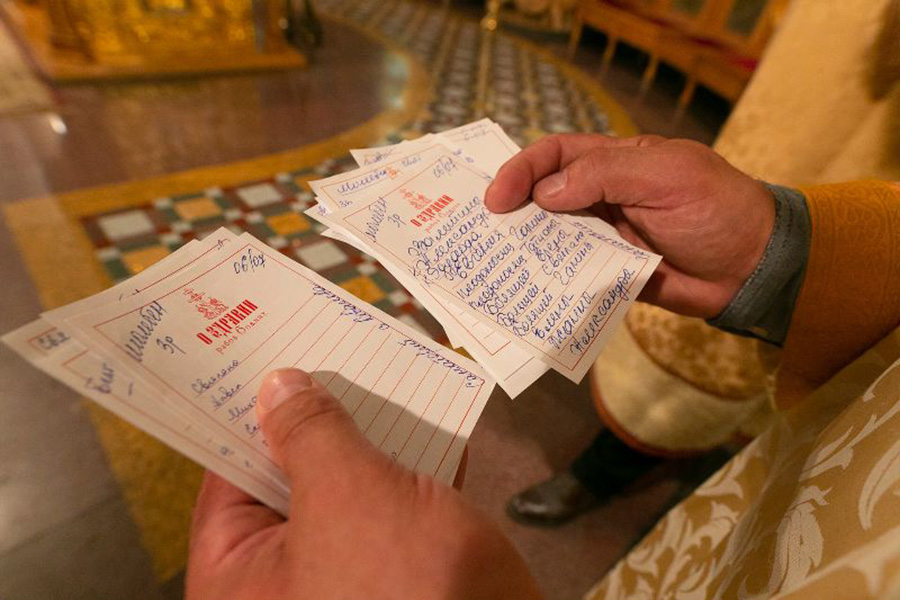
Current Practice in the Russian Orthodox Church
Despite periodic discussions, the Russian Orthodox Church’s position on this matter has remained essentially unchanged for two centuries. The established practice is as follows:
☑️ Only baptized Orthodox Christians may be commemorated at the Proskomedia (with a few exceptions, which will be explored in a separate issue).
☑️ Non-Orthodox Christians may be prayed for at molebens (intercessory services), panikhidas (memorial services), or during the reading of the Psalter in monasteries. While meaningful, these services are not sacramental.
☑️ General intercessions during the Liturgy (e.g., prayers “for the peace of the whole world”) encompass all people, including those outside the Church.
☑️ Private prayer—both at home and in church—is encouraged for individuals of any faith. The prayer of St. Leo of Optina is often used in such cases:
“Seek out, O Lord, the lost soul of Your servant [Name]. If it is possible, have mercy. Your judgments are unfathomable. Do not account this prayer of mine as a sin, but may Your holy will be done.”
Theological Foundations
The Church’s stance on commemorating non-Orthodox Christians is rooted in several key theological principles:
➖ Historical Precedent:
Public commemorations in Orthodox worship traditionally reflected the community’s discernment of who lived in accordance with the true faith.
➖ Sacramental Participation:
Only baptized Orthodox Christians partake in the Eucharist, which extends even to those commemorated during the Liturgy. The one for whom the priest prays is, in a mystical sense, participating in the Eucharistic offering.
➖ Sacramental Unity:
The Proskomedia’s symbolism—the particles placed on the diskos and later immersed in the Chalice—represents the unity of the Church. According to the Catechism of St. Philaret:
“The Church is a society established by God, united by Orthodox faith, God’s law, hierarchy, and the Sacraments” (§250).
By this definition, non-Orthodox Christians remain outside this sacramental unity.
While critics propose counterarguments, they have yet to persuade the Church to modify its traditional practice. Even so, Orthodoxy provides ample means to express Christian love and concern without overstepping canonical boundaries.

Conclusion
The Church, in her pastoral wisdom, has long upheld a balanced approach to the commemoration of non-Orthodox Christians.
While maintaining strict sacramental discipline, she does not prohibit intercessory prayer for those outside her visible boundaries. Through molebens, panikhidas, private prayers, and general intercessions, clergy and laity alike can express their love for all people while remaining faithful to the teachings of the Church.
As this topic continues to be discussed in the life of the Church, may the Lord grant us discernment, wisdom, and a heart full of Christian love.
Through the prayers of His saints, may He guide us all in truth!
If our articles have been helpful to you, the best way to thank us is by choosing our store for your church supply needs—each order helps us continue sharing valuable resources with you.
Related Articles


Related Products
- Comment(s)
Close
- Someone purchased a
Lestovka Prayer Rope 50 Segments
7 hours ago from Oceanside, USAs low as $23.00 - Someone purchased a
Horologion (The Book of Hours) in Church Slavonic
8 hours ago from New Egypt, US$17.00 - Someone purchased a
Small Gold-Plated Pectoral Cross w/Chain
1 hour ago from Saint Joseph, US$250.00 - Someone purchased a
Medium Triptych with Our Lady of Kazan Icon
7 hours ago from Oceanside, US$16.00