This website uses cookies to ensure you get the best experience on our website. Read more

Commemorating Prayer Requests: Best Practices and Insights
 20Sep
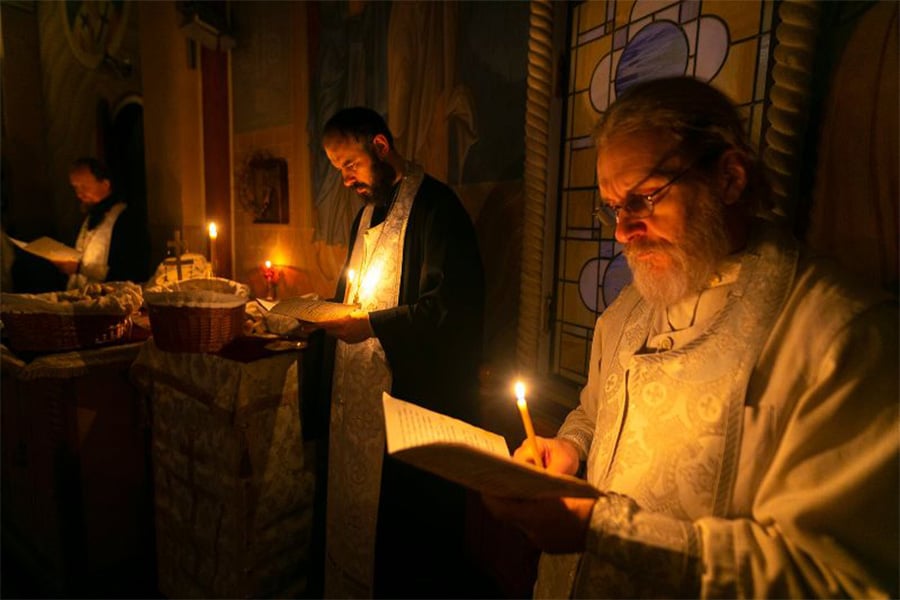
20SepThe topic we are addressing today may not present entirely new concepts for many of you. However, even within the Russian Orthodox Church, approaches to commemoration notes vary, and opinions on their practice often diverge.
Many parish priests still have practical questions about how to handle this aspect of parish life appropriately. Drawing from discussions on www.priest.today and other reliable sources, we hope this newsletter will provide clarity and provoke reflection on this meaningful practice.
A Bit of History
Liturgical texts indicate that the use of lists for church commemoration during the Liturgy dates back to apostolic times.
By the fourth or fifth century, these lists were commonly referred to as diptychs, named after the two-fold writing tablets used to record them. These lists varied in their content, often categorising individuals by their status: martyrs and other saints, newly baptised Christians, bishops, clergy, lay members of the congregation, and the deceased.
This ancient tradition continues to our day, with adaptations. Modern variations include one-page commemoration notes and larger memorial books often referred to as synodics (from the Greek συνοδικός, meaning “conciliar” or “joined together”).
The Significance of the Commemoration Note
A commemoration note serves multiple purposes:
1️⃣ On the one hand, like a church candle, it represents a tangible offering and a form of collective support for worship and church life. Submitting a prayer request note is often associated with a fixed or discretionary donation, reflecting the biblical principle that no one should “appear before the Lord empty-handed” (Deuteronomy 16:16).
2️⃣ On the other hand, it is a deeply personal act of intercession and remembrance. By submitting a commemoration note, the faithful ask for God’s grace, sanctification, and the remission of sins for themselves and their loved ones, living and departed. This request is tied to the purifying sacrifice offered at the Holy Table.
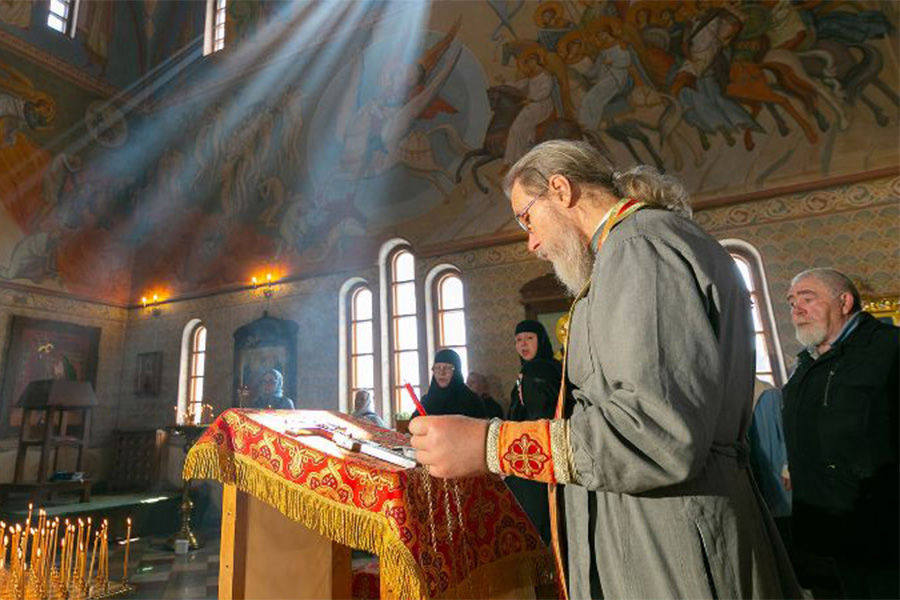
Archpriest Konstantin Ostrovsky describes this poignantly:
"Imagine an elderly woman sitting at home, writing prayer request slips for the Liturgy. She grieves for her unbelieving relatives, both living and deceased, longing for their eternal salvation. She brings her note to the candle desk, makes a donation, prays at the Liturgy, and receives Holy Communion. Through her sorrow, prayer, and Communion, she partakes of Eternal Life and, in a mysterious way, makes those for whom she grieves and prays also not alien to this Life."
This perspective underscores the profound theological and spiritual significance of the commemoration note, elevating it beyond a mere custom to a meaningful expression of faith and love.
The System in Brief
Prayer request slips vary in purpose, service type, and duration. These distinctions help define how and where the names submitted for commemoration are included in prayers.
Below is a brief outline of the most common types:
➖ Type of Commemoration: Slips may request prayers for health or repose.
➖ Service Type: Commemoration may occur at the Divine Liturgy (Proskomedia and during the Litanies), prayer services (molebens), funerals, memorial services (parastasis, panikhidas), or other rites.
➖ Duration: Requests may be for a single occasion, forty consecutive Liturgies (sorokoust), half a year, a year, or, in some cases, perpetual commemoration. In monasteries where the Psalter is read continuously, names may also be included during these readings.
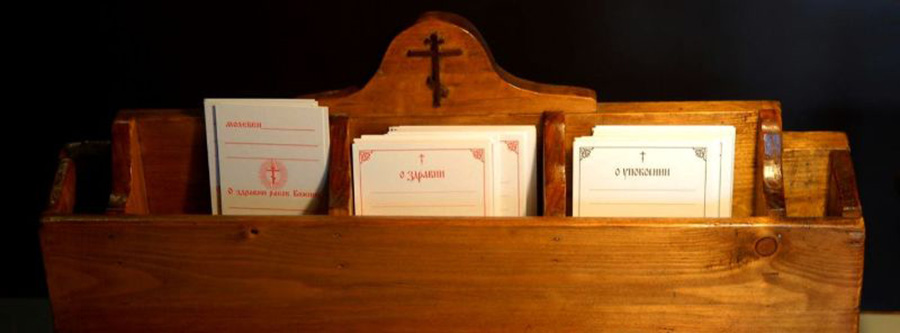
Sorokoust
A forty-day commemoration (sorokoust) is most effective in parishes or monasteries where the Divine Liturgy is served daily or almost daily. This is especially meaningful for commemorating the newly reposed during the forty days following death.
However, in parishes with services held only once a week or on major feast days, completing a sorokoust can take several months. While this limitation may reduce its practical significance in such settings, clergy should make every effort to adapt to their local circumstances and maintain the spirit of the practice.
Commemoration at the Liturgy
The most common system for Liturgy-related commemoration divides prayer slips into two categories:
➖ Proskomedia Slips: These requests are remembered during the Proskomedia. Donations for these slips are usually left to the discretion of the submitter.
➖ “Ordered” Slips: These slips are commemorated both at the Proskomedia and the Litany of the Liturgy. A minimum donation is typically required. Depending on the volume of requests, only some names may be read aloud publicly during the service.
➖ Additional commemorations (such as at a moleben or panikhida) are often left to the rector’s discretion. In parishes where the rector actively cares for his flock, slips submitted for prayer services are often remembered at the Proskomedia as well.
Historical Context of “Ordered” Slips
The term “ordered slips” has historical roots. In the past, parishes that did not hold daily Liturgies would accept special requests for Liturgies tied to specific occasions (e.g., baptisms, weddings, or memorials for the departed). These Liturgies were accompanied by significant donations, which helped cover the costs of singers, candles, and other needs.
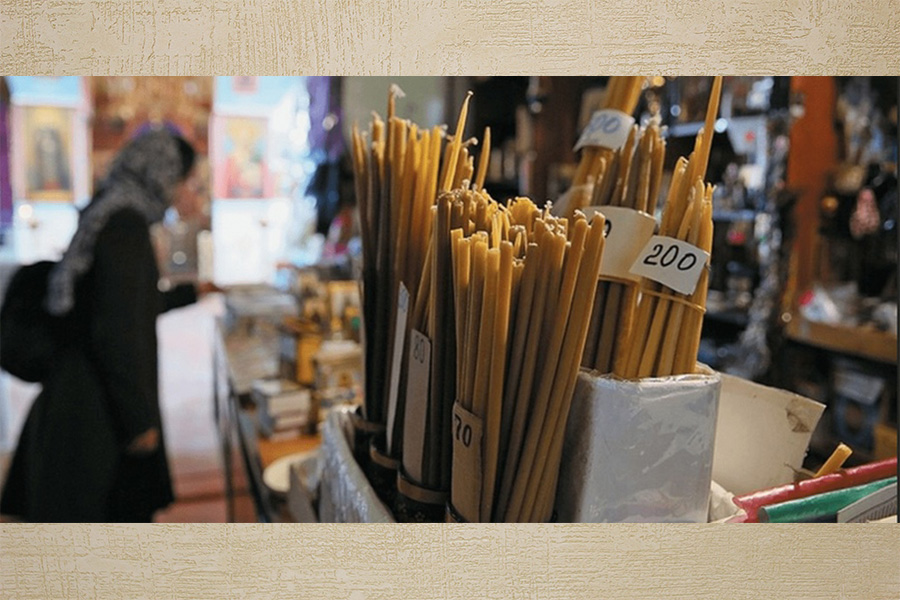
✅ Balancing Commemoration and Financial Practicality
The current system accommodates varying levels of financial ability. On one hand, it ensures that anyone can submit a prayer request regardless of income. On the other hand, it provides parishes with a degree of financial stability and predictability, especially in smaller or struggling communities.
Critics of this system often cite the risk of “commercialisation,” which can undermine the spiritual focus of the practice. However, practical realities, including the financial demands of running a parish, often make this system necessary.
It is worth noting, however, that some parishes and monasteries have found ways to sustain themselves without relying on a fixed-donation system. These examples remind us that while financial considerations are often unavoidable, they should never overshadow the spiritual essence of commemoration.
Practice of Honouring Prayer Requests Without a Specific Donation
Archpriest Vladimir Vorobyev of Moscow shares an example of a parish that prioritises prayer over financial considerations:
"At St Nicholas Church in Kuznetsy, we do not differentiate between commemoration notes, treating them all equally. I believe that a commercial approach in the Church is a very dangerous thing. In our church, all services are free—there is no charge for molebens, funeral services, weddings, baptisms, or remembrances at the Proskomedia. Parishioners can donate as much as they wish to the collection box inside the church.
We remind our parishioners that parish life is a shared responsibility. To sustain our community and its activities, funds are needed, and these must come from all of us, collectively. The parishioners do donate, and through this shared effort, we manage to sustain our needs.
Of course, this approach does not result in any surplus or financial stability. There are times when things become challenging. But in those moments, the Lord provides—occasionally through a benefactor who brings us the support we need. This is how we have lived for decades, trusting in the Lord’s provision. I believe that God is pleased with our desire to fulfil His commandment: ‘Freely you have received, freely give’ (Mt 10:8). In my opinion, this is the right approach, free from any sense of commercialism."
The Diversity of Practices Across Parishes
The practicalities of organising commemorations vary significantly depending on the specific circumstances of each parish and its rector's guidance. While the principle of communal responsibility is universal, its application differs widely.
Bishop Kirill (Zinkovsky) observes:
"If we compare a rural parish with a small number of parishioners to a city cathedral, where the flow of people is many times greater, their practices are naturally unlikely to be identical."
Archimandrite Seraphim (Krechetov) offers a similar perspective:
"The faith of those who donate and those who pray is what matters most. It is not necessary to complicate the process with rigid conditions. For instance, while it is customary to use multiple prosphora during the Proskomedia, there are situations where only one is available. In such cases, all necessary particles can be taken from a single prosphoron. The priority is ensuring that the prayers are said with sincerity and faith."
Metropolitan Tikhon (Shevkunov) also acknowledges the diversity of traditions:
"Different practices have developed due to varying factors, including financial constraints. Therefore, we should leave these decisions to the rectors. The essential point is to commemorate all prayer requests fairly. While it is not necessary to take out a particle for each name, all notes should be included in the Proskomedia prayers."
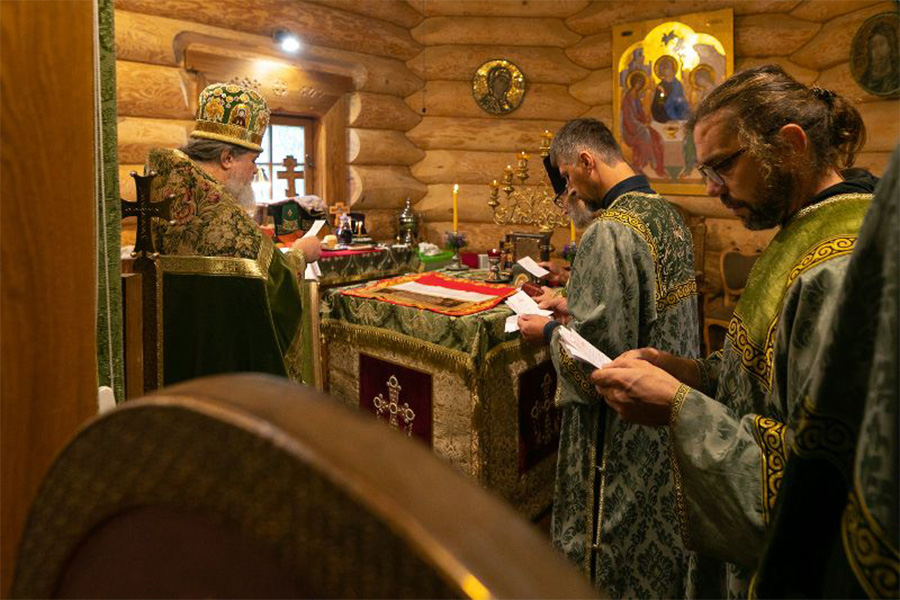
Who Is Responsible for Commemorating Prayer Request Slips?
The responsibility for commemorating prayer request slips primarily falls on the celebrating priest, guided by his pastoral conscience. However, practical considerations such as a large volume of requests, time constraints, or personal circumstances (e.g., illness or family responsibilities) make it permissible to share this responsibility with other clergy, altar servers, or even laypeople.
Bishop Kirill (Zinkovsky) highlights the balance required:
"Of course, we understand that if a priest has young children waiting for him at home, this is one scenario. But for priests whose children are grown and who feel called to it, some spend hours, even half the night, remembering a large number of prayer slips. It is essential, however, not to neglect one’s small church, one’s family. And we must trust that if the priest’s assistants commemorate prayer notes reverently, the Lord will certainly accept this remembrance."
Metropolitan Tikhon (Shevkunov) adds:
"It makes no difference whether prayer slips are read in or outside the altar, or whether they are read by someone vested in the phelonion, clergy, or even laypeople."
Archpriest Vladimir Vorobyev observes:
"When the Litany is said, all parishioners should remember their sick and departed loved ones because they know for whom they are praying. It makes sense for the priest to pray for those he knows personally, as this allows him to pray with his heart. When faced with mountains of prayer slips, I believe it matters less who reads them and how they are read."
When Should Prayer Requests Be Commemorated?
Bishop Kirill (Zinkovsky) provides a clear directive:
"All prayer request slips should be commemorated at the Proskomedia. This is the primary part of commemoration."
This view is universally supported by authoritative voices.
Commemoration During the Litany of Fervent Supplication
While the service book provides specific instructions regarding commemoration during the Proskomedia, the practice of commemorating names during the Liturgy is more fluid. This is largely shaped by tradition and may involve some degree of liturgical discretion.
For example, the Litany for the Departed includes a clear framework for commemoration, but this litany is not always included in every service according to the Canon.
Over time, the practice of adding petitions and commemorations (e.g., for the sick, travellers, or other needs) to the Litany of Fervent Supplication has developed.
However, prominent liturgists, such as St. Athanasius (Sakharov) and Archimandrite Cyprian (Kern), as well as many priests, advise against excessively long voiced commemorations during the service. Instead, they recommend delegating a fair share of these commemorations to altar servers.
Should a Particle Be Taken for Each Name?
Ideally, as prescribed by the service book, a particle should be taken out for each name, which is then immersed in the Chalice at the end of the Liturgy, sanctified by the Divine Blood. Many clergy emphasise the importance of this practice based on their experience.
Hieromonk Daniel (Lavrov) shares a personal account:
"I used to take out one particle for a priest’s matushka and children. When the children were unwell, I was often asked to pray for them. Once I began taking out a particle for each child, those requests ceased almost entirely."
However, when faced with an objectively large number of names, this ideal can be set aside.
Bishop Kirill (Zinkovsky) explains:
"We know of liturgical practices where a single particle is taken for an entire row of saints, all bishops, or even for the whole heavenly host as one large particle."
Archimandrite Job (Gumerov) provides a historical example:
"When St. John of Kronstadt served the Divine Liturgy, entire boxes of notes and telegrams containing names for remembrance were brought into the altar. During the Proskomedia, he stretched his hands over these boxes and prayed to the Lord to remember all those for whom the notes had been submitted."
Efforts to adhere to the statutory aspect of taking particles for each name can be seen in Athonite practices. According to one tradition:
"After the third hour is completed, the priest rings a bell, and in complete silence, the faithful commemorate their loved ones for health while the priest continuously takes out particles. Another bell signals the commemoration of the departed, and a third bell marks the end of the commemoration. To accommodate the number of names, the priest rotates the spear within the prosphora to extract additional particles."
The Whole Church Is Commemorated at the Liturgy
Despite our best efforts and practical approaches, it is impossible to account for every nuance. Therefore, as we strive to do what is within our capacity, we must place our trust in the merciful grace of God, which perfects our shortcomings.
Archpriest Konstantin Ostrovsky reflects:
"Of course, it is beautiful when a particle is taken out of your prosphoron for each name, and it is heartwarming to hear your request read aloud clearly by a deacon or priest during the Litany. And if you do not hear it, it can feel disappointing.
But while we focus on our personal experiences, let us not forget that in the temple of God—whether it is large or small, in the countryside or the city—the same Divine Liturgy is celebrated.
At the Liturgy, the entire One, Holy, Catholic, and Apostolic Church gathers around the Throne of God and partakes of Holy Communion. Not only those for whom particles were taken from the prosphora are remembered, but the entire Church is remembered. This is unchanging and is not limited by our weaknesses or any earthly circumstance."
CONCLUSION
As this discussion has illustrated (albeit not exhaustively), even within a single local Orthodox Church, there are varied opinions, approaches, and nuances concerning commemoration practices.
Across different regions of the world, these practices naturally adapt to local circumstances and traditions.
We warmly invite our readers to share insights about the practices observed in their congregations. You can reply directly to this email or join the conversation in our Facebook group—we’d love to hear from you!
If you have found this article helpful, don’t forget to visit our church supplies store, offering clergy essentials.
By supporting us with your purchase, you’re also helping us continue creating the OCC article you’re reading right now.
We’re deeply grateful to the many fathers who already order from us regularly—your trust means the world to us.
May the peace and goodness of the Lord be upon all our readers!
Sincerely,
Your OCC Team
Related Articles
Related Products
Close
- Someone purchased a
Lestovka Prayer Rope 50 Segments
7 hours ago from Oceanside, USAs low as $23.00 - Someone purchased a
Horologion (The Book of Hours) in Church Slavonic
8 hours ago from New Egypt, US$17.00 - Someone purchased a
Small Gold-Plated Pectoral Cross w/Chain
1 hour ago from Saint Joseph, US$250.00 - Someone purchased a
Medium Triptych with Our Lady of Kazan Icon
7 hours ago from Oceanside, US$16.00