This website uses cookies to ensure you get the best experience on our website. Read more

Overcoming Distractions At the Altar
 10Sep
10SepWe continue to translate for you the book by one of the most experienced and authoritative priests of the Moscow Diocese, Archpriest Konstantin Ostrovsky's Notes on Pastoral Ministry.
Prayer Is a Priest’s Sacred Duty
Prayer is an essential part of every Christian’s life. However, for a priest, prayer is not only a personal spiritual exercise but also a sacred duty tied to his ministry. While laypeople strive to maintain focus during the Liturgy, occasional lapses of attention may occur. If a layperson becomes distracted, repents, and approaches the Chalice with contrition, God forgives their absent-mindedness, granting them Communion for the remission of sins and eternal life.
For a priest, however, this responsibility is far weightier. Standing at the altar of the Most High, he is entrusted with lifting up the prayers of the Church on behalf of all the faithful. This requires both understanding and heartfelt attention to the words he speaks.
If the priest neglects this duty and allows his mind to wander, he risks reducing his ministry to mere outward formality. In such moments, though he may canonically occupy the place of a priest, he is not truly fulfilling his sacred role.
Repentance can heal even this sin, but it must be active and transformative. Without genuine repentance and a renewed effort to change, the priest risks estranging himself from his vocation. While he may continue to serve outwardly, he risks being spiritually unfit for the ministry entrusted to him.
Some clergy justify inattentiveness by reasoning that the sacraments are effective regardless of the priest’s state. While this is canonically true, it is spiritually dangerous to rest on this assurance. The sobering words of Christ remind us of the potential consequences:
"Many will say to Me in that day, 'Lord, Lord, have we not prophesied in Your name, cast out demons in Your name, and done many wonders in Your name?' And then I will declare to them, 'I never knew you; depart from Me, you who practice lawlessness!'" (Matthew 7:22–23).
This does not mean that priests who struggle with distraction during services should abandon their ministry. Rather, it is a call to repentance and spiritual labour. Prayer is both a gift of grace and a skill honed through practice. To improve, a priest must persevere in prayer itself, humbly seeking God's help to lift his heart and mind toward Him.
How to Pray during the Service
When and how should a priest recite prayers during the All-Night Vigil or the Divine Liturgy? Should they be read aloud, silently, or quietly? These questions have been extensively explored by liturgical scholars and are undoubtedly important. However, for whom are they truly relevant?
If a priest has reached a level of spiritual concentration where he prays attentively at every moment—reciting the prescribed prayers without distraction, whether silently or aloud, and maintaining heartfelt prayer throughout the service—then these subtleties are indeed worth considering. For such a person, adhering to liturgical precision can deepen their ministry and enrich the service for all present.
However, for the vast majority of us, the reality is quite different. Our minds are frequently distracted, even during the most sacred moments of the Liturgy. This challenge—remaining focused and present in prayer—is far more pressing than debates over the technicalities of liturgical practice.
➖ The struggle against distraction
Distraction in prayer is not always the result of negligence or laziness. While carelessness can often be corrected with effort and discipline, the deeper issue is that the level of prayerfulness a person can achieve is determined by their spiritual state. Growth in prayer is ultimately a gift of God.
This divine gift must be earnestly desired, carefully guarded by humility, and is often withdrawn when pride or judgment of others takes root in the heart. As the Gospel reminds us:
“Which of you by worrying can add one cubit to his stature?” (Matthew 6:27).
The same principle applies to spiritual growth. No amount of effort alone can force progress in prayer. It is a gift that comes in God’s time, granted to those who seek it with humility and repentance.
For clergy, this truth underscores the importance of striving for prayerful attentiveness while accepting their current limitations with humility. The focus should not be on achieving perfection immediately, but on cultivating a heart open to God's grace.
Struggling with Distraction at the Altar
What should we do in specific situations when, during the divine service, our minds are distracted from the words of prayer? From discussions with fellow clergy, I have come to understand how some priests attempt to manage this challenge.
For instance, some priests, anticipating that they may not have enough time to read a prayer attentively at the designated moment, choose to pray in advance—such as during the antiphons or while the Apostle is being read at the Divine Liturgy. If they intended to read the prayer at the proper moment but became distracted, they might look for an opportunity to recite it later. Similarly, at Matins, some may begin reading the lamp-lighting prayers before their designated point, such as from the start of the Six Psalms rather than its midpoint.
➖ Humility in our imperfection
In my view, none of these methods or techniques should be considered ideal or legitimised as standard practice. The goal must always remain the same: undistracted noetic prayer during the divine service. The fact that we often fall short of this standard should humble us, reminding us of our dependence on God's grace.
That said, I believe it is better for a priest to read liturgical prayers outside of their proper place, with as much attention as possible, than to maintain a strict outward appearance of dignity while neglecting prayer entirely. This is a lesser evil, born of our human weakness, and should be approached with humility rather than condemnation.
➖ Balance in pastoral practice
Therefore, the adaptations and "tricks" described above should not be denounced outright or prohibited, as they often reflect an earnest effort to maintain prayerfulness amidst distraction. However, they must not become a substitute for striving toward the ideal of attentive prayer, which should remain the norm. These adjustments should always be seen as temporary aids rather than a definitive solution.
Reading the Prayer Rule during or after the Service
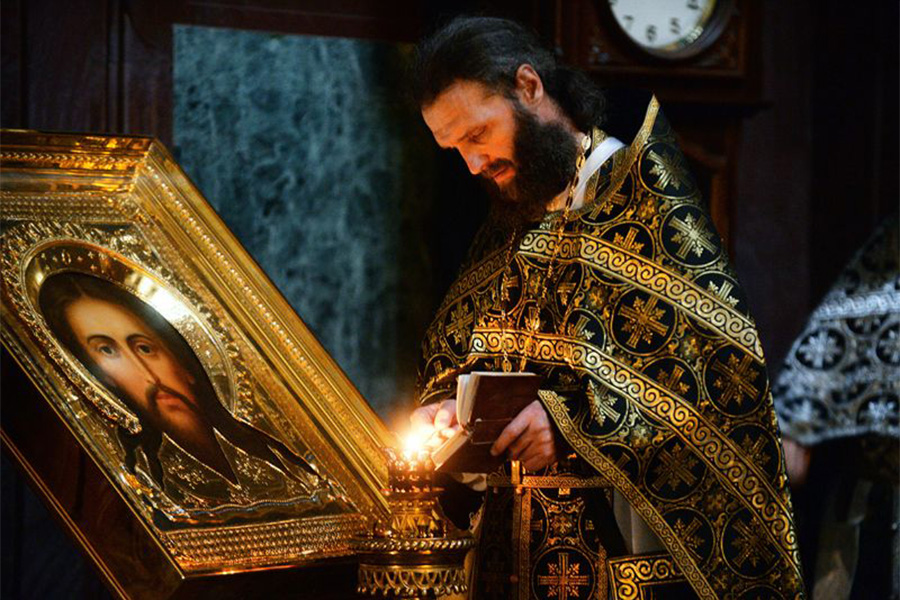
A recurring issue among clergy is the practice of reading the Prayer Rule during the All-Night Vigil or even during the Divine Liturgy. This may happen for various reasons: they might not have had time to complete it beforehand, they aim to save time, or they seek to avoid idleness during the service. However, this practice cannot be deemed spiritually beneficial.
➖ Priority on the Divine Service
During the divine service, our minds must remain fully engaged with it. This includes reading the prayers in the service book, listening attentively to the singing and readings, or maintaining heartfelt prayerful focus. Morning and evening prayers or the Rule for Holy Communion are themselves divine services, requiring undivided attention. To overlap these prayers with a different service diminishes the integrity of both.
While it is true that our minds may wander during the divine service, the proper response is to bring our attention back to the service we are performing, rather than allowing distractions to take the form of unrelated prayer practices.
➖ Missplaced efforts
If a priest has genuinely been unable to fulfil his prayer rule on time for a valid reason, there is no need for embarrassment. If the failure is due to negligence or worldly distractions, it should be a cause for repentance, trusting in God's forgiveness. Treating the divine service as a mere time block to fit in personal prayers or obligations reflects a mercenary approach unworthy of our calling. Particularly absurd is the practice of reciting the Rule for Holy Communion after receiving the Holy Mysteries.
➖ Making up for prayerful omissions
If a priest—or any Christian—feels a genuine spiritual loss for missing certain established prayers, it can be appropriate to make up for them after the Divine Liturgy. However, this should be approached freely, as an expression of personal devotion, rather than as a rigid obligation.
➖ Guidance for clergy
Should bishops, deans, or rectors reprimand clergy for reading the Prayer Rule in the altar during the service? In my opinion, such instances are better addressed through gentle explanations rather than strict prohibitions, provided the clergy in question are not disturbing others. While this practice is not ideal, it is better than idly standing in the altar and indulging in idle or distracting thoughts.
➖ Conclusion
The divine service itself is the primary focus of a priest’s time at the altar. Any additions to this practice must enhance, rather than detract from, the solemnity and purpose of the liturgical prayers. The goal is always to offer our full attention to God, aligning our minds and hearts with the sacred moment.
Dissipation during Service due to External Causes
While internal distractions can arise naturally during divine services, external circumstances often seem to provoke dissipation. Consider, for instance, a crowded and solemn service presided over by a bishop. Such services are rare for many priests, leaving them unfamiliar with the specific order of events, which can lead to confusion. Even more unsettling is the fear of making mistakes, being reprimanded by superiors, or disrupting the service.
In these situations, it is crucial to repent of these fears and remind ourselves that Christ Himself leads every Liturgy—whether priestly, episcopal, or patriarchal—and that our ultimate aim should be to serve Him. In truth, such fears are often exaggerated. In most cases, services proceed smoothly, and the anxiety stems not from real external challenges but from the unrest in our own hearts. For this, we must repent and seek humility.
➖ Dealing with criticism and fear
One bishop, known for his love of order, shared that he tries to avoid correcting clergy during services, even when mistakes are apparent. He instructs his subdeacons to offer quiet and timely reminders rather than rebukes. Priests, too, should not hesitate to ask subdeacons for guidance when needed—help is always available.
However, moments of criticism do arise, and they can be particularly challenging. When faced with correction, it is vital to accept it as coming from God’s hand, to reproach ourselves for our pride, and to pray for the strength to remain focused on prayer despite the discomfort.
➖ When we are the senior priest
Sometimes we find ourselves in the position of being the senior priest at a service, responsible for guiding others. In such cases, distractions can arise from the perceived shortcomings of others: the acolytes forget to light the censer, the choir sings too slowly or quickly, or perhaps their delivery is overly theatrical—or they fall silent altogether.
Nothing is more detrimental to the service or to those participating in it than a superior scolding clergy, staff, or parishioners during the service. Here, the wisdom of the experienced bishop mentioned earlier provides a valuable example: foster patience and maintain inner peace, refraining from outward displays of frustration.
➖ The true source of distraction
Regardless of the external circumstances, the root cause of dissipation is always within us. There are times when the external environment is chaotic, yet peace reigns in the heart; conversely, everything may seem perfectly calm and orderly, but our minds remain scattered.
The solution to all distractions—whether internal or external—is repentance. Only through humility and self-reproach can we regain focus and strive to serve God with our whole hearts, undistracted by the trials around us.
Should Prayers at the Altar Be Read Silently or Aloud?
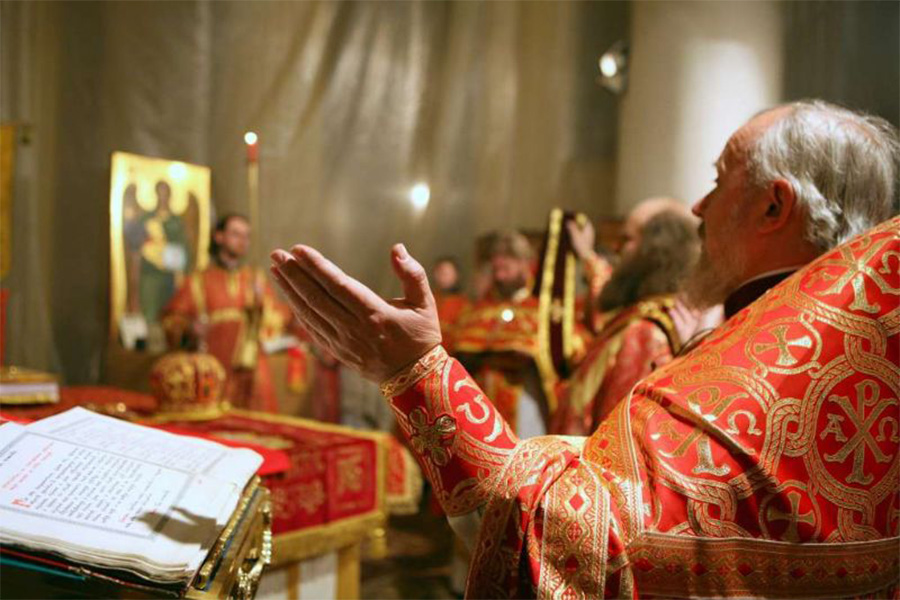
The question of whether prayers at the altar should be read silently or aloud is determined by both liturgical statutes and local customs, which a priest should respect and follow. These variations can present challenges for the priest who strives to pray with full attention while avoiding delays or disruptions to the service.
When considering whether the so-called "secret" prayers should be recited audibly or silently, it is important to balance pastoral sensitivity with personal prayerfulness.
In my view, it is generally fitting for the celebrant to recite these prayers aloud. However, if certain priests find it easier to concentrate and gather their minds in prayer when praying silently—and doing so does not disturb the service—then prioritising heartfelt prayer and inner focus should take precedence over strict adherence to theoretical norms.
Should a Priest Be Looking in the Service Book?
A related question arises concerning the use of the service book during communal services. Some believe that only the celebrant should read prayers directly from the service book, while the assisting clergy should follow without referencing it.
Here, flexibility is key. If the celebrant pronounces the prayers clearly and loudly enough, and the assisting priest is sufficiently attentive, then it is possible to participate in prayer without the service book. However, if a priest finds it difficult to maintain attentiveness without reading the prayers directly, then he should feel free to use the service book.
No one should discourage or prevent a priest from using the service book if it helps him maintain focus and engage fully in the prayers. Ultimately, the priority is that all clergy remain attentive and prayerful, ensuring that their service is offered with devotion and reverence.
May God guide us in all things.
Translated by OCC
Related Articles

Related Products
- $985.00$1,120.00As low as $1,475.00Comment(s)








Close
- Someone purchased a8 hours ago from grand rapids , US$18.00
- Someone purchased a7 hours ago from West Valley City, US$2,725.00
- Someone purchased a
100-Segment Lestovka Prayer Rope
8 hours ago from grand rapids , USAs low as $30.00 - Someone purchased a
Hanger for Vestments (360 mm top, 390mm side, 820 mm bottom)
3 hours ago from Plano, US$40.00 - Someone purchased a
Chalice Covers and Veil with Byzantine Embroidery sh-10-86-4
7 hours ago from West Valley City, USAs low as $350.00