This website uses cookies to ensure you get the best experience on our website. Read more

On Dealing with Thoughts
 30Aug
30AugWe are pleased to bring you the latest segment from Notes on Pastoral Ministry by Archpriest Konstantin Ostrovsky.
This work addresses significant topics for clergy that are often overlooked in Orthodox seminary curricula.
The Cloud of Thoughts and the Talent of Prayer
Not only new Christians but many seasoned believers find their minds constantly overwhelmed by thoughts, as though caught in a restless sleep. While this state may feel uncontrollable, it does not excuse us from spiritual vigilance, as the passions driving these thoughts continue to act upon us, often worsening our inner state.
Thankfully, God grants moments of clarity. In these fleeting seconds, we can regain freedom and turn our minds toward Him in prayer. The challenge is to seize these opportunities and make the most of them. Even a single moment used to glorify God will not go unnoticed by His grace. If we consistently value and dedicate these moments to Him, He will bless us with even greater capacity for prayer and communion with Him.
Consider the parable of the talents (Matthew 25:21–30). The Lord commends the faithful servant who used his talents wisely: “Well done, good and faithful servant; you were faithful over a few things, I will make you ruler over many things.” Conversely, the servant who buried his talent is cast into outer darkness, where “there will be weeping and gnashing of teeth.” Likewise, neglecting the moments God grants us for prayer and reflection can lead to spiritual stagnation and loss.
Ignore Sinful Thoughts
What should we do during times of temptation when sinful thoughts or feelings arise? A common suggestion is to counteract such thoughts with their opposites. For example, if one feels impure desire, they might attempt to quash it by focusing on the flaws of the person who provoked it. Similarly, if anger arises, one might try to dispel it by recalling the person’s virtues.
❗️ While well-intentioned, these methods ⬆️ are largely ineffective.
Attempting to battle temptation by engaging with sinful thoughts, even to oppose them, is akin to pouring fuel on a fire.
Instead of extinguishing the temptation, it often intensifies it.
The Orthodox approach is to entirely ignore such thoughts.
Rather than dwelling on or dissecting them, redirect your attention to prayer. However, this does not mean making the thoughts themselves the subject of your prayers. Avoid overly emotional responses or pleading with God to “remove” the thoughts.
Instead, turn your focus entirely toward Christ in simple, humble prayer, such as the Jesus Prayer: “Lord Jesus Christ, Son of God, have mercy on me, a sinner.”
The following analogy is helpful: if someone contracts a disease due to sin, they do not address the disease by begging it to leave. Instead, they seek repentance, pursue healing, and take care to avoid repeating the circumstances that led to their illness.
Likewise, when confronted with sinful thoughts, do not engage with them directly; instead, seek God’s grace and protection through sincere prayer and repentance.
Another analogy illustrates the futility of reasoning with temptation: a little girl dragged into the bushes by a predator does not argue or plead with her captor; instead, she cries out for help. Similarly, we should not attempt to rationalise or argue with sinful thoughts. Instead, call upon God for deliverance and focus your mind and heart on Him.
By ignoring sinful thoughts and anchoring ourselves in prayer, we leave no room for temptation to take root. As St. Theophan the Recluse teaches, “When the mind is focused on God, there is no space for the enemy to enter.”

Thoughts During Prayer
Two elderly priests once met, and one remarked with irony, “The clergy today have become so secularised—not like our generation. Remember, when you and I served in the cathedral, what spiritual conversations we had during the six psalms!”
The humour lies in the obvious contradiction: the six psalms are not a time for conversations.
This anecdote illustrates an important point: while pondering worthwhile or pious thoughts is not inherently wrong, it is not prayer.
Prayer demands an undivided focus on God. Any thoughts—whether sinful, neutral, or even noble—are distractions during prayer. As St. John Climacus advises, “Do not let the time of prayer be an hour for considering necessary things or even spiritual tasks, otherwise you will lose the better part” (The Ladder of Divine Ascent, 28:59).
When thoughts intrude during prayer, whether at church or at home, it is necessary to set them aside and refocus on God. A simple inward plea, such as “Lord, help me to remain undistracted in prayer,” can re-centre the heart and mind.
This discipline is especially crucial for inner, unceasing prayer. The moments when God blesses us with the ability to pray sincerely should be treasured. Turning away from prayer for any distraction, even briefly, wastes these precious opportunities. Instead, we must strive to remain in prayer until God’s grace grants us deeper communion.
When Distraction Overtakes Us
Every person has a certain measure of prayerfulness and, correspondingly, a level of distraction they can manage. However, there are times when we find ourselves overwhelmed by distractions beyond our usual experience. In such moments, it is helpful to examine the source of these distractions.
Fear:
If fear occupies our minds, it is an opportunity to strengthen our faith. Pray for courage, surrender yourself to God, and place your trust in His providence.
Desire:
When overwhelmed by longing for something, remember that God knows what is best for us. Place your desires in His hands, trusting that He will provide what is truly necessary.
Overindulgence:
If overeating or other excesses hinder prayer, acknowledge the mistake, humble yourself, and resolve to be more careful in the future.
Pride or Judgement:
These are perhaps the most harmful distractions, as they defile prayer and alienate us from God. If you recognise thoughts of self-exaltation or condemnation of others, repent immediately and refocus your attention on humility and self-reproach.
After a brief self-examination, which may take only seconds, turn your attention back to prayer. By addressing distractions with repentance and humility, we clear the way for renewed focus on God.
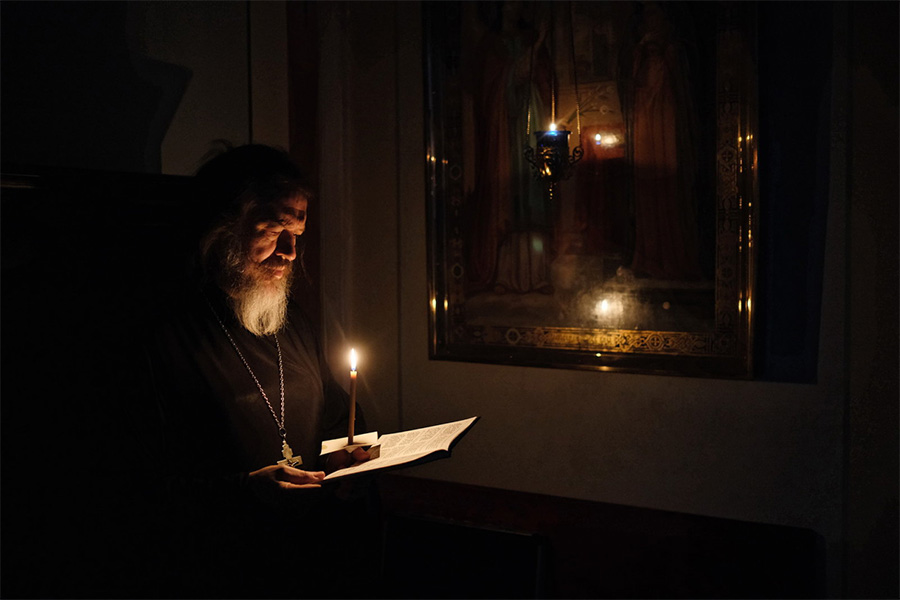
Fantasies and Emotions
In the context of prayer, it is crucial to understand the distinction between true communion with God and the distractions of fantasy.
St John of the Ladder reminds us: “During prayer do not admit any sensory imagination, so as not to be subject to distraction” (The Ladder 28:42). Prayer coloured or supported by fantasy is not genuine prayer.
We should aim to eliminate all imagined images during prayer—whether visual, auditory, verbal, or symbolic. Such images are like drawings on a windowpane: they might appear beautiful, but they obscure the true light and prevent us from seeing reality. Authentic prayer seeks to encounter God directly, without the filters of human imagination.
Equally, sincerity in prayer requires the removal of excessive emotionality. While emotions are appropriate and meaningful in our interactions with loved ones, they are not suitable in our communication with God.
Emotional prayer can feel pleasant or even compelling, but it risks becoming self-centred and inauthentic. The Lord, in His infinite love, may tolerate such imperfect prayers for a time, but as we grow in spiritual maturity, we are called to transcend emotionality and reasoning in prayer. Persisting in these limitations without striving for growth can ultimately hinder the experience of divine grace.
When Will Success Come?
The struggle for focused and undistracted prayer is, for most of us, a lifelong endeavour. While some may attain spiritual heights in a short time, for the vast majority, this journey requires patience, humility, and persistence.
St John of the Ladder encourages us: “Constantly wrestle with your thought, and whenever it wanders call it back to you. God does not require from those still under obedience prayer completely free of distractions. Do not despond when your thoughts are filched, but remain calm, and unceasingly recall your mind. Unbroken recollection is proper only to an angel” (The Ladder 4:92).
True attentiveness in prayer—what the Fathers call “non-hovering prayer”—is a gift from God, not something we can achieve through human effort alone.
Yet, our work in striving for purity of heart and mind prepares the ground for this gift. As St Theophan the Recluse teaches, the mind follows the heart, and since our hearts are often attached to worldly or sinful things, our thoughts stray to these attachments. Thus, the battle against distraction is closely tied to the battle against passions.
It is essential not to scold or berate ourselves for our shortcomings in prayer. Self-condemnation, anger, or frustration can often be expressions of pride and spiritual inexperience. Instead, let us humble ourselves, acknowledging our weaknesses before God. Humility attracts divine grace, which, in turn, helps to still the wandering mind and focus it on prayer.
St John of the Ladder advises: “When you are going to stand before the Lord, let the garment of your soul be woven throughout with the thread that has become oblivious of wrongs. Otherwise, prayer will bring you no benefit” (The Ladder 28:4).
He also adds: “If you are clothed in all meekness and freedom from anger, you will not have much trouble in losing your mind from captivity” (The Ladder 28:15).
May these reflections inspire us to persevere in our prayer life with humility and faith, knowing that every effort is precious in the eyes of God.
Related Articles


Related Products








Close
- Someone purchased a
100-Segment Lestovka Prayer Rope
1 hour ago from Toms River, USAs low as $30.00 - Someone purchased a
Lestovka Prayer Bracelet 25 segments
1 hour ago from Northville, USAs low as $18.00 - Someone purchased a
Horologion (The Book of Hours) in Church Slavonic
1 hour ago from New Egypt, US$17.00 - Someone purchased a
Russian-Style Priest Vestment with an Icon of Christ and embroidery
7 hours ago from Denver, US$1,515.00 - Someone purchased a
Greek-Style Priest Vestment with Embroidery and Medallion
6 hours ago from Washington, US$744.00 - Someone purchased a
Chalice Covers and Veil with Embroidery sh-10-71-7
7 hours ago from Denver, US$315.00