This website uses cookies to ensure you get the best experience on our website. Read more

Clergy Dilemmas: Burying Non-Orthodox
 20Aug
20AugToday’s issue addresses a situation that many do not think about until they are faced with it: the role of an Orthodox priest in the burial of a non-Orthodox person. While those who have encountered this situation may already be familiar with the complexities, this discussion will be helpful for others to consider in advance—forewarned is forearmed.
In our era of migration, mixed marriages, and diverse social ties, cases involving the burial of non-Orthodox individuals are increasingly common.
Some typical scenarios include:
➖ Requests from Orthodox relatives or friends to participate in the burial of a deceased non-Orthodox person.
➖ Heterodox individuals who regularly attended Orthodox services due to the absence of a church of their own confession but never formally converted.
➖ Intended converts who expressed a firm desire to join the Orthodox Church but passed away before completing their journey to Orthodoxy.
➖ Non-affiliated individuals with no connection to an Orthodox parish.
What Should Guide the Priest?
In any such case, the priest must seek guidance and blessing from the diocesan authorities.
Since there is no universally standardised rule for Orthodox clergy regarding participation in the burial of non-Orthodox individuals, local practices may vary significantly.
For instance, with the blessing of the diocesan bishop, an Orthodox funeral rite may sometimes be permitted for those who firmly intended to convert but passed away before doing so (Sergius V. Bulgakov, Clergyman’s Handbook).
For all other cases, two critical questions must be clarified:
1) What order of service to follow, and
2) Whether it is permissible to perform any extended rites in the parish church.
A Historical Perspective
The Clergyman’s Handbook states:
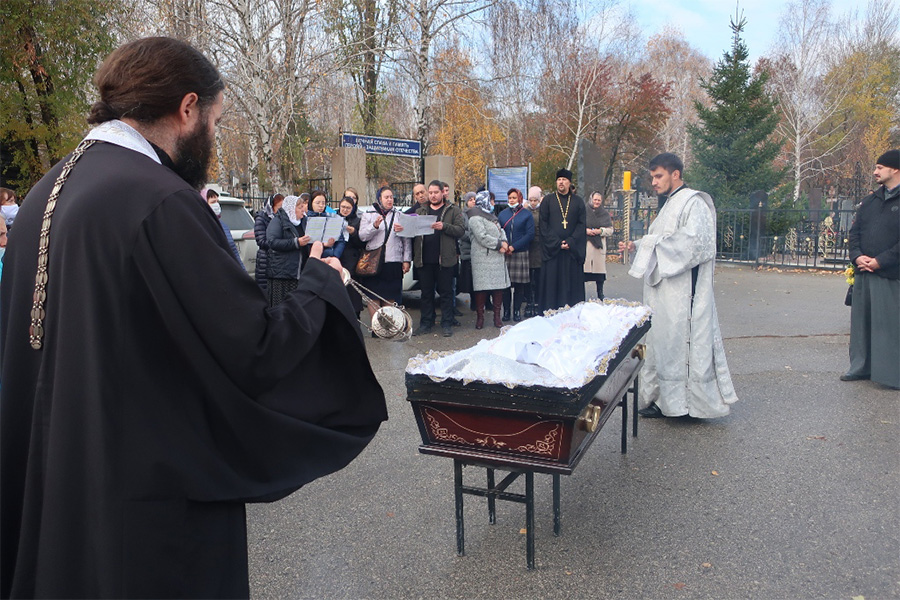
“It is forbidden to bury non-Orthodox believers according to the rite of the Orthodox Church. However, if a heterodox person of another Christian confession dies and no priest or pastor of their confession is available to perform the funeral, the Church permits the Orthodox priest, vested in epitrachelion and phelonion, to accompany the body of the deceased from its place to the cemetery and to lower it into the grave while singing the hymn ‘Holy God.’” (Decree of the Holy Synod, 24 August 1797).
The Handbook also notes:
“The obligation for an Orthodox priest to bury a heterodox Christian is conditional on the absence of a clergyman from their confession. The Orthodox priest must verify this before fulfilling a request for the burial of a non-Orthodox individual.” (Church Herald, 1906, Issue 20).
In a ruling from 10–15 March 1847, the Holy Synod further decreed that the body of a deceased non-Orthodox Christian may not be brought into an Orthodox church before burial.
Diverging Practices
Over time, more lenient practices developed in some Orthodox Churches. In 1869, Patriarch Gregory VI of Constantinople established a special rite for the burial of non-Orthodox individuals, which was later adopted by the Hellenic Synod.
This rite includes the Trisagion, the 17th Kathisma with its refrains, an Epistle reading, a Gospel reading, and a short dismissal. Importantly, it allows for the body of the deceased to be brought into the cemetery church.
However, within the Russian Orthodox Church, this practice was often viewed with suspicion, being associated with modernist or Renewalist movements. This ambiguity has contributed to ongoing differences in practice across Local Orthodox Churches and dioceses.
The Order with the 17th Kathisma
Attempts to formalise this order within the Russian Orthodox Church (ROC) have occurred at various times. Notably, in 1984, a service titled Office for the Repose of the Non-Orthodox was included in the Trebnik (Book of Needs) of the Moscow Patriarchate.
This order, based on the Greek tradition and compiled with the personal involvement of His Holiness Patriarch Sergius in 1944, received the approval of the Holy Synod (Journal of the Moscow Patriarchate, 1985, Issue #1, p.79). However, it no longer appears in subsequent editions of the Trebnik. Despite this, the order gained some degree of acceptance and use.
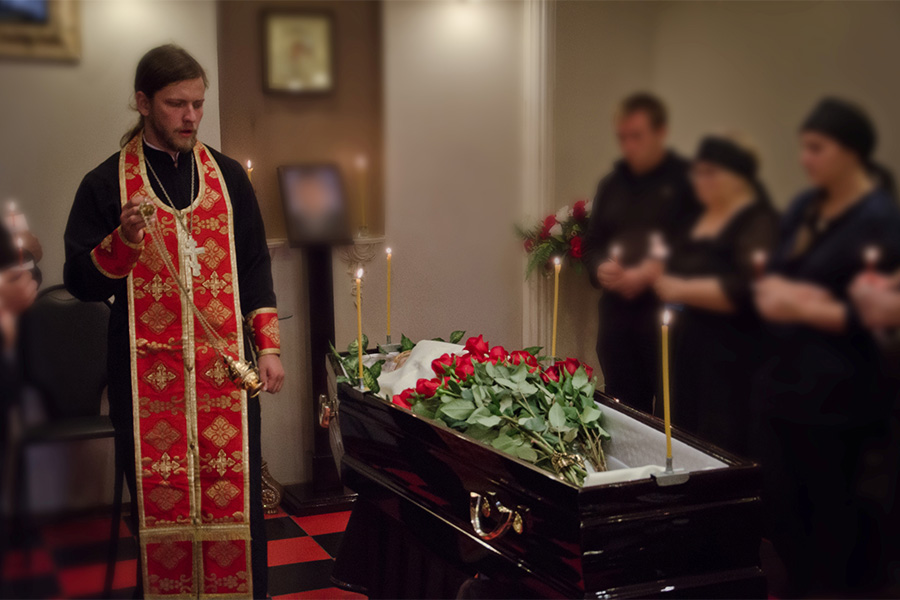
*️⃣ According to our information, this order (possibly with textual variations) is still practiced in some foreign dioceses of the Russian Church and the Orthodox Church in America (OCA), with the blessing of diocesan bishops.
Arguments in Favour of This Order
The Need for a Fuller Expression of Prayer:
“The mere singing of this brief verse [the Trisagion] will not satisfy the desire of the Orthodox relatives of the deceased to pray for him, for the sake of which the participation of an Orthodox priest is permitted.” – (Sacraments and Rites of the Orthodox Church / Archpriest Gennady Nefedov).
The Trisagion alone may not be sufficient for the spiritual and emotional needs of the Orthodox relatives present, nor does it reflect the fullness of the Orthodox liturgical tradition, especially in the presence of non-Orthodox attendees.
Encouragement of Private Prayer:
While the liturgical commemoration of non-Orthodox individuals is not accepted, private prayer for their repose is encouraged. This order includes general Christian prayers—such as Psalms, an Epistle, and a Gospel reading—along with expressions of praise to God, allowing those present to add private prayers for the deceased.
Structure of the 1984 Office:
The Office for the Repose of the Non-Orthodox includes the following elements:
➖ Opening: Trisagion through "Our Father"
➖ Psalms: Psalm 88 ("O Lord, God of my salvation, I have cried out day and night before You…"); the 17th Kathisma with “Hallelujah” sung after the opening verses of each stasis, followed by the Evlogitaria; and Psalm 39 ("I said, 'I will guard my ways…'").
➖ Scripture: A special prokeimenon, readings from the Apostle (Romans 13:11-14) and Gospel (John 5:24-30).
➖ Farewell Stichera: "Come, Let Us Give the Last Kiss."
➖ Dismissal: "May He who rose from the dead…" followed by "Memory Eternal," but notably without the proclamation, "Grant rest eternal in blessed repose…."
❌ No litanies or prayer of absolution are included in this order.
Note: A PDF version of this order in English, albeit with some variations such as litanies, can be found online.
Additional Considerations
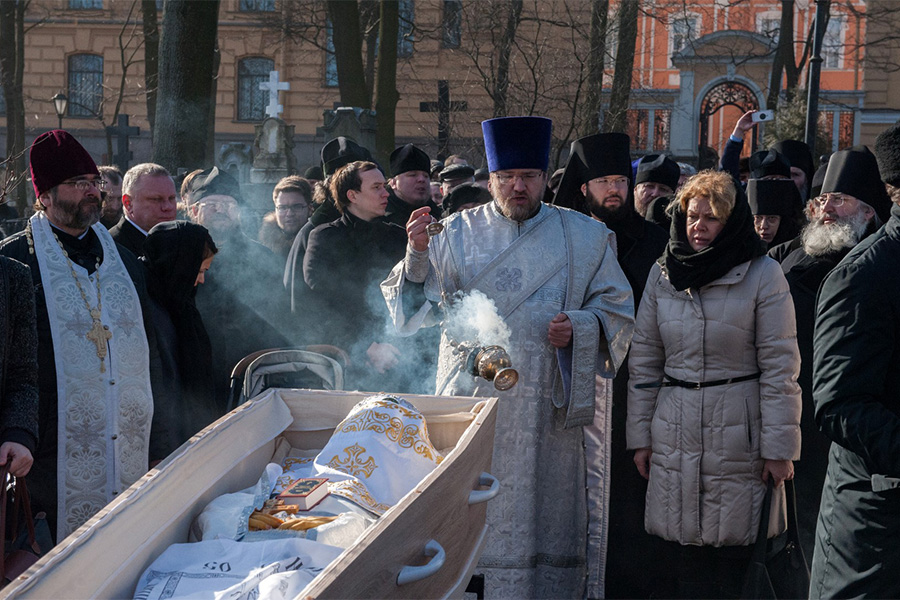
Before proceeding with this order, the following conditions must be met:
➖ No Clergy of the Deceased’s Denomination Available:
It must be established that it is objectively impossible or significantly difficult to arrange for a clergyman of the deceased’s own denomination to perform the burial.
➖No Opposition from the Deceased:
There must be no evidence that the deceased expressed a clear opposition during their lifetime to being buried with the participation of an Orthodox priest.
Furthermore, the Church cannot offer prayers for individuals who:
➖ Openly denied the existence of God,
➖ Blasphemed against the Church, Her faith, or Her sacraments, or
➖ Remained unrepentant of their sins, as reliably confirmed by credible witnesses.
We hope this issue has provided useful insights into the complex and sensitive topic of burying non-Orthodox individuals. As always, we welcome your thoughts and shared experiences on this matter.
May God guide us in all things.
Related Articles
Related Products
- Comment(s)

Close
- Someone purchased a8 hours ago from grand rapids , US$18.00
- Someone purchased a7 hours ago from West Valley City, US$2,725.00
- Someone purchased a
100-Segment Lestovka Prayer Rope
8 hours ago from grand rapids , USAs low as $30.00 - Someone purchased a
Hanger for Vestments (360 mm top, 390mm side, 820 mm bottom)
3 hours ago from Plano, US$40.00 - Someone purchased a
Chalice Covers and Veil with Byzantine Embroidery sh-10-86-4
7 hours ago from West Valley City, USAs low as $350.00