This website uses cookies to ensure you get the best experience on our website. Read more

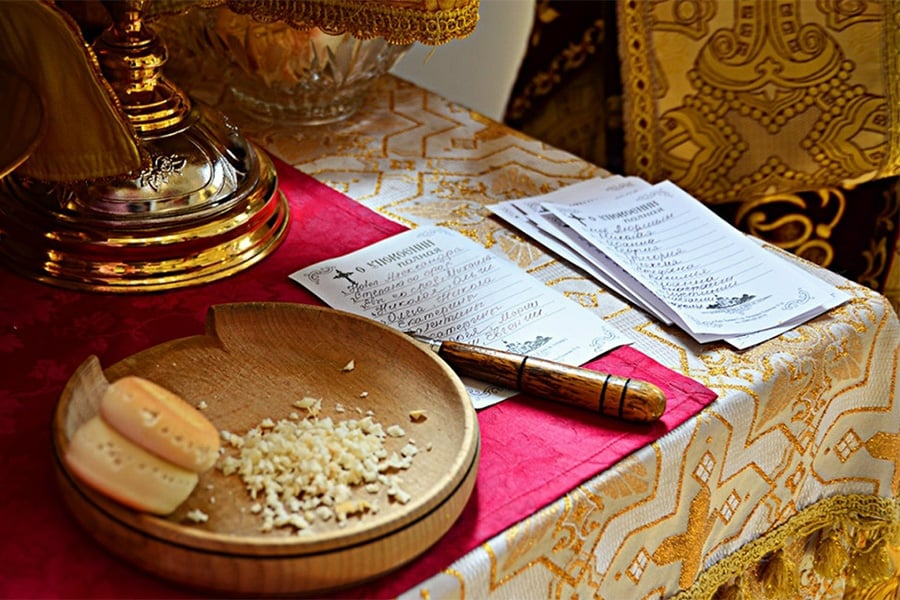
Commemoration of the Unchurched
 30Oct
30OctIn our previous issue on commemorating non-Orthodox Christians during the Proskomedia (the Liturgy of Preparation), we promised to address a related topic at readers’ request: the commemoration of those baptized in Orthodoxy but not actively living a church life (the “unchurched”) or those entirely distant from the faith.
Regarding the Russian Orthodox Church’s current stance on this matter—a topic we are more qualified to discuss—the general approach to commemorating the unchurched remains tolerant.
However, differences in opinion, debates, and even localized rigorism persist. In some parishes and monasteries, when submitting names for commemoration, one might encounter not only the customary question, “Are all those listed baptized Orthodox?” but also, “Are they churched?”—i.e., do they regularly attend services, confess, and commune?
Today, we will briefly explore the arguments on both sides. A deeper analysis of nuances would require far more space and time, though it is undoubtedly worthwhile.
Arguments against Commemoration
1️⃣ Patristic Foundations
This position draws from the teachings of three widely revered saints, with the foundational argument attributed to the first, and the others building upon it.
St. Simeon of Thessalonica (late 14th c.–1429) writes in his work On the Temple (ch. 62–63), citing “the ancient Fathers”:
“The particles [offered at the Proskomedia] intercede for the departed faithful, securing deliverance from sins and communion with divine grace, while for the living who lead repentant lives, they provide protection from misfortunes and intercession for the remission of sins… But for one who is entangled in sin and refuses to repent, the offering becomes a cause of greater condemnation.
Therefore, the priest must carefully ensure that he does not accept offerings or lift up sacrifices for such people, who have cast out shame and conscience from their hearts and surrendered to lawlessness—lest he incur condemnation alongside them.”
St. Paisius Velichkovsky (1722–1794), invoking the authority of St. Simeon [of Thessalonica], writes similarly:
“If anyone, even among Orthodox Christians, openly sins and does not repent, the Holy Church forbids the offering of the Bloodless Sacrifice for such a one until he utterly abandons his sin and repents sincerely.”
He extends this principle to the departed: “Likewise, we must not offer it for those who died in unrepentant opposition to the Holy Church.”
St. Paisius concludes with a warning rooted in apostolic teaching: “Therefore, no priest should dare to offer the Sacrifice or perform commemoration for one who is openly sinning and unrepentant, for such an offering becomes a cause of condemnation for them—just as the reception of the awesome Mysteries [Holy Communion] by the unworthy and unrepentant brings judgment, according to the divine Paul’s words: ‘For anyone who eats and drinks without discerning the body eats and drinks judgment on himself’ (1 Corinthians 11:29).”
St. Leo of Optina (1768–1841) advises:
“Do not commemorate openly unrepentant sinners, those in error, or schismatics. According to the Church’s teachers, the union of their particles with the Divine Blood brings them not purification but condemnation… Submit names for the Proskomedia only for those close to you whom you know well. For others, pray privately, striving in your mind to regard all as saints (without imitating their evil deeds).”
These teachings are echoed in the Skrizhal (a 17th-century theological compilation approved by the Moscow Council of 1656) and the Kormchaya Kniga (Rudder), which instruct priests to avoid accepting offerings from the unrepentant or those living in open sin.
2️⃣ Historical Context
Liturgist Fr. Mikhail Zheltov notes that the Proskomedia’s practice of removing particles from prosphora (liturgical bread) evolved from early Byzantine traditions of celebrating Liturgy with multiple loaves and chalices.
As the Church shifted to using a single loaf, particles from other prosphora were retained for commemoration. Logically, such offerings were accepted only from active community members.
In the early Church, names of the departed were inscribed in diptychs (memorial lists) and publicly read aloud. Congregants could challenge a name if the individual’s life conflicted with Christian norms, leading to its removal if justified.
3️⃣ Symbolic Meaning
The Proskomedia mystically symbolizes the gathering of the entire Church—both heavenly and earthly. Only the faithful (saints and repentant believers) may stand with the Lamb. Those outside the Church’s life, even if commemorated, cannot constitute this unity.
4️⃣ Canonical Status of the Unchurched
The Church has long recognized the concept of the “lapsed” (those who abandon the faith). Today, the Rite of Reunion is prescribed for baptized Orthodox who later joined other religions, adopted non-Christian practices (e.g., Eastern meditation), or lived in prolonged estrangement.
The 80th Canon of the Sixth Ecumenical Council (Trullo) stipulates excommunication for those who miss three consecutive Sundays—a rule still valid, though rarely enforced. The Church’s prayer for the penitent (“reconcile and unite him to Your… Church”) implies that the unrepentant remain outside this unity.
Thus, commemorating the unchurched at the Proskomedia is seen as spiritually harmful, not merely a disciplinary matter. However, this does not preclude praying for their enlightenment at molebens (intercessory services) or in private prayer.
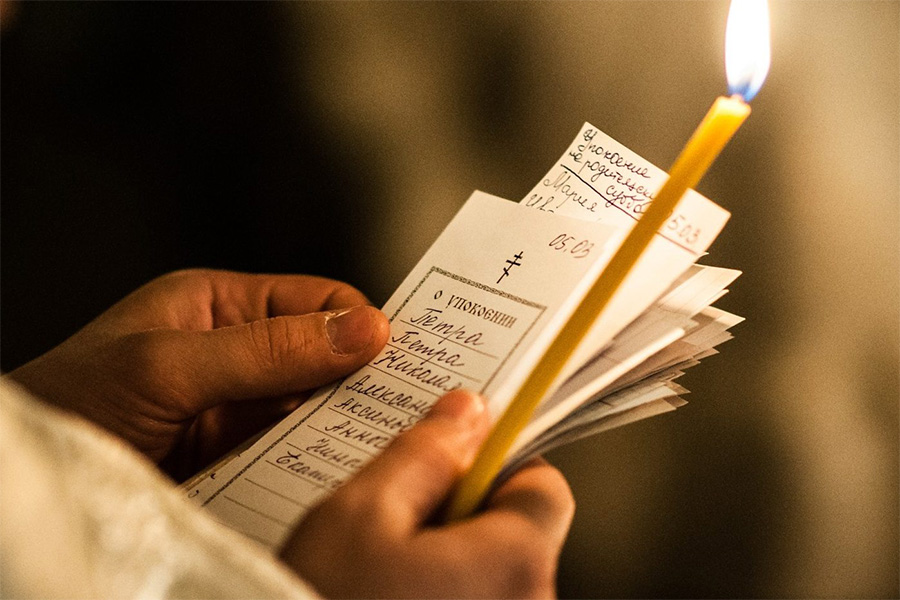
Arguments for Commemoration
It is important to note that the current situation in the Russian Orthodox Church (ROC) is unprecedented, shaped by the cataclysms of the early 20th century.
- prior to these upheavals, the ROC held a stable position in society and possessed significant influence over its spiritual state. While unchurched attitudes and atheism were growing trends, they remained relatively rare, warranting strict—and at times harsh—responses (as seen in the excommunication of Leo Tolstoy).
- subsequently, the Church endured a period of survival under atheist state ideology.
Today, the situation has grown vastly more complex: the ROC no longer occupies its former societal role, and the defunct Soviet ideology has been replaced by equally pernicious ideas. In this context, the Church has far less grounds to consider its mission fully accomplished or to justify excluding—even partially—such a vast number of spiritually lost souls.
Thus, the situation demands thorough ecclesial reflection and the articulation of an official conciliar position. However, the debate and the voices of opponents have yet to reach the necessary intensity. Let us now hear the arguments of proponents—their stance may seem less rigorously grounded or overly emotional, yet it is rooted in compassion and personal pastoral experience.
Bishop Anthony (Azizov):
"It is clear that during Liturgy, we pray only for members of the Church. Yet this raises another question: where do the Church’s boundaries lie? If a person openly declares themselves—even if baptized—to be outside the Church, we naturally cannot commemorate them corporately at the Divine Liturgy... As for questions about how often one communes, I am firmly convinced that such inquiries (especially from candle-stand workers) are, at the very least, illegitimate."
Archpriest Lev Makhno (Tula):
“Can we remove particles for the unchurched? But are priests themselves so thoroughly ‘churched’? If a person is baptized, the Sacrament of Baptism grants them the right to be a Christian within the Church’s fold. How they exercise this right is their free choice—but we must pray for them.”
Archimandrite John (Krestyankin) (+2006):
“Without fail, pray for your baptized relatives while you live! We must not preempt God’s judgment. The Lord alone knows each person’s circumstances and sees their heart. He will pronounce judgment in His time. For now, fulfill your filial duty to parents and your duty of love to kin through prayerful remembrance. Your prayers will not go unanswered.
Only sectarians, heretics, and conscious blasphemers who openly testify to their enmity toward God should be excluded from liturgical commemoration.”
(Letter to Servant of God E., Reflections with Counsel anthology, pp. 473–475)
The opinion of Fr. John—a near-contemporary confessor endowed with undoubted spiritual gifts—holds particular weight and authority for the author. Yet for a fuller picture, we include additional perspectives, even if from authors with less widespread recognition or whose arguments, though valid, lack universal acceptance.
Further Perspectives...
Fr. Mikhail Asmus (Moscow):
“It is difficult to speak of a patristic tradition based on references to just three saints. Regarding the commemoration of sinners, heretics, and the demon-possessed in the Eucharistic offering, we read in the Liturgy of St. Basil the Great: ‘Make the wicked good by Your goodness,’ ‘Turn back the deceived and unite them to Your holy, catholic, and apostolic Church,’ ‘Deliver those oppressed by unclean spirits,’ and finally: ‘All who stand in need of Your great mercy, those who love us and those who hate us.’ Thus, St. Paisius’ strict stance is merely a hostage to Blessed Simeon’s excessive symbolism.”
Archpriest Dionysius:
“When citing the Holy Fathers on practical (rather than doctrinal) matters, we must account for the historical context in which they lived, labored, and preached. Otherwise, their guidance risks becoming unworkable.”
Hieromonk Nicholas:
“Neither the Typikon nor canon law recognizes terms like ‘churched’ or ‘unchurched.’ There are only members and non-members of the Church. To claim that ‘sin separates one from the Church’ or that ‘one’s fallen life proves they are not a Christian’ may be rhetorically valid but is entirely uncanonical.”
Archpriest Alexander:
“Personally, I remove particles for the unchurched if they are baptized and their relatives—our parishioners—request prayers for them. I am unsure if this is correct, but I believe that an element of faith, hope, and love for others may outweigh strict rules. Ultimately, even if we err, He who receives our offering may accept or reject it as He wills. If we bring too much, He will sift out what displeases Him.”
Anonymous Priest:
“A commemoration note is, in any case, a token of intercession and sacrifice on behalf of the one submitting it. We must not deprive souls of even this aid.”
Archpriest Gregory:
“Parishioners generally perceive the Proskomedia as an intensified, exceptional prayer. Thus, they submit names of all whom they love. A priest cannot scrutinize the worthiness of each name and therefore removes particles for all. The Lord Himself, knowing each soul, accepts or rejects them. Yet priests must still explain whom to commemorate at the Proskomedia and whom to include in private or moleben prayers.”
Alternatives to Proskomedia Commemoration
Opponents of commemorating the unchurched at the Proskomedia propose, in addition to private prayer, commemorating them at molebens (intercessory services), including special services “for the deluded.”
A recently published supplement to the Trebnik (Book of Needs) includes a Rite for the Uprooting of Heresies and Schisms, the Healing of Church Divisions, and the Return of Those Straying from Truth (if readers express interest through responses to this newsletter, we will attempt to publish it in a future issue).
This approach would benefit all: clergy of differing views could express Christian love for wayward loved ones, while parishioners gain a means to offer collective prayerful sacrifice for those whose spiritual state concerns them most.
In any case, a parish’s stance on commemoration must align with communal consensus and episcopal blessing.
Related Articles


Related Products
- $575.00Comment(s)




Close
- Someone purchased a
Акафист Божией Матери в честь иконы Ея "Всецарица" (in Russian)
12 minutes ago from Danbury, US$2.00 - Someone purchased a
Келейная книжица. Покаянные молитвы и размышления, архимандрит Иоанн (Крестьянкин) (in Russian)
12 minutes ago from Danbury, US$2.00 - Someone purchased a
Православный молитвослов: Правило ко Причащению (in Russian)
12 minutes ago from Danbury, US$3.00 - Someone purchased a
Сокровенный разговор об исповеди (in Russian)
12 minutes ago from Danbury, US$1.00 - Someone purchased a
Collection of Akathists to the Most Holy Theotokos
12 minutes ago from Danbury, US$7.00 - Someone purchased a
Holy Gospel in Church Slavonic with Translation in Russian
12 minutes ago from Danbury, US$25.00 - Someone purchased a
Daily Orthodox Calendar with Scripture Readings for the 2027 Year
12 minutes ago from Danbury, US$14.00