This website uses cookies to ensure you get the best experience on our website. Read more

What Truly Builds a Parish
 30Sep
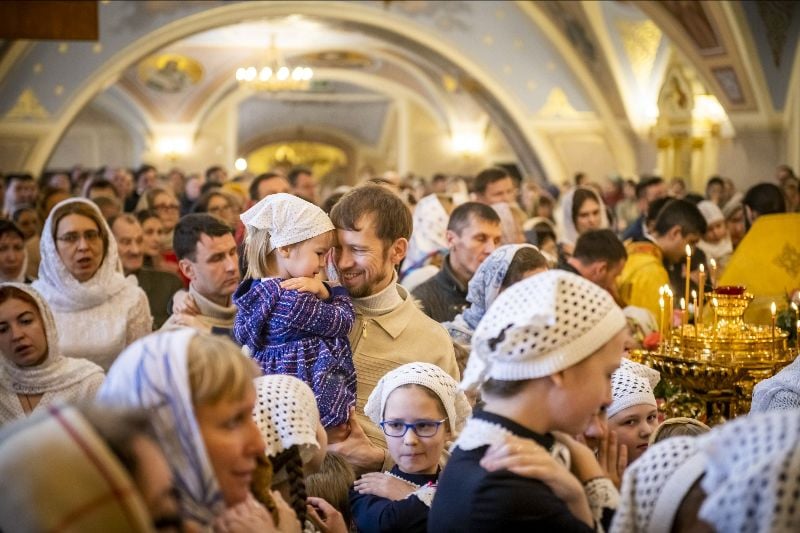
30SepIn our previous instalment, Fr Konstantin Ostrovsky reminded us that a parish is held together not primarily by friendship, shared interests, or even affection for its priest, but by something infinitely greater: our common participation in the Body and Blood of Christ.
Every other aspect of parish life finds its proper place only when it grows from that Eucharistic centre.
In today's chapter, he develops this thought further.
❓ What truly builds a parish?
❓ Is it energetic activity, successful programmes, or the rector's organisational skills?
❓ Or does genuine parish life arise in a very different way?
Fr Konstantin invites us to rediscover the Church's surprisingly simple—and profoundly demanding—answer.
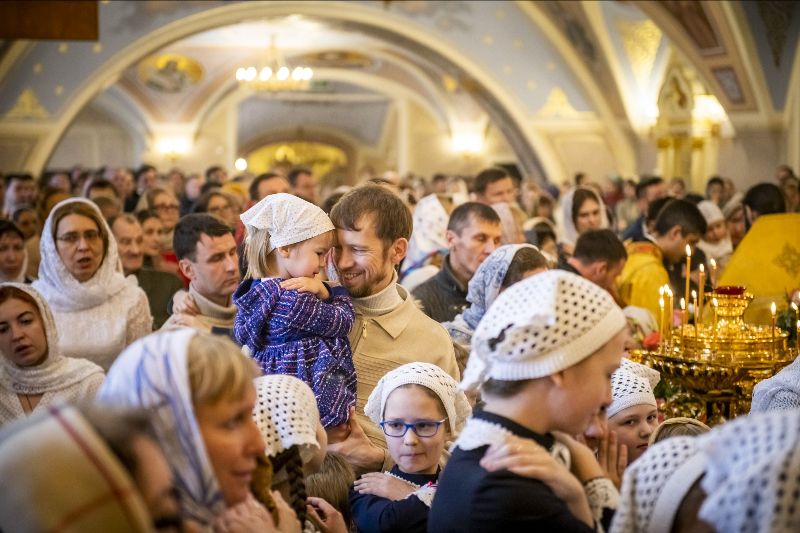
A PARISH IS THE BODY OF CHRIST
The Church's understanding of a parish may seem almost too simple. A parish, she tells us, is a community of Orthodox Christians united in the Divine Liturgy. To modern ears this can sound surprisingly modest, as though something essential were missing.
Yet perhaps the problem is not that the Church's vision is too small, but that we stand too far from its true height. Mountains also appear low when viewed from a great distance, though in reality they tower above us.
Whenever a parish gathers for the Divine Liturgy—whether in a remote village church or a great cathedral—the whole Church stands before the throne of God.
Personal relationships among parishioners may develop in many different ways, and they certainly matter. Yet they are not what ultimately defines the parish. Its true heart is the Body and Blood of Christ. Both priest and faithful come to the house of God above all to be united with Him.
Within that one Body, each person serves according to the calling God has given. One celebrates the divine services, another sings, another teaches, another quietly fulfils some unseen obedience, while still another simply comes faithfully to pray and receive the Holy Mysteries. Before God, these distinctions are secondary.
A common misunderstanding is to assume that someone becomes a "real" member of the parish only by participating in organised parish activities, rather than simply by faithfully worshipping and receiving Holy Communion.
Suppose a Christian family is raising several children. The mother devotes herself to their upbringing, while the father spends long days at work to provide for them. They strive to live according to the Gospel and, amid the demands of family life, are able to come to church only on Sundays, where they pray and receive Communion. In what sense are they incomplete members of the parish?
Experience teaches quite the opposite. A parishioner who serves no committee, attends no meetings, and holds no visible responsibility may nevertheless be living a deeply Christian life—struggling against the passions, praying according to his strength, remaining faithful to the Church, and quietly seeking repentance. Such a person is no less a member of the parish community than anyone else.
The measure of belonging is not activity but Сommunion.
HOW IS A PARISH BUILT?
How does a Christian woman become a mother? She marries, loves her husband, prays, endures sickness and hardship, entrusts herself to God—and, if God grants it, children are born. A parish comes into being in much the same way.
A priest is called simply to celebrate the divine services faithfully, to pray, to endure patiently, and to love the people whom God has entrusted to him. The rest cannot be manufactured. It comes not according to our own plans but according to God's providence. "Do your duty, and leave the rest to God."
The history of the Church offers countless examples of this. We have already spoken of the "family of repentance" that grew around the righteous Fr Alexei Mechev. The same principle may be seen in the founding of many of the Church's great monasteries.
Did St Sergius of Radonezh first devise a strategy for attracting followers? Did he seek influential patrons, organise ambitious building campaigns, or concern himself with publicity? Of course not. He withdrew into the wilderness to seek God in prayer. God brought people to him.
Only then, in His own time, did the Lord bring into being the monastery that would become the Holy Trinity Lavra. It was God's work—not the product of religious ambition or carefully designed pastoral programmes.
The same principle applies to parish life today.
Every genuine work of the parish—whether teaching, catechesis, charitable ministry, youth work, or missionary outreach—must grow naturally from the grace received in the Divine Liturgy, sustained by prayer, patience, and love.
Activities that spring from this living source bear lasting fruit.
Those that arise chiefly from human enthusiasm, organisational skill, or the desire to build an impressive parish may appear energetic, successful, and widely admired. Yet if they are no longer nourished by the life of prayer and the Eucharist, they will ultimately prove barren.
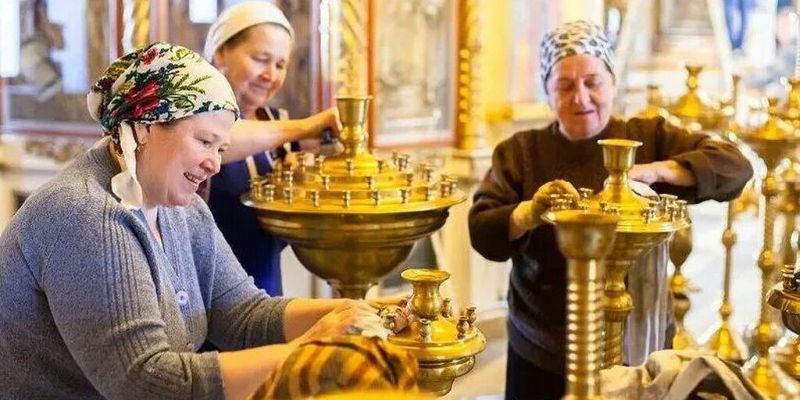
THOSE WHO LABOUR TOGETHER
The clergy and parish workers also form a community of their own.
Everyone who serves in the parish under the rector's guidance—whether ordained, employed by the parish, or volunteering their time—shares in the Church's common work, provided it is undertaken for the glory of God rather than personal ambition.
The rector therefore carries a delicate responsibility. He must preserve this fellowship without allowing it to become something unhealthy: not a community gathered around Christ, but a tightly knit circle revolving around itself—a kind of Orthodox sect, outwardly correct in its practices yet inwardly defined by loyalty to personalities rather than by life in the Church.
God has entrusted me with the ministry of serving this parish. Others, in turn, have been entrusted with serving alongside me. Together we labour in one work.
When the Mother of God and the Lord's relatives sought to speak with Christ, He replied:
"Whoever does the will of My Father in heaven is My brother and sister and mother" (Matthew 12:50).
In much the same way, those who faithfully labour together in Christ naturally become brothers and sisters.
This, however, should never become an excuse for neglecting one's own family. A priest's first parish is still his domestic church. His wife and children are not competitors for his attention but part of the ministry entrusted to him. Giving proper care to both home and parish is never easy, yet both belong to his vocation.
Naturally, human relationships differ. One of your closest co-workers may never become a close personal friend. There is nothing alarming in that.
Soldiers standing shoulder to shoulder need not share the same temperament. One may be quiet, another talkative; one reserved, another outgoing. Yet they defend the same position. When necessary, they support one another and, if called upon, are prepared to lay down their lives for one another.
So it should be among those who labour together in the Church.
"OUR PARISH IS NOTHING BUT OLD LADIES"
An energetic young priest may sometimes arrive at a parish only to find himself disappointed. The church is financially stable. The services are well attended.
Yet the congregation seems, in his eyes, rather unremarkable—mostly elderly women. There are few young families, little visible activity, and the Divine Liturgy is celebrated only on Sundays and major feasts.
What is he to do?
Perhaps this is precisely the moment to remember the priest's first calling: prayer.
We often speak about problems in parish life, yet every genuine solution begins in the same place. Prayer itself is learned only through prayer.
I recall one priest who had previously served in a cathedral before being appointed rector of just such a quiet rural parish. He hoped to celebrate the Divine Liturgy more frequently, but those who served in the parish resisted the idea. They had grown accustomed to having Liturgy only on Sundays and major feast days.
Rather than arguing, he quietly began opening the church every morning on non-liturgical days. At the same hour each day he read the Morning Prayers aloud, followed by three canons, an Akathist, and a memorial litiya. He simply announced these services to the parish.
Little by little, a few people began joining him. The experiment ended only because he was later transferred back to the cathedral. The lesson, however, remained.
A parish need not be transformed through campaigns or programmes. Sometimes it grows simply because the priest himself begins praying more faithfully.
Another temptation deserves equal attention. Some priests become preoccupied with attracting young people, almost measuring the health of the parish by its average age.
Here it is worth asking ourselves an uncomfortable question: Why do I feel such a strong need to make my parish younger? Is this concern always born of pastoral love? Or might it sometimes resemble a physician worrying that too many of his patients are elderly?
The physician treats whoever comes through the door. The priest serves those whom God sends.
Certainly, a young priest often finds it easier and more enjoyable to spend time with young people. That is perfectly understandable. But Christ did not place us in parishes so that we might draw emotional strength from our parishioners.
He placed us there to feed them with the true Food—the Body and Blood of Christ. Our natural desire for pleasant companionship is human enough. We simply ought not mistake it for a pastoral virtue.
PASTORS COME AND GO—THE CHURCH REMAINS
A gifted pastor may lead a parish for many years, gathering around him a remarkable spiritual family.
Yet when he dies or is transferred elsewhere, that community often changes profoundly. Sometimes it disappears altogether.
Should this trouble us? To some extent, such an outcome is almost inevitable.
Communities gathered around a deeply loved spiritual father naturally experience a painful loss when he is no longer present. If a recognised successor continues his work, the community may endure for another generation. If not, it usually changes its character or gradually disperses.
The parish of St Nicholas in Klenniki, associated with the righteous Fr Alexei Mechev, offers a striking example.
Before his repose, Fr Alexei entrusted the pastoral care of his spiritual family to his son, Archpriest Sergius Mechev, later glorified among the New Martyrs. Because the succession was accepted by everyone, the community remained united. Only after Fr Sergius's arrest in 1941 and the closure of the church did that remarkable spiritual family gradually come to an end.
Today parish life has returned to St Nicholas Church, and the memory of that earlier generation is cherished with gratitude. Yet naturally, it is no longer the same community.
There is nothing tragic in this. Even the holiest pastors eventually depart. The Church does not.
We continue to honour those who guided us, pray for them, remember their example, and remain grateful for their labour. But if we are left without the shepherd who once led us, we should not lose heart.
God never abandons those who sincerely desire to live according to His will.
SHOULD PARISHES ELECT THEIR CLERGY?
From time to time, proposals arise suggesting that parish clergy should be elected directly by the congregation. At first glance, the idea appears attractive.
A parish needs a new priest. The faithful identify a suitable candidate and present him to the diocesan bishop. After satisfying himself that the candidate is worthy and canonically eligible, the bishop ordains or appoints him to serve that parish.
In reality, something very similar often happens already—only in a different order.
A man preparing for the priesthood ordinarily receives theological formation and becomes known to the Church through his studies and service. When a vacancy arises, the rector—or, where appropriate, the dean—brings the parish's needs to the attention of the diocesan bishop and may also recommend a particular candidate. If the bishop finds no obstacle, that candidate is appointed.
Some may object that parishioners themselves are rarely consulted directly in such decisions. That depends on what we mean by consultation.
Where church life is healthy, the bishop knows his clergy, the dean knows the rectors, the rectors know both their fellow clergy and their parishioners, and together they form one people of God.
Ideally, these relationships are built not merely upon administration but upon mutual trust, shared life, and love.
Whenever that unity is weakened, the cause is seldom organisational. It is usually spiritual.
The deficiency lies not in Church structures but in our own lack of love for one another.
No administrative procedure can fully compensate for that loss. Only repentance, prayer, and renewed charity can.
If, instead, we attempt to repair our lack of love simply by introducing democratic procedures—formal parish memberships, election campaigns, and voting blocs—we may easily replace one weakness with another.
Soon enough, factions emerge within the parish. One candidate gathers support from influential local figures, another from prominent benefactors. Meanwhile, the most humble and spiritually minded candidate may well withdraw altogether, unwilling to compete for the priesthood.
History offers many examples of precisely this outcome. For that reason, the Church gradually abandoned formal popular elections of parish clergy.
Yet this should not be misunderstood. A wise rector, dean, or bishop naturally seeks to appoint priests whom the faithful already respect and love. The voice of the parish is not ignored; rather, it is heard most fruitfully through living relationships rather than formal political processes.
LET US CHANGE OURSELVES—AND THE LIFE OF THE CHURCH WILL CHANGE
No one would deny that shortcomings exist within the life of the Church. The question is where their deepest causes lie. More often than not, our problems arise not from defective structures but from the passions that still rule our hearts.
Ivan Krylov illustrates this well in his famous fable about the monkey, the donkey, the goat, and the bear. Dissatisfied with their performance as musicians, they imagine that simply changing seats will improve the music. Yet, as the nightingale tells them:
"However you rearrange yourselves, you will never become musicians." The point is plain.
No rearrangement can substitute for what is lacking within.
Conversely, genuine musicians will continue to make music no matter where they are seated. The same principle applies to us.
We are neither perfect nor free from the passions. That is why the life of our parishes, our dioceses, and the Church as a whole so often bears the marks of our own spiritual weakness.
This should not lead us to discouragement. Rather, it should remind us where true renewal begins. Not with endless restructuring. Not with new systems. Not with better strategies. But with repentance.
If we ourselves begin to change, then, by God's grace, the life around us will also begin to change.
Related Articles


Related Products
- $2,640.00Comment(s)


Close
- Someone purchased a15 hours ago from Minneapolis, US$18.00
- Someone purchased a
Lestovka Prayer Rope 50 Segments
12 hours ago from Maple Falls, USAs low as $23.00 - Someone purchased a6 hours ago from North Vancouver, CA$20.00