



What the Feast of the Ascension Reveals About Christ — and Humanity
Before turning to the iconography of the feast, it is worth recalling the meaning of the Ascension itself.
On the one hand, the feast commemorates a concrete event recorded in the Gospel: forty days after His Resurrection, Christ ascended bodily from earth into Heaven. Yet the Church celebrates this day not merely as the conclusion of Christ’s earthly ministry, but as a revelation of humanity’s restored destiny. In ascending to the Father, Christ did not simply return to the glory He possessed before all ages. He also raised human nature itself into heavenly glory, restoring the dignity for which mankind was created from the beginning.
The Ascension is described in two Gospels and in the Acts of the Apostles (Mark 16:19–20; Luke 24:50–53; Acts 1:4–11). After His Resurrection, Christ remained with His disciples for forty days, appearing to them and speaking of the Kingdom of God. During this time, He gradually prepared them for the apostolic ministry that lay ahead. The same fishermen and craftsmen who had once struggled to understand His words were being transformed into future preachers of the Gospel.
Yet Christ also tells them that their preparation is not yet complete. Soon the Holy Spirit will descend upon them, granting the fullness of spiritual understanding and power. What the apostles receive during these forty days is a beginning — an inward preparation for Pentecost and for the mission that will carry them throughout the world.
Having spoken His final words to them, the Lord leads His disciples to the Mount of Olives near Jerusalem. There, before their eyes, something utterly unprecedented takes place. Raising His hands in blessing, Christ begins to ascend from the earth and is taken up into a radiant cloud. The apostles stand in awe and wonder. Then angels appear beside them and say:
“Men of Galilee, why do you stand gazing up into heaven? This same Jesus, who was taken up from you into heaven, will so come in like manner as you saw Him go into heaven” (Acts 1:11).
This Gospel account would eventually become the foundation of the Church’s iconography of the Ascension. But the earliest depictions of the feast differed considerably from the forms familiar to us today.
Early Images of the Ascension
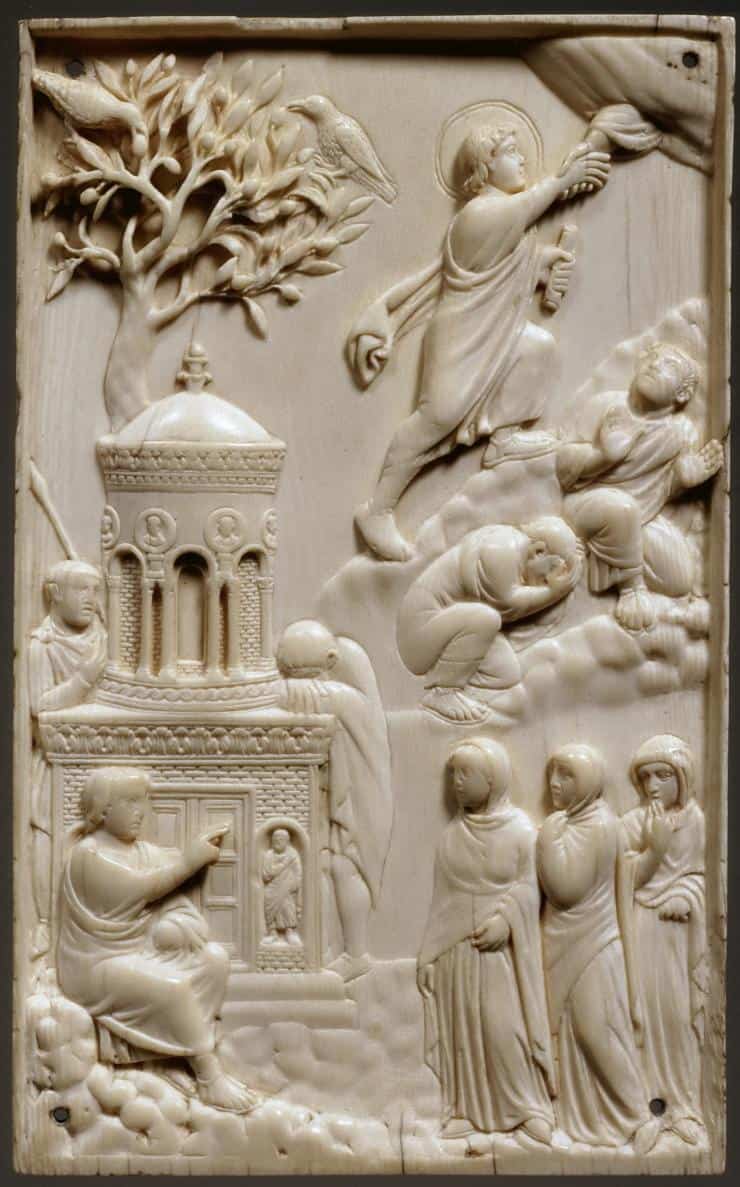 The Ascension of the Lord. Fifth century. Roman Empire
The oldest surviving image associated with the Ascension is a carved ivory plaque from the early fifth century, now preserved in Munich. Its composition is closer to a Resurrection scene than to the form the Ascension icon would later assume. The myrrh-bearing women stand at Christ’s tomb; an angel appears beside the sepulchre; soldiers surround the burial place. Above them all, Christ rises upward toward the Father. Yet He does not appear to ascend by His own movement alone: a hand emerging from Heaven reaches down toward Him and draws Him upward.
This unusual imagery arose from several features of early Christian thought and art.
In some early Christian preaching and visual tradition, particular emphasis was placed on the Father glorifying the risen Christ. Artists sometimes expressed this symbolically through the image of the “Hand of God” descending from Heaven. Such imagery belongs to a period when the Church was still developing the theological language that would later receive precise expression in the great Trinitarian councils. The Church would eventually articulate with greater clarity the full equality and consubstantial unity of the Father, Son, and Holy Spirit within the one divine nature.
At the same time, some early Western Christian imagery did not always sharply distinguish between Christ’s Resurrection, Ascension, and heavenly glorification. These events were often contemplated together as different aspects of His triumph over death and His return to divine glory. This helps explain why certain early depictions combine Paschal and Ascension motifs within a single composition.
The Development of Ascension Iconography
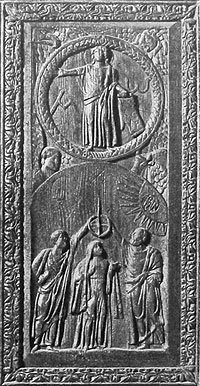 The Ascension of the Lord. Fifth century. Detail from the carved doors of the Basilica of Santa Sabina, Rome
Over time, depictions of the Ascension gradually assumed forms much closer to the icons known in the Orthodox tradition today.
A notable example may be found on the fifth-century wooden doors of the Basilica of Santa Sabina in Rome. Here the composition is already recognisably similar to later Christian iconography. The image is divided into two realms: earth below and Heaven above.
In the lower portion stands the Mother of God, flanked by the Apostles Peter and Paul, who hold a royal crown above Her. In the heavenly realm above appears Christ Himself, surrounded by four winged creatures symbolising the four Evangelists. Beside Him are the Greek letters Alpha and Omega — a reference to the words spoken by Christ in the Apocalypse:
“I am the Alpha and the Omega, the Beginning and the End, the First and the Last” (Revelation 22:13).
Interestingly, Christ is depicted without a beard. This detail may reflect another biblical image frequently associated with Him in early Christian thought: the beloved Servant of the Father spoken of by the prophet Isaiah and quoted in the Gospel:
“Behold! My Servant whom I have chosen, My Beloved in whom My soul is well pleased” (Matthew 12:18).
The creators of these church doors were not simply illustrating a historical event. Rather, they sought to express the theological meaning hidden within the feast itself.
This becomes especially clear in the figure of the Mother of God.
The New Testament does not explicitly mention Her presence at the Ascension. Yet Church Tradition consistently affirms that She was among those gathered on the Mount of Olives. In iconography, however, Her presence carries a meaning deeper than historical reconstruction alone. The Mother of God stands at the heart of the Church. She represents redeemed humanity — humanity already fully turned toward God and united to Him in faithfulness and love. For this reason, She occupies a central place in almost every icon of the Ascension.
The Apostles Peter and Paul likewise carry symbolic significance. Together they express the fullness of the Church’s life. Peter is often associated with steadfast fidelity to the apostolic tradition and commandments, while Paul speaks powerfully of the freedom and new life revealed in Christ. Yet these are not opposing principles. In the Church, truth and freedom, obedience and grace, belong together within the one life of communion with God.
And above them all stands Christ Himself.
He appears here not merely as the Teacher ascending before His disciples, but as the glorified Lord and King of creation: the Son of God, Judge of the world, Creator and Ruler of all things. The four winged creatures surrounding Him are ancient biblical symbols of divine majesty and heavenly kingship. The Ascension icon thus points beyond the historical moment itself toward Christ’s eternal reign and His future coming in glory.
The Canonical Icon of the Ascension
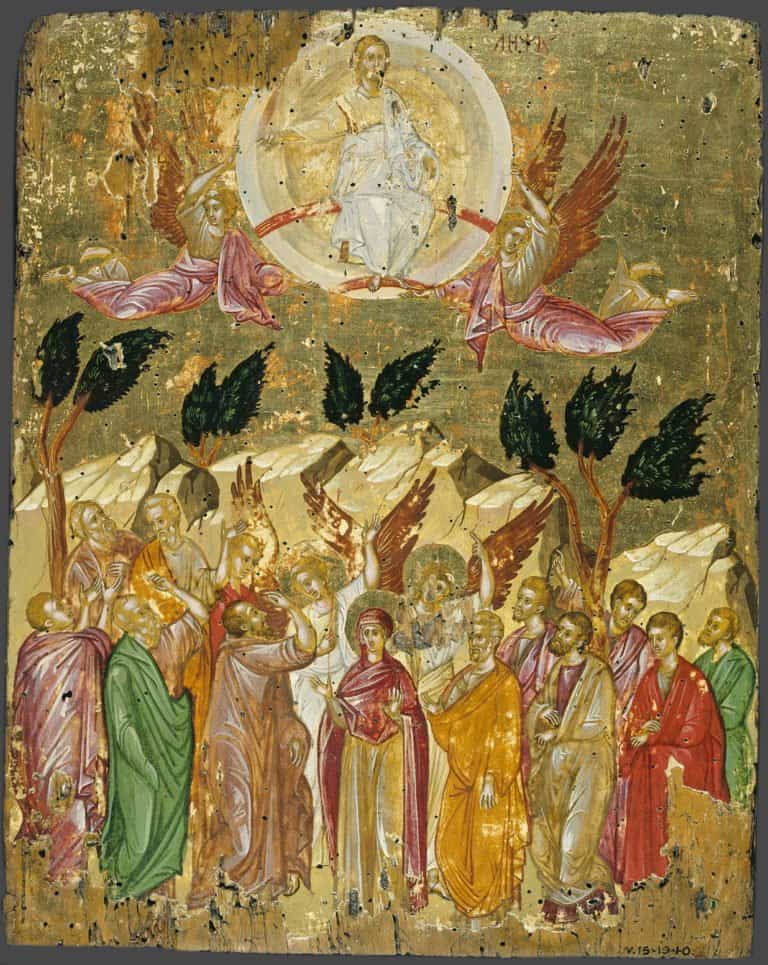 The Ascension of the Lord. Greece, Crete. Fifteenth century. http://ruicon.ru
By approximately the ninth century, after the triumph over Iconoclasm, the principal features of Ascension iconography had become firmly established in the Christian East and, in part, in the West as well.
In the traditional icon, the golden background symbolises divine light and heavenly glory. The composition is divided into two realms separated by the Mount of Olives. In the upper portion, Christ appears enthroned within a radiant mandorla — the luminous sphere that signifies divine glory and the mystery of Heaven. Angels accompany Him as He ascends.
Below stand the apostles, the Mother of God, and angels addressing the disciples. Apart from the presence of the Virgin Mary, this lower portion follows the Gospel narrative closely and remains comparatively historical in character.
Western religious painting would later move increasingly toward naturalistic depictions of the scene, often focusing primarily on the visible event itself: Christ rising heavenward amid clouds and light. Orthodox iconography, however, continued to preserve a more symbolic and theological language.
Ancient icons frequently reveal dimensions of meaning that are less apparent in later, more purely illustrative works. They invite the viewer not merely to observe the Ascension as an event of the past, but to contemplate what it means for humanity itself.
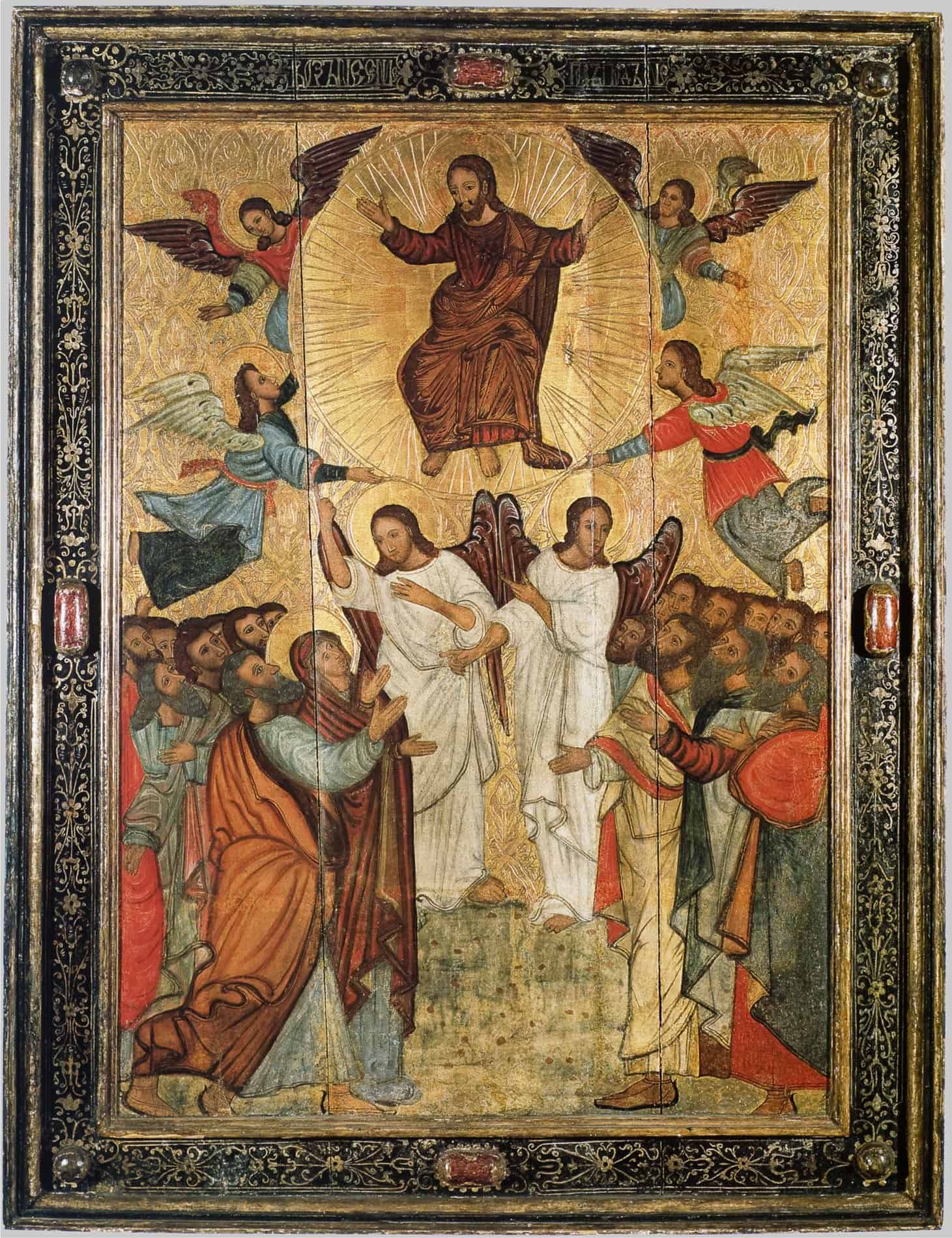 The Ascension of the Lord. Belarus. Seventeenth century. http://ruicon.ru
For the central message of the feast is this: through His Ascension, Christ opened Heaven once more to human nature. In Him, humanity is no longer confined to earth and death, but is called to partake of divine glory and eternal life.
The icon of the Ascension therefore speaks not only about Christ’s departure from the world, but also about mankind’s destiny in Him.
Translated by the Catalogue of Good Deeds
Source: https://foma.ru/ikonografiya-vozneseniya-gospodnya.html


Thank you for the explanation.
How I would love to see the icons you show in real life, so interesting to see them.