
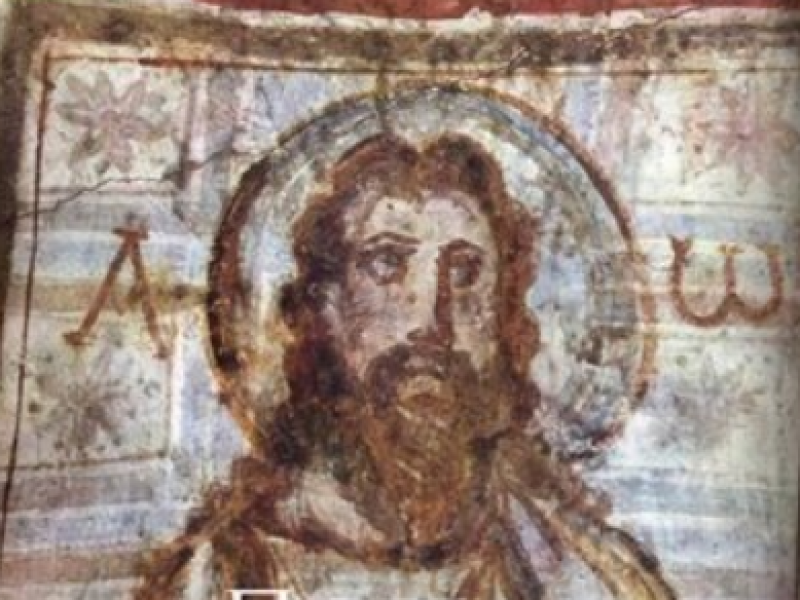
In the earliest surviving Christian images, Christ often looks nothing like the Saviour we immediately recognise in an Orthodox icon. He may appear as a beardless young man, a shepherd carrying a lamb, or a teacher with a scroll in His hand. Some images even draw upon visual types associated with the ancient figures of Orpheus or Helios.
How did Christians come to portray Christ in such different ways? And when did the familiar image emerge—the long hair and beard, the cruciform halo, the hand raised in blessing?
To understand this, we need to begin with a more fundamental question.
1. If Christ Is God, Why Can He Be Depicted?
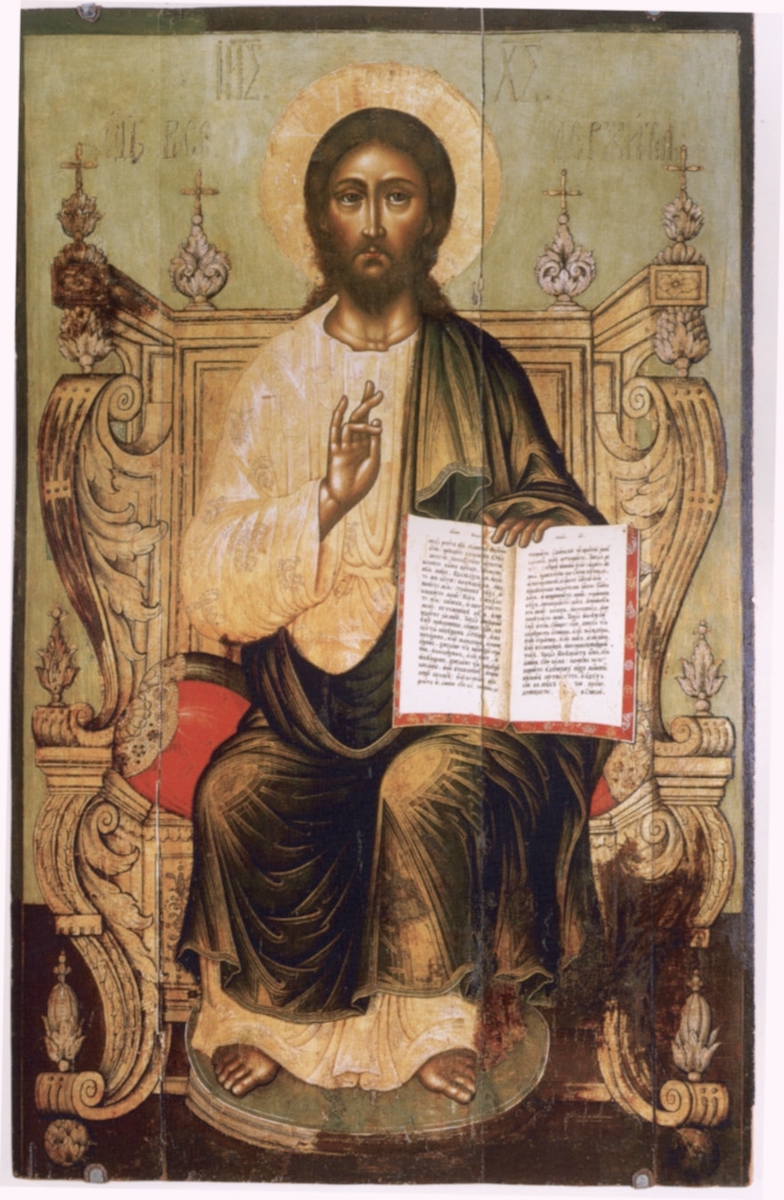 Christ Enthroned. 18th century. Kirill Ulanov. Pereslavl-Zalessky State Historical, Architectural and Art Museum-Reserve.
Whether Christ could be represented at all was a question that accompanied Christian art from its earliest centuries. God is invisible and beyond comprehension, and the Old Testament strictly forbade Israel to fashion images of the invisible God.
Christianity, however, begins from a decisive new reality: the Incarnation.
The Son of God became truly human. He lived among men, could be seen and touched, and entered human history with a real human body and face. As St John writes, “the Word became flesh and dwelt among us” (John 1:14), while St Paul calls Christ “the image of the invisible God” (Colossians 1:15).
These passages are not themselves instructions about sacred art. Yet they provide the Christological foundation upon which the Church’s defence of icons would later rest. If the Son of God truly became man, then His humanity was not an appearance or an abstraction. He could be seen.
This became especially important during the Iconoclastic controversy of the eighth and ninth centuries. The Fathers of the Seventh Ecumenical Council, held at Nicaea in 787, affirmed the veneration of sacred images within precisely this incarnational understanding: Christ may be depicted because the Word truly took flesh.
An icon does not attempt to portray the invisible divine nature. It bears witness to the mystery that the invisible God truly became visible in Christ.
2. What Did Christ Actually Look Like?
Here the Gospels are remarkably silent.
They tell us almost nothing about Jesus’ physical appearance: not His height, the colour of His hair or eyes, or the individual features of His face. The Evangelists were concerned above all with Who He was, what He taught and did, His death upon the Cross and His Resurrection.
This silence left room for very different interpretations among early Christian writers.
Some turned to Isaiah’s prophecy of the suffering Servant—“He had no form or majesty” (Isaiah 53:2)—and imagined Christ as outwardly unremarkable, perhaps even unattractive. They connected this with the mystery of the Son of God Who “emptied Himself, taking the form of a servant” (Philippians 2:7).
Others looked instead to the Psalmist’s words, “You are fairer than the sons of men” (Psalm 45:2; 44:3 LXX), and spoke of the beauty and perfection of Christ’s human appearance.
Scripture itself settles neither question. The Gospel gives us no physical portrait of the Saviour.
And this helps explain something that may initially surprise us about the earliest Christian art.
3. The Image Not Made by Hands
A special place in Christian tradition belongs to the Image Not Made by Hands, or Mandylion of Edessa, associated with King Abgar.
In the later form of the tradition, Christ miraculously left the imprint of His face upon a cloth. During the Iconoclastic period, the story acquired particular importance because it presented the image of Christ not as an arbitrary human invention, but as something originating with the Saviour Himself.
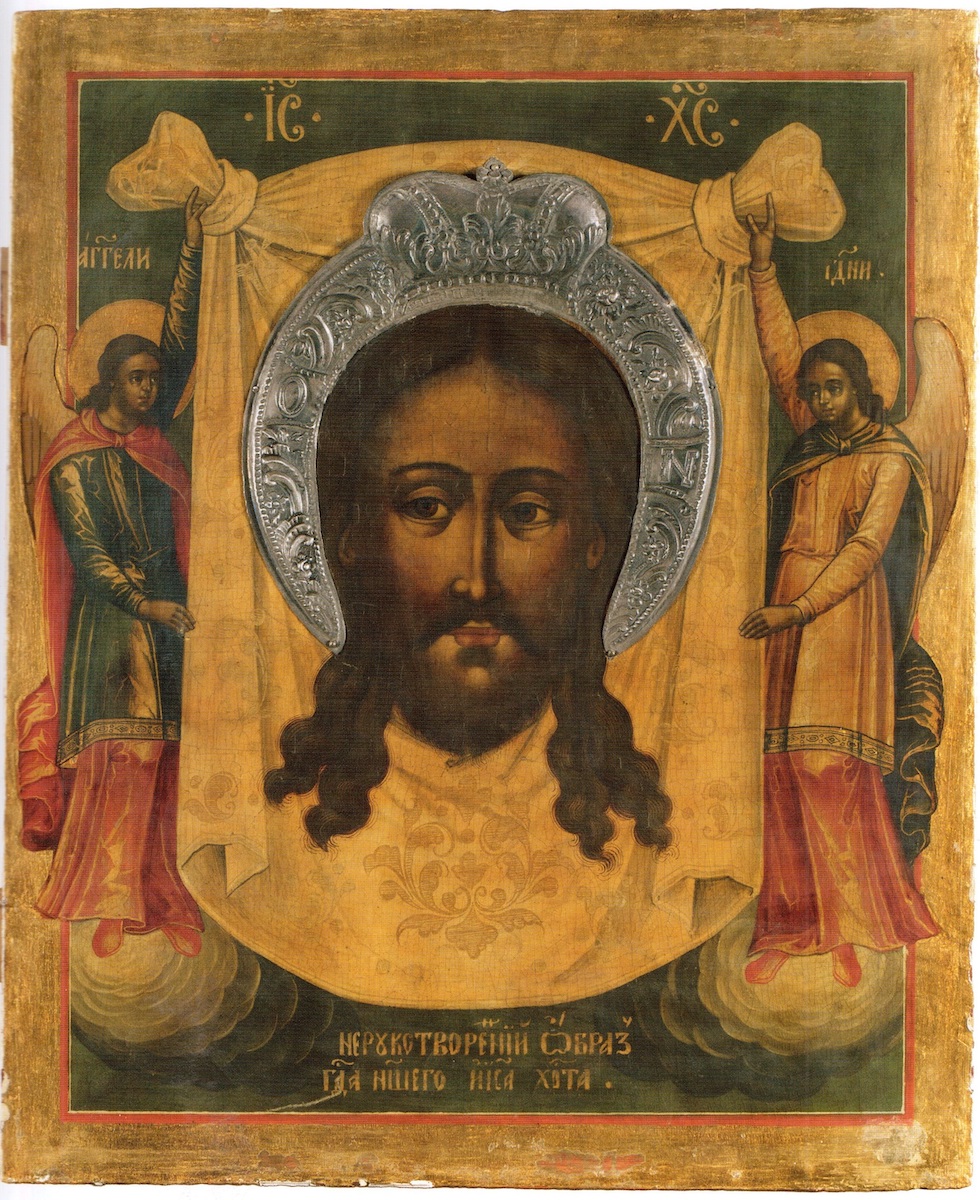
The Image of the Saviour Not Made by Hands. Russia, 18th century.
Some modern researchers have proposed that the Mandylion may have been the object now known as the Turin Shroud. According to this hypothesis, the Shroud might once have been folded so that only the face was visible and venerated as the famous Edessan image.
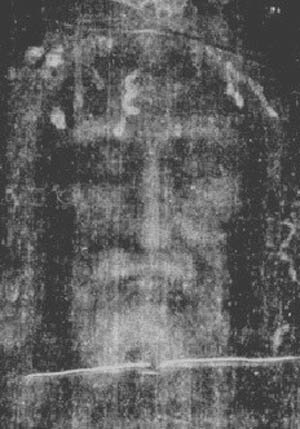
The Image of Christ on the Turin Shroud.
The identification is intriguing, but it remains a hypothesis rather than an established scholarly conclusion.
Those who support it point to similarities between the face on the Shroud and the image of Christ that later became widespread in Byzantine art: long hair parted in the centre, a beard, a high forehead, large eyes and an elongated nose. If the Shroud and the Mandylion were indeed the same relic, such parallels might help explain the persistence of these features in later Christian iconography.
Yet the earliest surviving Christian representations of Christ often look very different.
4. Why Did Early Christians Not Try to Paint a “Portrait” of Christ?
The artists of the first Christian centuries were generally not trying to reconstruct the earthly features of Jesus.
Their images were concerned less with portrait likeness than with revealing the identity and saving work of the One depicted. Christ therefore appears as Shepherd, Teacher, Wonderworker and Lord.
There was another reason as well.
Early Christian art did not arise in isolation. Christians lived within the visual world of late Antiquity, surrounded by Roman funerary art, portraits, philosophical imagery, mythological figures and imperial symbolism. Christian artists naturally employed forms that people already understood, while giving them a new meaning in the light of the Gospel.
This is why some of the earliest representations of Christ can seem so unfamiliar to us today. Their visual vocabulary belongs to the ancient Mediterranean world; their message has become Christian.
5. The Youth, the Shepherd and the Teacher
One of the most widespread early images of Christ was the Good Shepherd: a young, beardless man carrying a lamb upon His shoulders.
For Christians, the meaning was clear. Christ Himself had said: “I am the good shepherd” (John 10:11).
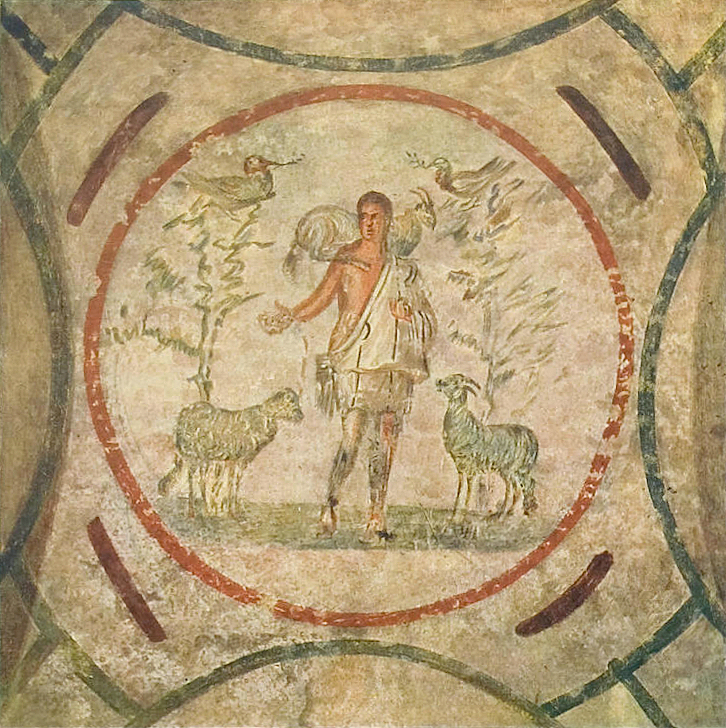
The Good Shepherd. Catacomb of Priscilla, 3rd century.
The figure of a shepherd carrying an animal was already familiar in Greco-Roman art. Christians took this recognisable image and filled it with the words of the Gospel: Christ is the Shepherd Who seeks, protects and saves His flock.
A celebrated example survives in the Catacomb of Priscilla in Rome, dating from the third century. Christ appears as a youthful shepherd with an animal across His shoulders, surrounded by the peaceful imagery of a paradisal landscape.
Another common type showed Christ as a teacher or philosopher. He wears the cloak associated in Antiquity with philosophers and learned men, holds a scroll, or raises His hand in the gesture of an orator. Here too, a familiar visual language receives a new meaning: the figure before us is no ordinary teacher, but the One Who speaks the words of eternal life.
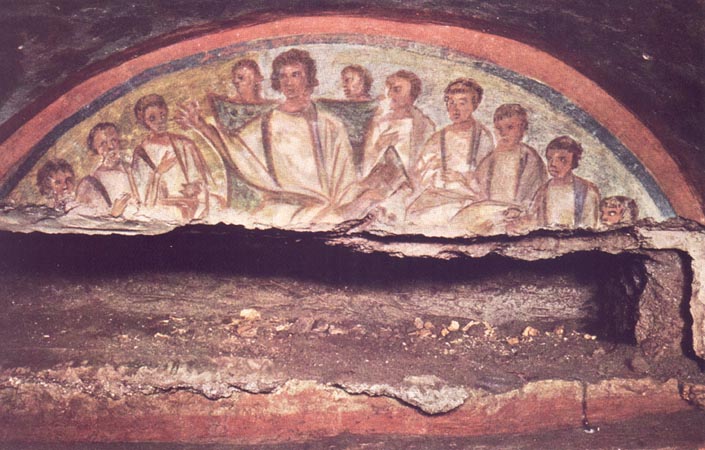
Christ the Teacher. Catacombs of Domitilla, 4th century.
Other examples are more surprising.
Some early Christian paintings have been interpreted as adapting imagery associated with Orpheus, the legendary musician whose music tamed wild animals. An Orpheus-like figure appears, for example, in the Catacombs of Saints Peter and Marcellinus in Rome. For a Christian viewer, such imagery could take on an entirely new resonance: Christ as the divine Logos Who brings harmony to creation and draws human souls to Himself.
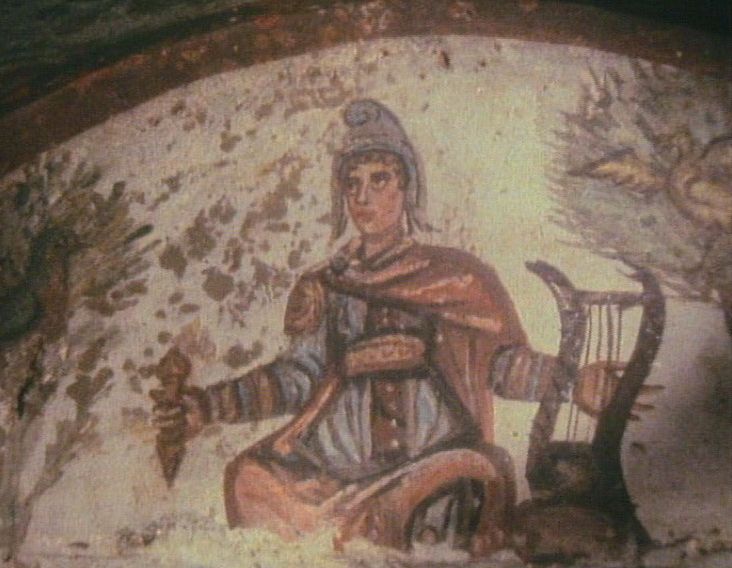
Christ Depicted as Orpheus. Catacombs of Saints Peter and Marcellinus, 4th century.
Another famous mosaic, discovered in the necropolis beneath St Peter’s Basilica, depicts a radiant figure driving a chariot across the heavens. It has often been interpreted as Christ represented through solar imagery familiar from portrayals of Helios.
This does not mean that early Christians identified Christ with pagan gods or mythological heroes. Rather, they could take a visual form already familiar to their contemporaries and use it to proclaim something entirely new.
The Gospel was being expressed in a language the ancient world could understand.
Throughout many of these images, Christ remains strikingly young: beardless, idealised, almost untouched by age. His youthful face does not seek portrait likeness. It points instead towards a beauty and life that do not grow old.
6. How Did the Familiar Image of Christ Emerge?
After the age of persecution, Christian art developed on an entirely new scale. Churches were built openly, and their interiors filled with monumental mosaics and sacred images.
Alongside the youthful, beardless Christ, another type became increasingly prominent: a mature man with long hair, a beard and a grave, commanding gaze.
For some time the two forms existed side by side. Gradually, however, the mature, bearded image became dominant in Byzantine Christian art and developed into the iconographic type familiar to us today.
One of the great landmarks in this development is the late fourth-century apse mosaic of Santa Pudenziana in Rome. Christ no longer appears simply as a youthful teacher. He sits enthroned among His Apostles as the heavenly King, with the heavenly Jerusalem behind Him. The visual language of authority once associated with the imperial world is now directed towards Christ, the true Lord of heaven and earth.
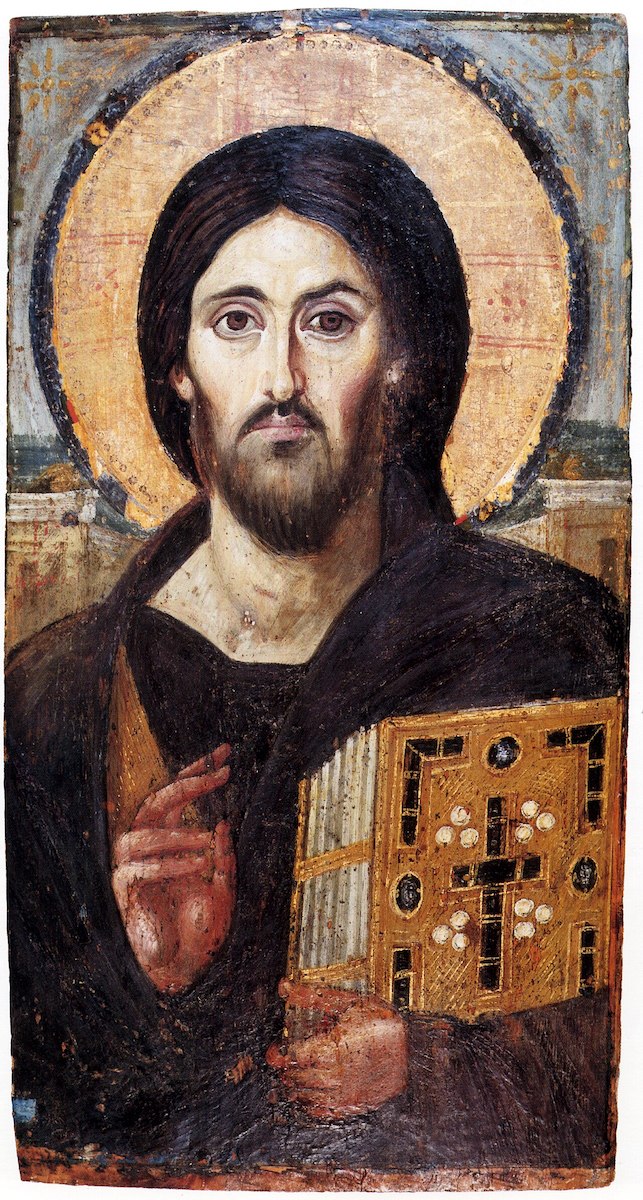 Christ Pantocrator. 6th century. St Catherine’s Monastery, Sinai.
An even more familiar face meets us in the famous sixth-century icon of Christ Pantocrator at St Catherine’s Monastery on Mount Sinai.
Here much of what would become characteristic of Orthodox representations of the Saviour is already present. Christ is shown frontally, with long dark hair and a beard. His right hand is raised in blessing; His left holds the Gospel. His gaze is direct and solemn, confronting the viewer not merely with a figure from the past, but with the living Lord.
Those who connect the Mandylion with the Turin Shroud have drawn attention to similarities between the Sinai Pantocrator and the face visible on the Shroud—the parted hair, shape of the beard, high forehead, large eyes and long nose. Whatever conclusion one reaches about that hypothesis, the Sinai icon stands as one of the clearest early examples of the image of Christ that would shape Byzantine and, later, Orthodox iconography for centuries.
Other familiar features also became established over time. Christ is distinguished by a cruciform halo, setting His image apart from those of the saints. He blesses with His right hand and often holds the Gospel or a scroll in His left.
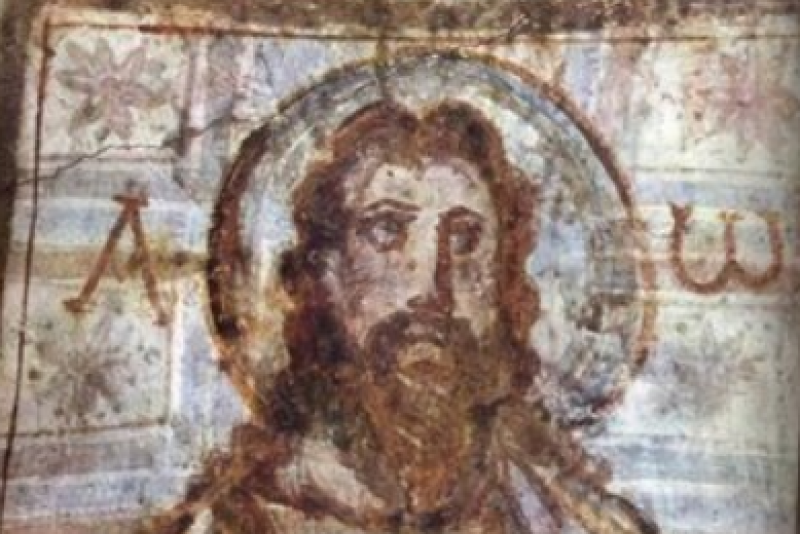
The halo may bear the Greek letters Ὁ ὬΝ — “He Who Is”, recalling the divine Name revealed to Moses: “I AM WHO I AM” (Exodus 3:14). Elsewhere Christian imagery invokes Alpha and Omega, the beginning and the end (Revelation 1:8).
These details do more than identify the figure before us. They confess Who He is.
Following the triumph of Orthodoxy over Iconoclasm in the ninth century, this iconographic language became increasingly established in the tradition of the Church. The face that had emerged over centuries of Christian art became recognisable throughout the Orthodox world.
Yet behind that familiar image lies a remarkable history.
The earliest surviving Christian images suggest that believers were concerned not simply with reconstructing the physical features of Jesus, but with proclaiming the mystery of His person.
He is the Shepherd Who lays down His life for the sheep.
The Teacher Who speaks with divine authority.
The Word through Whom creation receives life and harmony.
The King enthroned in glory.
The invisible God Who, for our salvation, became truly visible.
And it is ultimately the mystery of the Incarnation—not curiosity about Christ’s appearance—that gives Christian iconography both its possibility and its meaning.
Translated by the Catalogue of Good Deeds
Source: https://foma.ru/kak-uznat-hrista-na-drevnejshih-ikonah.html