

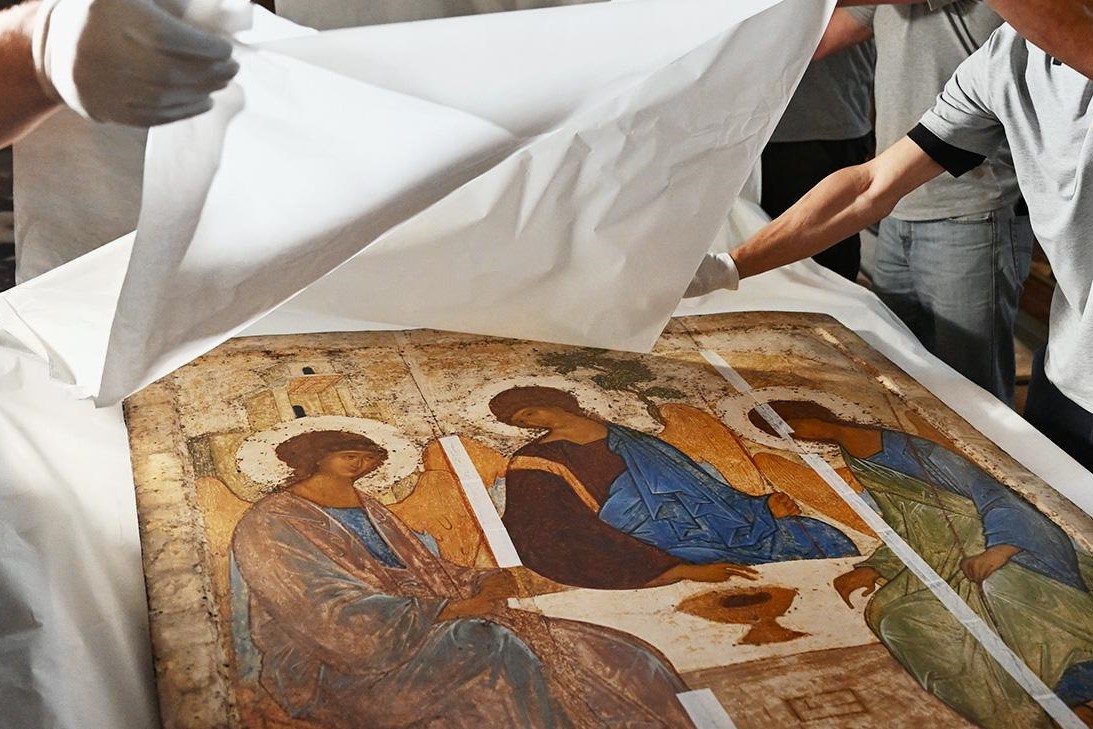
Among all depictions of God in the history of iconography, few are as revered and mysterious as the Icon of the Holy Trinity by St Andrei Rublev. Within the Russian — and, indeed, pan-Orthodox — tradition, this image has attained not only profound spiritual significance but also a dogmatic and liturgical status.
The mystery of the One God in Three Persons has always stood at the very heart of Christian theology. At the same time, it remains one of its most difficult truths to express. In the 14th century, St Sergius of Radonezh made a decisive contribution to the spiritual understanding of the Trinity, not merely as a theological concept but as a living mystery to be contemplated in prayer and reflected in the life of the Church. It was this vision that St Andrei Rublev — himself a monk of the Trinity-St Sergius Monastery — would later translate into colour and form, offering the world an icon that expresses what words often fail to capture.
In this article, we invite you to explore the many-layered meanings embedded in Rublev’s icon — to see not only an image, but a vision of divine love and unity.
From Narrative to Contemplation: A Canon in Colour
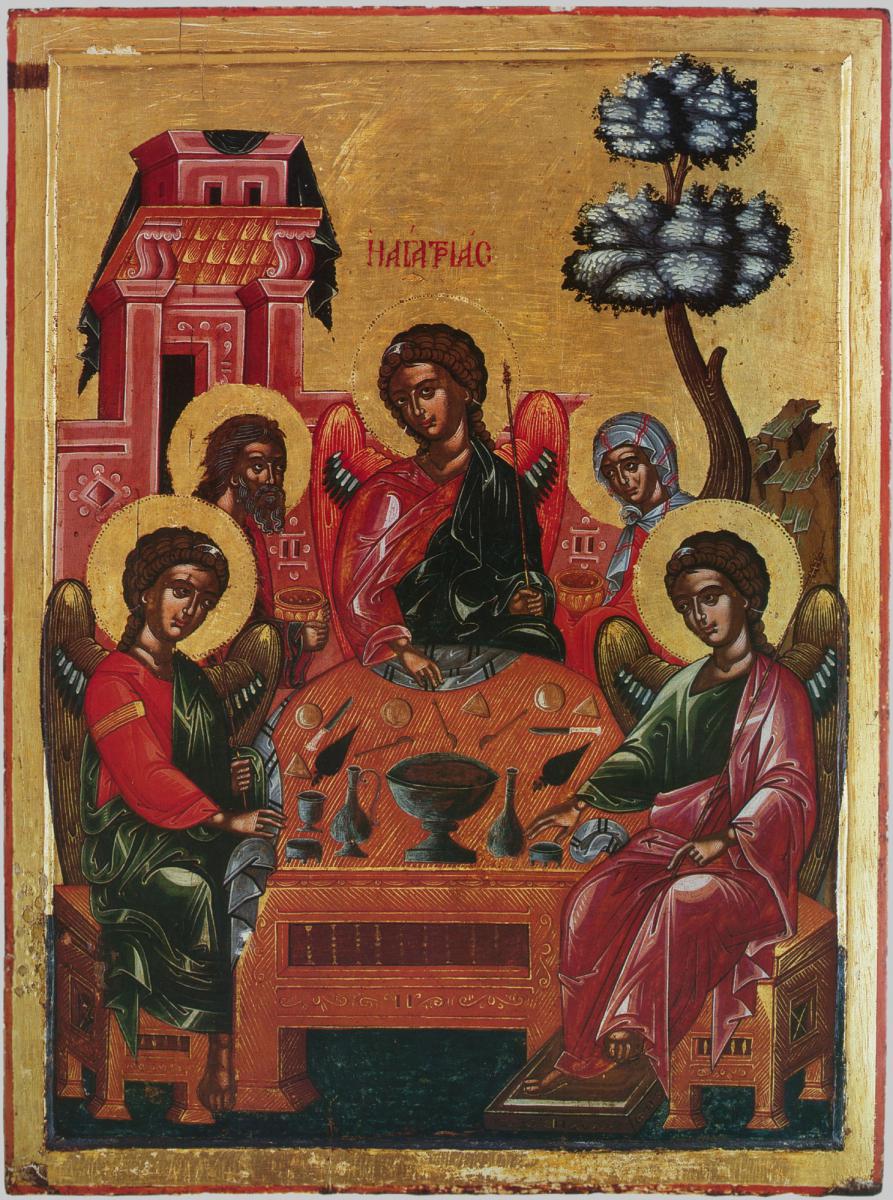
Christian artists had long attempted to portray the mystery of the Trinity, most often through visual representations of the story from Genesis 18 — the “Hospitality of Abraham” — where three strangers appear to the Patriarch and are received as honoured guests. Over time, this Old Testament scene was interpreted as a prefiguration of the Trinity. Earlier icons often included Abraham and Sarah along with the three angelic visitors, placing emphasis on the biblical narrative.
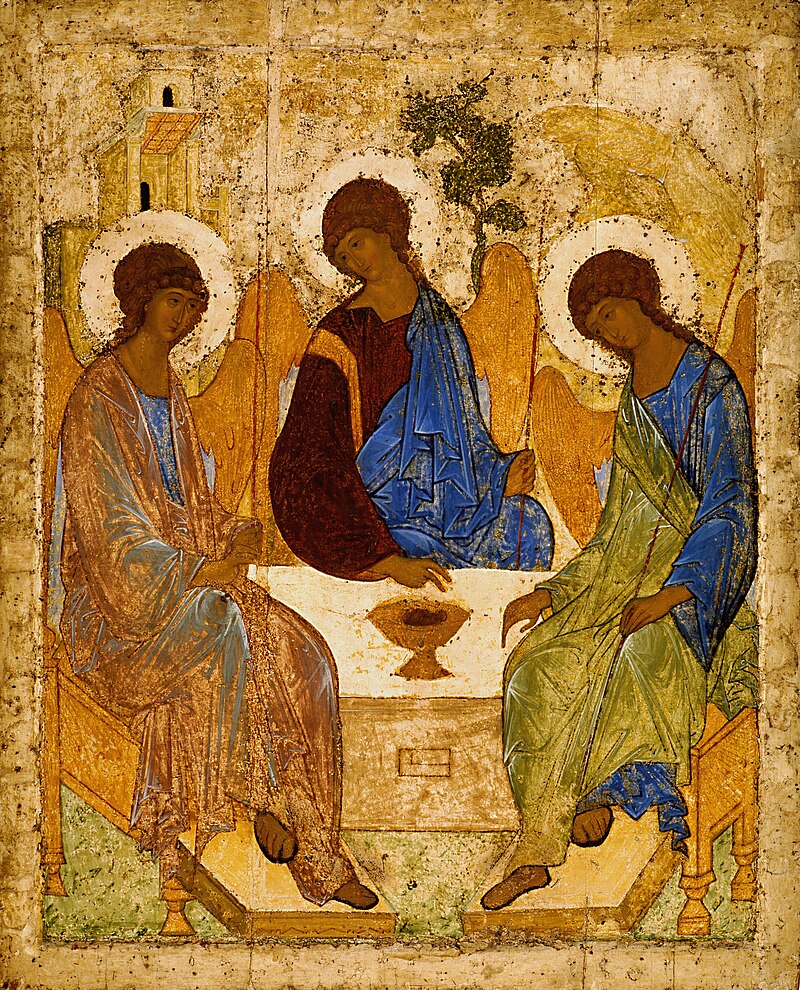
What makes Rublev’s composition so remarkable is its departure from this precedent. He omits all secondary figures and narrative context, focusing solely on the three angels seated in divine harmony. With this bold and prayerful move, he draws the viewer away from historical retelling and toward the eternal mystery itself: the mystery of the Triune God.
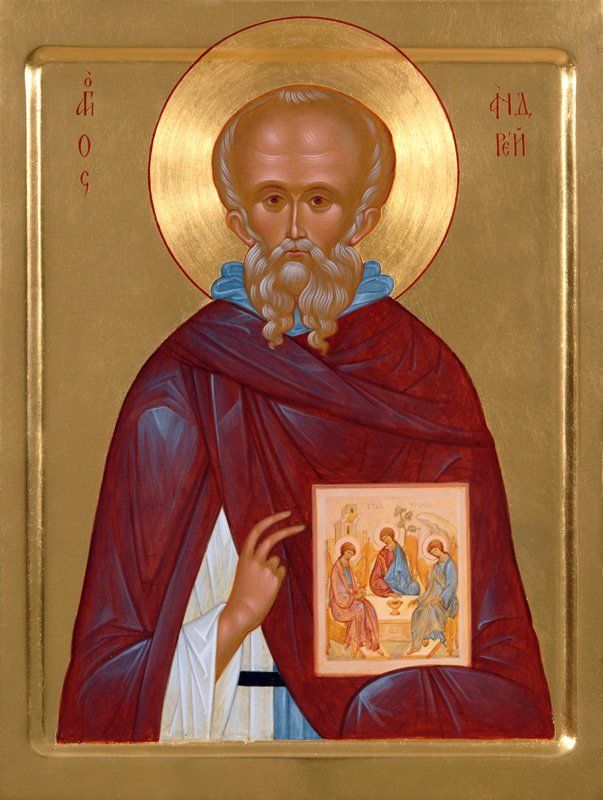
In its essence, iconography is a sacred work of spiritual communion — a soborny (conciliar) effort of both individual saints and the believing Church as a whole. The creation of the Trinity icon was no exception. Its theological foundations were laid by St Sergius, who, through personal experience and ascetic vision, contemplated the life of the Holy Trinity as the archetype of divine unity and the calling of human community. In his teaching, the Trinity becomes both the eternal ideal and the model for earthly life: perfect unity without fusion or division, perfect love without domination. In the Trinity, schism is condemned and conciliarity is blessed; coercion is cast out, and spiritual freedom is revealed.
After the repose of St Sergius, this vision was made visible in paint. At the request of Abbot Nikon of Radonezh, St Andrei Rublev painted the icon in honour of his great predecessor — an image that was immediately recognised as miraculous by many of its beholders.
A century later, in 1551, the Stoglav Council — a great ecclesiastical assembly of the Russian Church — affirmed Rublev’s icon as the highest expression of the Orthodox Church’s teaching on the Triune God. It was canonised as the model for all subsequent depictions of the Holy Trinity in Orthodox iconography.
A Mystery in Many Dimensions: Layers of Meaning in the Icon
Rublev’s Trinity is unique in its richness. Far from offering a single, fixed interpretation, the icon opens itself to multiple, overlapping readings — each of them steeped in Scripture and the tradition of the Church.
• A Revelation of Christ: The central angel often follows the iconographic language traditionally used for Christ, i. e., clothed in the colours traditionally associated with the Saviour.
• One God in Three Persons: The three angels are painted with nearly identical faces — a visual affirmation of the shared essence and unity of the Godhead.
• The Pre-Eternal Counsel: The composition can also be read as a representation of the mysterious conversation within the Trinity concerning the salvation of humanity — the Father, with the Son’s willing assent, sends Him into the world for the redemption of mankind.
• A Vision of Sacrifice: At the centre of the icon stands a chalice containing the head of a sacrificial calf — a direct reference to the Eucharist and the redemptive death of Christ. Furthermore, the bowed forms of the two flanking angels frame the central figure in a manner reminiscent of a liturgical chalice, visually reinforcing the theme of the Divine Liturgy.
In all these interpretations, the icon reveals its profound liturgical and Christological depth. It is not merely a depiction, but a theological statement in colour and line — a confession of faith expressed through beauty, silence, and stillness.
A Dialogue of Gestures and an Invitation to Participate
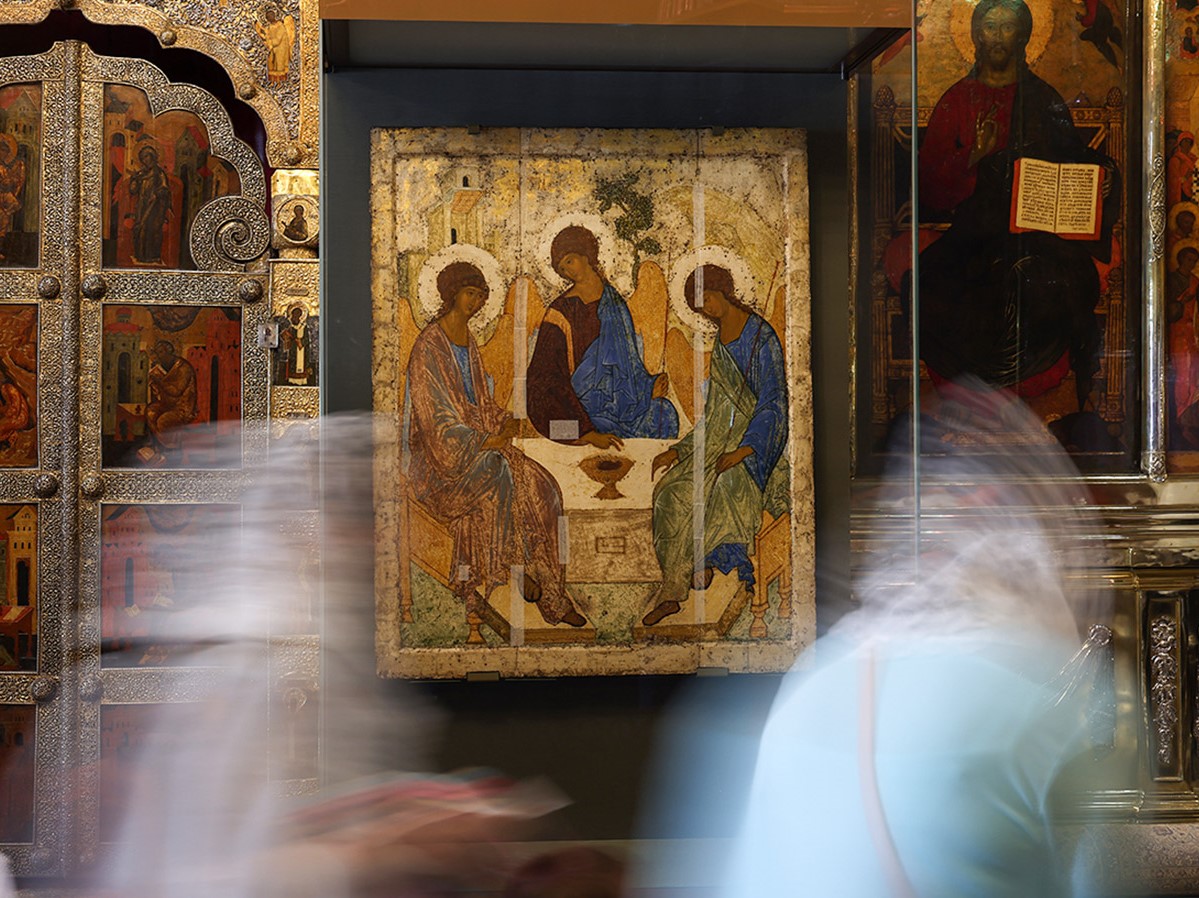
There is no definitive consensus within the Church as to which Angel symbolizes which Person of the Holy Trinity. However, one of the most respected Orthodox theologians and iconologists, Leonid Ouspensky, proposed that the three figures are to be read from left to right, following the order of the Nicene Creed: Father, Son, and Holy Spirit. The gentle turn of their bodies, their garments, and the gestures of their hands support this reading.
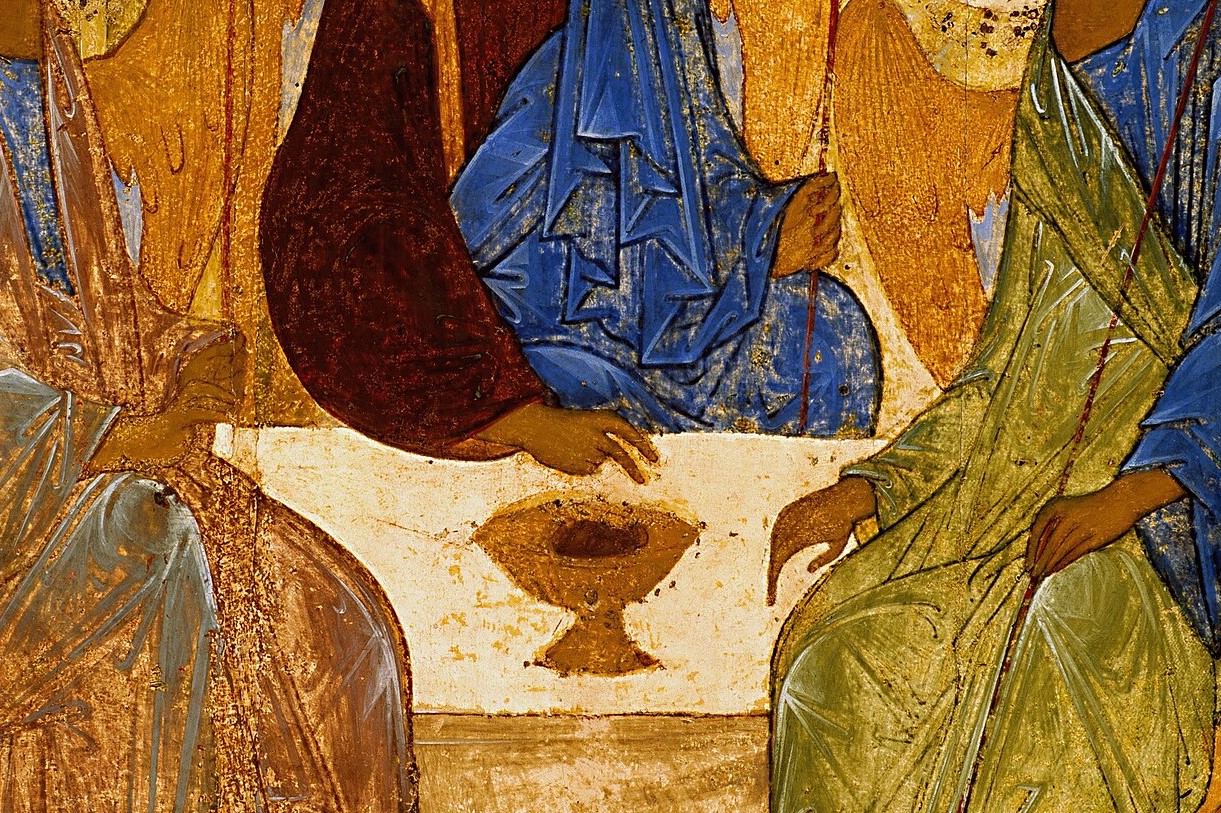
At the centre of the composition stands a chalice — the Eucharistic vessel — resting on what is both table and altar. Around it unfolds a silent dialogue. The figure on the left, understood as the Father, raises His hand in a blessing. He is distant from the chalice, as though bestowing His blessing upon the one who is to offer Himself. The central figure — Christ — inclines His head in quiet assent, His hand extended above the cup. The third angel’s gesture draws the viewer’s gaze downward and forward — a movement interpreted by many as the descent of the Holy Spirit, who comes to sanctify the Church through this redemptive offering.
Behind each angel, elements of the background offer further theological clues:
• Behind the central angel, we see a tree — not only the oak of Mamre from the Genesis account, but also a symbol of the Tree of Life, a foreshadowing of the Cross and the Resurrection.
• Behind the left angel, there is a house, traditionally interpreted as Abraham’s dwelling, but here representing the divine household — the oikonomia, or providential ordering of salvation — and thus symbolising God the Father.
• Behind the right angel, a mountain rises — an ancient biblical image of divine ascent and spiritual elevation, fitting for the Holy Spirit who lifts the soul heavenward.
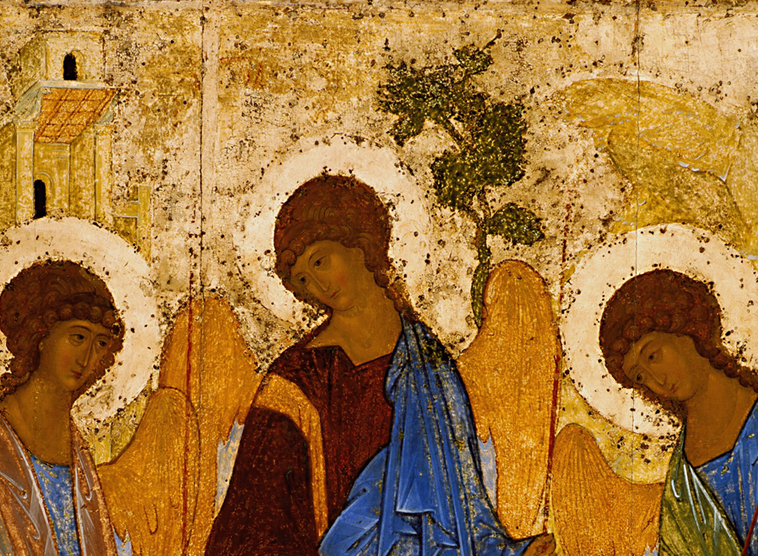
And yet, even with these narrative and theological elements, the icon does not seek to explain or define. This is precisely what the Stoglav Council sought to preserve when it formally forbade the inscription of names over the angels and prohibited the use of the “cruciform halo” (reserved for Christ) in this icon. The intention was clear: Rublev’s icon does not portray the individual Persons of the Trinity in a literal sense. Instead, it presents to us the Mystery of the Triune God — eternal communion, perfect unity, and divine love.
The Silent Question on the Altar
One small but striking detail in Rublev’s icon often elicits particular attention: the rectangular opening on the front of the altar table. At first glance, it may seem insignificant, yet its placement is deliberate — and deeply meaningful.
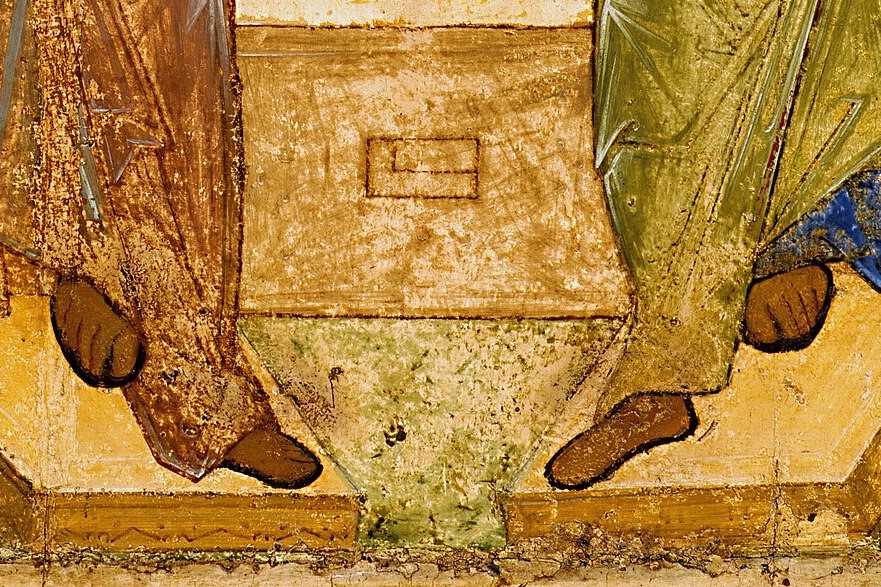
In Orthodox tradition, relics of the saints are placed within every consecrated altar. Yet here, the opening is empty. The chalice at the centre — symbolising the sacrifice of Christ — is present. But there is no visible response to that offering from the human side. One interpretation suggests that this empty space conveys a divine question: Where is your response to this love? Where are the lives of the saints — the martyrs, the confessors, the holy ones — who offer themselves in return?
The composition itself subtly includes us in this question. The lines of the altar and footstool are drawn using reverse perspective, a technique in iconography where the vanishing point does not recede into the image but instead converges toward the viewer. In doing so, the icon does not merely represent a divine reality — it draws us into it.
Moreover, the three angels are seated on three sides of a square table. The fourth side — the one nearest to us — remains empty. It is the place once occupied by Abraham, who received the heavenly guests. But now, that place is open… for each one of us. The icon, in its silence, extends a gentle yet powerful invitation: Come, take your place at the table. Enter into the life of the Trinity.
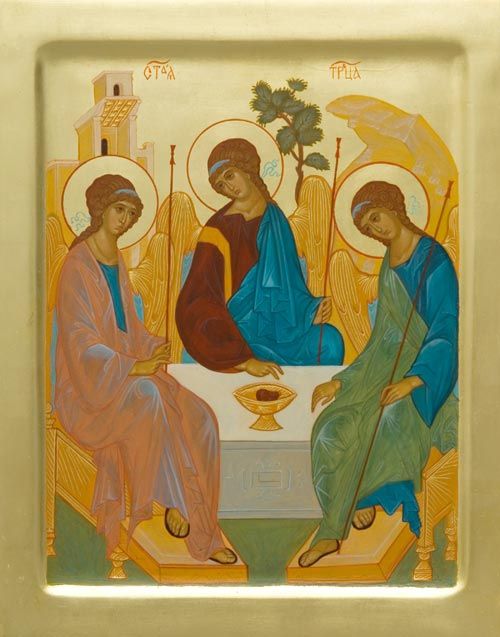
Not Only Theology — A Masterpiece of Sacred Art
Rublev’s Trinity is often described as a theological treatise in colour. Yet it is also a work of extraordinary artistic beauty, widely acknowledged as one of the greatest masterpieces of world art.
For centuries, the icon was darkened by layers of old varnish. But when it was carefully restored in the twentieth century, the colours that emerged astonished even the experts: a radiant palette of luminous blue, shimmering gold, deep crimson and rose, and garments touched with vivid green — tones that seem to carry within them the light of paradise itself.
The visual harmony of the composition — its gentle curves, balanced proportions, and contemplative stillness — reflects not only aesthetic genius but spiritual insight. Rublev achieved something exceedingly rare: an image that reveals, in a visible form, the beauty of divine love and eternal unity.
A Contemporary Iconographer’s Offering
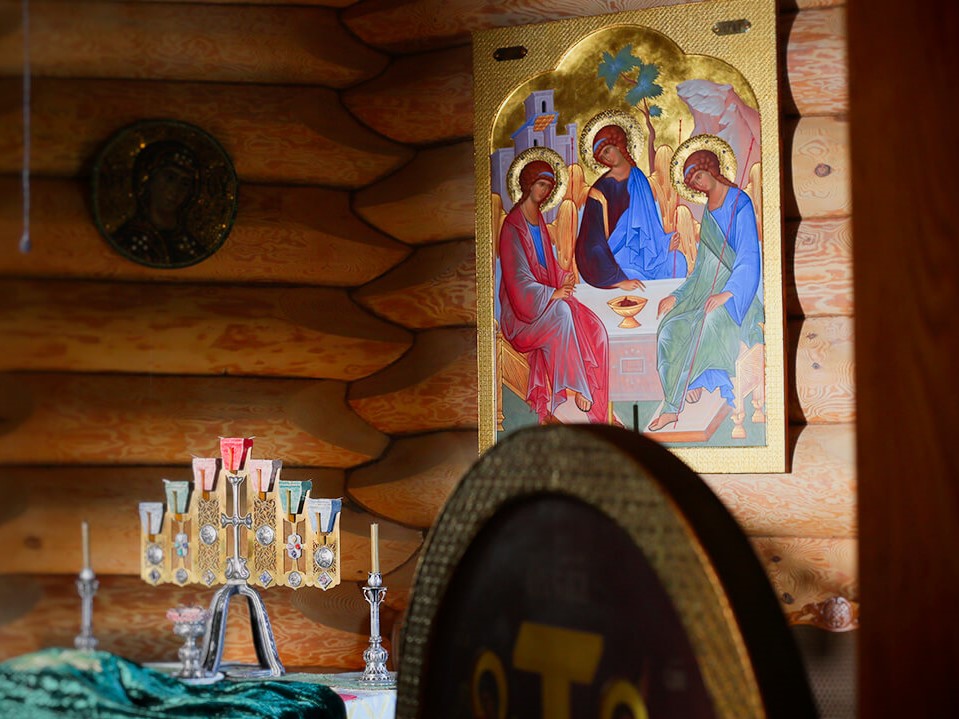
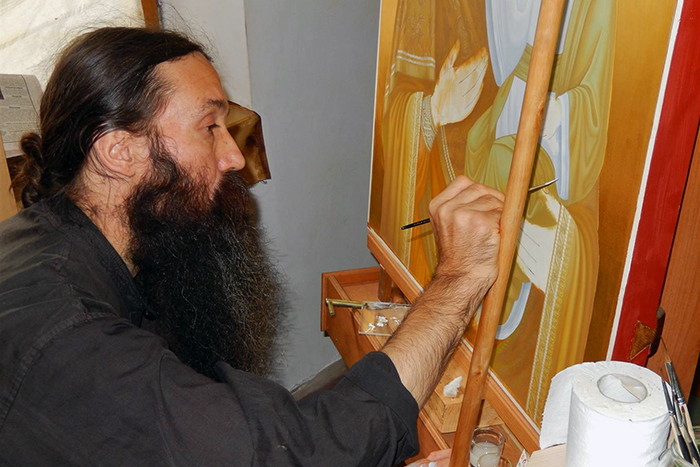
The tradition of sacred iconography continues in our own day, with each iconographer standing humbly in the footsteps of the great masters before them. Not long ago, Sister Maria (Egereva), an iconographer of our monastery, was given the obedience to paint a copy of Rublev’s Trinity for the altar of the Church of St Sergius of Radonezh, located at the women’s metochion of our convent.
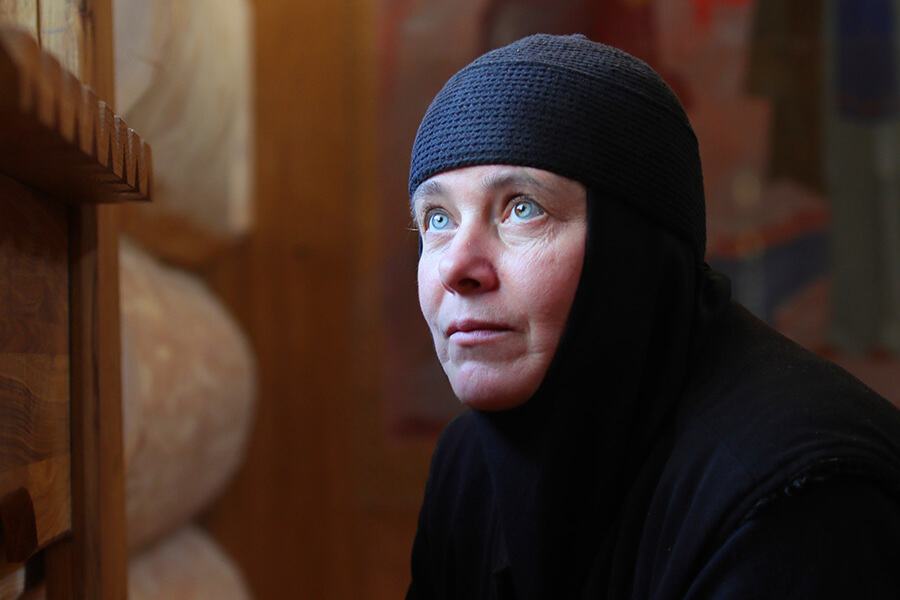
She shared with us her experience:
“I believe that St Andrei Rublev painted the Trinity through divine inspiration. It is true theology in colour. Every iconographer can only dream of being able to paint such a sacred and great image. While I was working on it, I felt both joy and awe — for such a task is beyond human strength. It can only be accomplished through the help of God.”
The finished icon now stands above the altar as a quiet witness to the same mystery Rublev once sought to express — the mystery of God as Love revealed.
If you would like to commission a sacred icon — whether of the Holy Trinity or any other feast or saint — we warmly invite you to get in touch with us. Our monastic workshop would be honoured to prayerfully create an icon for your home, parish, or loved ones.
You can submit a request here.

Glory to God! Christ is in our midst. He is and ever shall be!
💖💖🙏☦️⚓️🕊️🧎♀️💖💖