


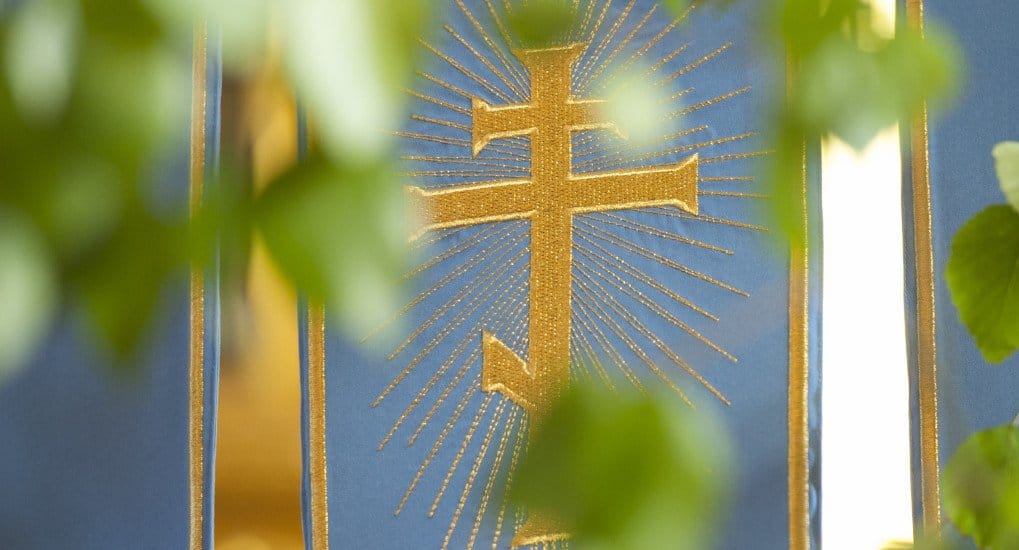
On 31 May 2026, the Church celebrates one of Her great feasts: Pentecost, also called Trinity Sunday. Fifty days after Christ’s Resurrection, the apostles were gathered in the Upper Room in Jerusalem when the Holy Spirit descended upon them. This gift of the Spirit enabled them to speak in many languages, heralding the Gospel to all nations. Pentecost reveals the life of God dwelling within the Church and the beginning of Her mission to the world.
1. Why do we call Pentecost the “Birthday of the Church”?
The Church is not merely a gathering of believers or a human society; She is the Body of Christ — a living communion through which His life flows. The Holy Spirit gives life to this Body, uniting believers and sustaining them in love and purpose.
As the Apostle Paul writes:
“For as the body is one and has many members, but all the members of that one body, being many, are one body, so also is Christ. For by one Spirit we were all baptised into one body — whether Jews or Greeks, whether slaves or free — and have all been made to drink into one Spirit” (1 Cor. 12:12–13).
Pentecost is called the birth of the Church because on that day the disciples were not merely inspired or encouraged. Through the descent of the Holy Spirit, they were united into a new life in Christ and sent forth to proclaim the Gospel to the world.
2. Was there a “Church” before Christ?
In a sense, yes. The word “church” literally means an assembly of those who are called together, and the people of God in the Old Testament were such an assembly.
Yet Pentecost introduces a new stage in salvation history. Before Christ, God’s people awaited the fulfilment of His promises. Through Christ’s death, Resurrection, and the coming of the Holy Spirit, the Church is revealed in Her fullness as the Body of Christ. The Spirit dwells within Her, uniting believers to the crucified and risen Lord and drawing them into His life.
3. Who is the Holy Spirit?
The Holy Spirit is not an impersonal power, but the Third Person of the Holy Trinity: fully God, co-eternal with the Father and the Son.
He speaks of Himself as “I”:
“While they were worshipping the Lord and fasting, the Holy Spirit said, ‘Set apart for Me Barnabas and Saul for the work to which I have called them’” (Acts 13:2).
He possesses a will:
“It seemed good to the Holy Spirit and to us” (Acts 15:28).
He may be grieved by human sin:
“And do not grieve the Holy Spirit of God, by whom you were sealed for the day of redemption” (Eph. 4:30).
One may even lie to Him, and as Scripture says, to lie to the Holy Spirit is to lie to God Himself (Acts 5:3–4).
4. Why did the Holy Spirit come only after Christ’s Resurrection?
First, humanity was separated from God by sin, and that separation had to be healed.
Second, the Holy Spirit is given to unite us to Christ — to the crucified and risen Lord — and to lead us into the new life He opens. Humanity was created to know God, rejoice in Him, and share in His eternal life. But sin darkened our hearts and weakened our nature, making us unable to restore ourselves to communion with God.
Sin brings both guilt and wounding. We are guilty because we transgress God’s law:
“Your iniquities have separated you from your God; your sins have hidden His face from you” (Is. 59:2).
Yet sin also damages the human heart, inclining us toward further wrongdoing and limiting our ability to change. Like a person caught in a destructive cycle they cannot escape alone, we may long for the good but lack the power to attain it.
Christ comes to rescue us. The sinless Son of God bears our sins and dies for us — “the righteous for the unrighteous.” As He says at the Mystical Supper:
“This is My Blood of the New Covenant, which is shed for many for the remission of sins” (Matt. 26:28).
Through repentance and faith, we are reconciled to God and freed from condemnation. The Holy Spirit then enters to unite us to this new life, guiding, illuminating, and sustaining us in Christ.
5. Does the Holy Spirit dwell in every believer?
The Holy Spirit dwells in all who are truly Christian. No one can belong to Christ without Him
“If anyone does not have the Spirit of Christ, he does not belong to Him” (Rom. 8:9).
In the saints, His work is often more evident, manifest in holiness that inspires others. Yet even those far from sanctity become Christians only through the Spirit. Faith itself is a gift of God: without Him, we could neither recognize Christ, desire transformation, nor begin to change our lives.
6. Can the Spirit work outside the Church?
Yes, to a degree. God’s grace can touch hearts even before formal membership in the Church, sometimes called “inviting” grace. Yet this grace ultimately draws people into the Church, where the Spirit completes His work of union with Christ.
The Spirit convicts the world of unbelief, glorifies Christ, and recalls His promises:
“I will build My Church, and the gates of hell shall not prevail against it” (Matt. 16:18).
Even when acting outside the visible Church, His goal is to lead souls into communion with Christ’s Body.
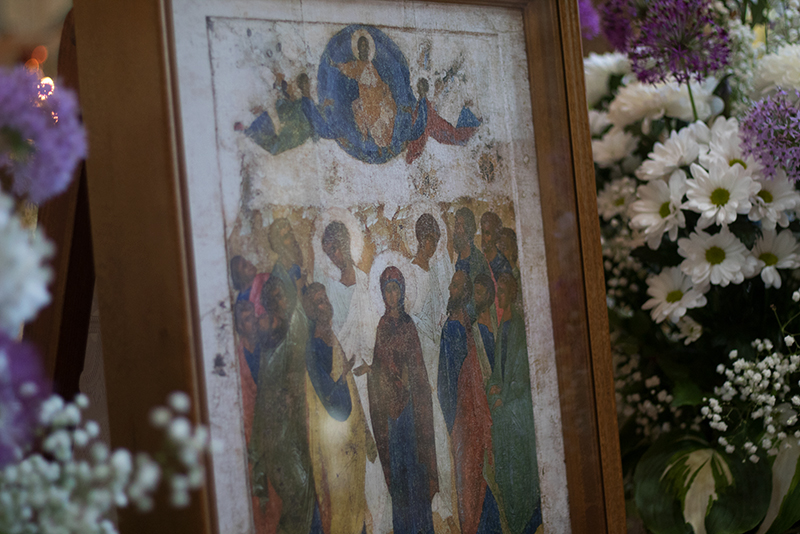
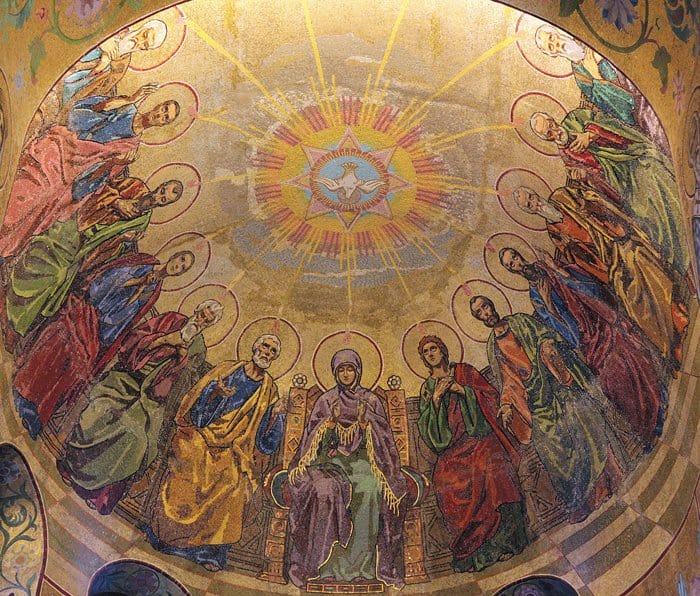 The Descent of the Holy Spirit on the Apostles, Church of the Resurrection of Christ, St. Petersburg, photo from www.lori.ru
7. How can we recognise Christ’s Church today?
When the apostles gathered and prayed, the Spirit descended upon them. They preached, and signs and wonders accompanied their ministry. One key sign of the true Church is the continuity of faith.
Founded by Christ in the first century, the Church continues uninterrupted. From the first century to the twenty-first, the same faith is confessed and the same Eucharist celebrated. Orthodox bishops and priests remain connected to the apostles through an unbroken chain of ordination. The Church cannot be “re-founded” by human hands; we join the Church Christ Himself established.
8. Does ordination guarantee the Spirit’s action?
Not at all. The Spirit determines how He builds the Church and whom He calls. Since apostolic times, the gift of the Spirit for ministry has been transmitted through ordination. For example, the apostles ordained presbyters, praying with fasting and entrusting them to the Lord (Acts 14:23). Paul exhorts Timothy:
“Kindle afresh the gift of God which is in you through the laying on of my hands” (2 Tim. 1:6).
The Spirit acts according to His will, not ritual mechanics.
9. Can the Spirit work through imperfect ministers?
Yes. Just as a messenger delivering a king’s letter does not nullify its authority, the personal failings of a minister do not prevent the Holy Spirit from acting. God does not withhold grace from a faithful believer because of the sins of others, including clergy.
When a Christian receives the Eucharist with faith and reverence, they receive Communion even if the minister is unworthy. Likewise, absolution and forgiveness are effective through God’s grace, not the holiness of the priest.
10. Can believers guided by the Spirit still stumble?
The Spirit does not make an individual infallible. His guidance is gentle and persuasive, respecting human freedom. Persistent, deliberate rebellion against God’s will can separate a person from the Spirit until repentance. Yet even those who falter through weakness or ignorance remain under His call to restoration.
11. Why don’t Christians speak in many languages today?
That was a unique sign for a particular moment: the reversal of Babel. At the Tower of Babel (Gen. 11), human pride caused the confusion of languages, dividing humanity. Pentecost heals that division: the Spirit unites all nations and tongues in the one Church.
As Paul writes:
“In Christ there is neither Jew nor Greek, slave nor free, barbarian nor Scythian; all and in all is Christ” (Col. 3:11). The Spirit restores the unity broken by human pride.
12. How does the Holy Spirit show His presence in our lives?
The gifts of the Spirit are primarily moral and spiritual. He convicts us of sin so that we may repent; as the Fathers said, one who sees his own sins is more perfect than one who sees angels.
He inspires steadfast faith in Christ, certain hope of forgiveness, and filial confidence:
“For you did not receive the spirit of bondage again to fear, but you received the Spirit of adoption, whereby we cry, ‘Abba, Father!’” (Rom. 8:15–16).
He cultivates the fruits described by Paul: love, joy, peace, patience, kindness, goodness, faithfulness, meekness, and self-control (Gal. 5:22–23). While God may allow saints to perform miracles, the true sign of the Spirit’s presence is sincere repentance, authentic freedom, sound faith, and a righteous life — bringing inner contentment, fullness of meaning, and genuine joy.
Translated by the Catalogue of Good Deeds
Source: https://foma.ru/12-voprosov-o-pyatidesyatnicze.html