


On 8 November, the Orthodox Church keeps a rather unusual remembrance: the day of the Constantinople earthquake of 740, described in the Church calendar as “the great and fearful shaking that occurred in Tsargrad (Constantinople)”. Against the background of feasts dedicated to Jesus Christ, the Mother of God, and the saints, this commemoration can seem strange. Why would a natural disaster leave such a mark on the Church’s memory? What spiritual meaning does the Orthodox tradition see in it? Let us consider this more closely.
Sparse Facts from the Chronicles
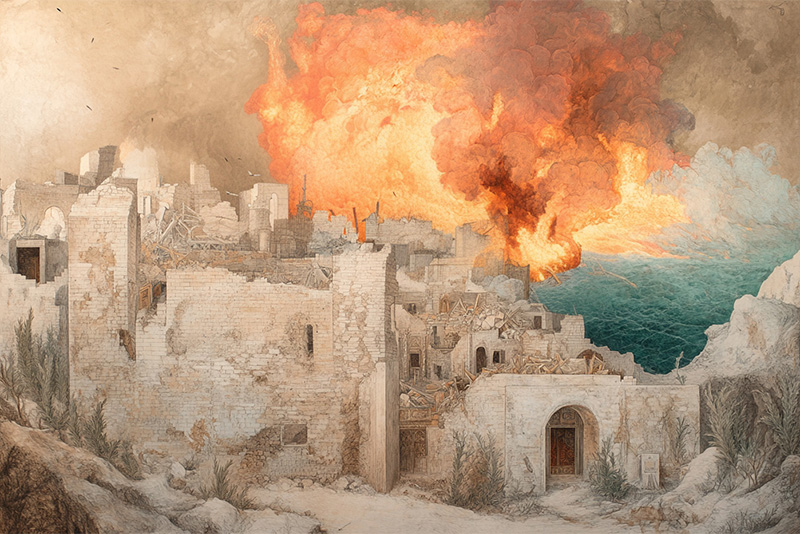
In the autumn of 740, Constantinople and its surrounding regions were struck by powerful tremors. The destruction was severe. Many churches and civil buildings were damaged. Even the city’s fortifications could not withstand the force of the quake: several towers of the wall collapsed along with buildings and monuments across the capital.
The earthquake caused immense loss. A large part of the population was left without shelter. Many died, and not only those trapped indoors: in the narrow streets of the city, people were killed by falling masonry and uprooted trees. Each time debris began to be cleared, another tremor would strike and the tragedy would repeat itself. Chroniclers say the shocks continued for about a year. Cities near the epicentre could scarcely be rebuilt at all, and many people lived out in the open, in tents.
This created further misery. Sanitary conditions deteriorated, and the number of victims rose even more. Rebuilding began only when people were confident the tremors had finally ceased.
Historical Background
The same event can affect people and history very differently, depending on what else is happening at the time. Something that might seem secondary can become decisive, simply because it occurs at a moment when society is already strained and divided. The earthquake of 740 gained its particular significance because it came during an era when the Eastern Church was being shaken by the iconoclast heresy: a teaching that forbade the making of sacred images and rejected their veneration.
What was iconoclasm, in plain terms?
In those years, the imperial authorities began to treat icons as a threat. Holy images were destroyed, and those who held them dear could be driven out, punished, and in some cases even killed with impunity. For the Orthodox, this was not a matter of “religious décor”. Icons belong to the Church’s confession of the Incarnation: we venerate the icon not as a god, but as a witness that the Son of God truly took flesh, and that creation can be sanctified by His grace. To wage war on icons was, in practice, to wound that confession and to silence part of the Church’s living language of faith.
Iconoclasm was introduced as state policy under Emperor Leo III the Isaurian. His initiative became the beginning of a long church-and-state turmoil within the empire. Even harsher measures followed under his son, Constantine V Kopronymos, who came to the throne in the summer of 741. In addition to banning the veneration of icons, he initiated outright persecution of monastics and all who resisted iconoclast policies.
Although iconoclasm had already existed as an official doctrine for more than a decade, many people still remained faithful to Orthodoxy. A military commander, Artavasdos, relied on their support when he rose against Constantine, seized the throne, and held power for about a year.
For Orthodox believers, the great earthquake of Constantinople became a sign of God’s wrath. Artavasdos and his supporters were able to use the disaster as evidence of their own legitimacy, and many among the Orthodox population placed their hopes in him. Yet this did not spare the usurper from political defeat. In November 743, Constantine regained control of the empire and restored iconoclast policy. The struggle, however, was far from over. Iconoclasm would be condemned by the Seventh Ecumenical Council in 787, and after a brief resurgence in the ninth century, the veneration of holy icons would be restored for good in 843—an event the Church still celebrates as the Triumph of Orthodoxy.
A Spiritual Reading
Constantinople experienced several major earthquakes in its history. At least two other disasters, in 438 and 557, also entered the Church’s tradition.
The earthquake of 438 is linked, in tradition, with the appearance of the Trisagion prayer. After the tremors and widespread destruction, the faithful of the capital processed through ruined quarters in a крестный ход (a cross-bearing procession). During the prayers, an unseen power lifted one of the children into the air before the eyes of thousands. When the boy was brought down and asked what he had seen, he said he had encountered angels unceasingly glorifying God with the words: “Holy God, Holy Mighty, Holy Immortal.” Moved to compunction, the people began repeating these words, adding the penitential plea: “Have mercy on us.” Within a few years this prayer became so widely used that the Council of Chalcedon (451) confirmed its place in the worship of the Eastern Church.
The earthquake of 557 is remembered for the scale of its aftermath. It was a series of shocks, the strongest of which occurred at night on 14 December. Since most people were asleep, the loss of life was horrifying. Those who managed to escape from collapsed stone buildings poured into the streets in a chaotic crowd. Outside, another calamity awaited them: an icy downpour, highly unusual for the area. Many survivors tried to shelter in the buildings that still stood, which led to crushing and further deaths. In those days the city saw outbreaks of looting, robbery, and violence. Only after a couple of weeks did the authorities manage to calm the crowd. Much of the city lay in ruins; few buildings remained intact. Even the Church of Hagia Sophia was partly destroyed: its dome collapsed under its own weight. The consequences of this disaster took decades to overcome.
Witnesses say that these earthquakes (and others as well) were often followed by a surge of piety and repentance. The wealthy opened their homes and stores to those in need; churches filled with people at prayer. Such disasters seemed to shake people awake, pushing them towards amendment and a change of life. Yet, sadly, this awakening did not last long, and after a time life in the splendid Byzantine capital returned to its familiar course. People quickly forgot the lessons brought by earthquakes and other natural upheavals.
But the Church did not forget. As though drawing together the bitter experience of many generations, she eventually established a special day of remembrance in her calendar: a remembrance that fallen man is not master of the world or ruler of the elements; that he is vulnerable before the fearful forces of nature; that every aspect of our life is wholly in God’s hands; and that He alone is the true Governor of all that surrounds us.
The liturgical texts appointed for this commemoration speak in the same key. They see in these events a merciful admonition, God’s attempt to reach human hearts that have grown coarse under the influence of an overly comfortable way of life.
Prayers for the Day of Remembrance of the Great and Fearful Earthquake in Tsargrad (740)
Troparion, Tone 8
Thou Who lookest upon the earth and makest it tremble, deliver us from the fearful threat of earthquakes, O Christ our God; and send down upon us Thy abundant mercies, through the prayers of the Theotokos, and save us.
Kontakion, Tone 6
Deliver us all, O Lord, from grievous earthquakes, and from unbearable scourges because of our sins. Spare, O Lord, Thy Orthodox people, whom Thou hast purchased with Thy Blood, O Master; and give not the city over to perish in fearful tremors. For we know no other God but Thee. And cry aloud to those who sing: “I am with you, and none shall be against you.”
Translated by the Catalogue of Good Deeds
Sources: https://foma.ru/velikoe-konstantinopolskoe-zemletrjasenie-740-goda-pochemu-jeto-sobytie-otmecheno-v-cerkovnom-kalendare.html
Thank you for this beautiful article. Please pray for all of us. That we may stay in God’s will.
Thank you for your heartfelt request. We are indeed called to constant prayer for one another, that we may all find the strength and grace to abide in God’s holy will.
Your prayer brings to mind the words of the Psalmist: “The Lord knows the way of the righteous, but the way of the wicked will perish” (Psalm 1:6). As we recall the story of Sodom and Gomorrah, we remember not only judgment but also God’s profound mercy. For the sake of even a few righteous, He withheld His wrath. This is a powerful testament that the prayers and lives of the faithful can become a protecting veil for the world.
Let us pray with hope and trust, knowing that the Lord will not forsake the righteous. May He, through the intercessions of the Most Holy Theotokos and all the Saints, grant us discernment, faithfulness, and the peace that comes only from dwelling in His will.
With love in Christ,
The Catalogue of Good Deeds Team