


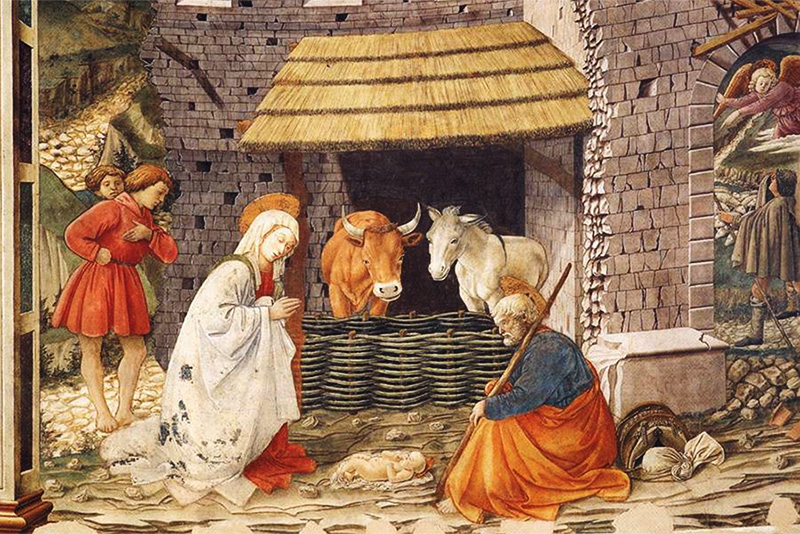
Every year at Christmas, the Church hears and sings one of the most joyful hymns of the Nativity:
“Glory to God in the highest, and on earth peace.”
These words are so familiar that we rarely pause over them, and their meaning can recede into the background. We hear them as an expression of praise addressed to God, and as a promise of peace given to the world through the coming of Christ—and rightly so. Yet for those who first heard this proclamation in the world of the first century, these words carried a weight and sharpness that are not always immediately apparent to us.
The Gospel of Luke places this hymn at the very heart of the Nativity narrative. Shepherds keeping watch over their flocks at night are suddenly confronted by an angel of the Lord, who announces the birth of the Saviour. Then, as the evangelist tells us, a multitude of the heavenly host appears, glorifying God and proclaiming:
“Glory to God in the highest,
and on earth peace…” (Luke 2:8–14)
At first glance, nothing could seem more gentle or more removed from the concerns of the world. And yet the language of this hymn belongs to a world saturated with claims about glory, peace, salvation, and lordship—claims that were not merely religious, but political and imperial.
To hear the angelic proclamation as it was first heard, we must recall what these words meant in the world into which Christ was born. Only then can we understand why the Church has preserved them at the centre of her celebration of the Nativity, and why they continue to speak with undiminished force.
To hear the angelic hymn as it would have been heard at the time of Christ’s birth, we must first attend to the world into which it was spoken. The words “peace,” “salvation,” and “good news” did not arrive in a cultural vacuum. They already belonged to the public language of power, celebration, and hope.
In the Roman Empire of the first century, such words were used confidently and expansively. They were applied not only to the gods, but to the emperor himself. Political rule was presented as a beneficent force, capable of restoring order to a fractured world and securing peace for humanity. This vision of peace was widely proclaimed, carefully cultivated, and publicly honoured.
Yet it was also contested by lived experience. The same empire that celebrated itself as humanity’s saviour was sustained by conquest and force, and its promises were not heard in the same way by all who lived under its rule.
It is within this charged world of competing claims that the proclamation of the Nativity must be placed. Only then can the words sung by the angels be heard with their full resonance—and only then does the contrast they reveal come clearly into view.
Across the eastern provinces of the Roman Empire, inscriptions survive that show how the reign of Augustus was understood and celebrated by his contemporaries. One such inscription, discovered in Lycia, honours “the divine Caesar Augustus, son of a god, ruler of land and sea, benefactor and saviour of the whole world.”
In nearby Halicarnassus, an even more elaborate inscription praises Augustus in language that leaves little doubt about the scope of imperial self-understanding:
“The eternal and immortal nature of the universe has bestowed upon humankind the greatest of blessings, granting us Caesar Augustus, the father of his country, divine Rome, and heir of Zeus, the saviour of the whole human race. His providence not only fulfilled but exceeded the hopes of all. For on land and sea he brought peace, and the cities abound in order, harmony, and prosperity.”
Such texts were not isolated expressions of enthusiasm. They belonged to a broader imperial culture in which political power was clothed in religious language, and the emperor was presented as the agent through whom the world had been rescued from chaos.
A provincial governor of Asia Minor, Paullus Fabius Maximus, spoke of Augustus’ birth in words that sound strikingly familiar to later Christian ears:
“The birthday of the most divine Caesar was the beginning of good news for the world. By his coming, he restored order to what was collapsing and gave a new form to the universe, which was rushing toward destruction. Without him, humanity would have had no hope. Therefore it is right to say that this day marked the beginning of life and existence, when people no longer had reason to regret being born.”
The same logic appears in a decree of the cities of Asia, which resolved that time itself should be reordered around the emperor:
“Since divine providence, which directs our lives, has brought into the world the most perfect good in Augustus, filling him with virtue for the benefit of humankind, and since his birth marked the beginning of the good news for the world… it has seemed fitting that the New Year should begin on the day of his birth.”
Even Roman poets gave voice to this vision. Horace, addressing Augustus, writes:
“While you are present, we pay you honour,
we raise altars to you and swear by your name as by a god,
believing that none has arisen your equal, nor ever will.”
In 8 BC, the Roman Senate went further still, voting to rename a month of the calendar in honour of the emperor. Augustus thus became not only master of territory, but also a marker of time itself. Having declared his adoptive father Julius Caesar divine, Augustus could rightly claim the title “son of god.”
Taken together, these testimonies reveal a coherent imperial worldview. Before the birth of Christ, the Roman world already had its “saviour,” its “lord,” its “son of god.” His reign, it was said, had brought peace to the earth and good news to humanity.
Yet this vision was not universally shared. For those who belonged to conquered nations, the peace of Rome often appeared in a very different light.
The Roman historian Tacitus preserves a speech attributed to the British leader Calgacus, delivered on the eve of a doomed uprising against Roman rule:
“They plunder, slaughter, and steal—this they falsely name empire; and where they make a desert, they call it peace.”
Calgacus speaks of forced conscription, the violation of families, the exhaustion of land and people alike. Rome’s peace, he insists, is experienced as bondage rather than blessing. Within hours of this speech, the rebellion was crushed, and Roman order was restored—once again, by force.
Taken together, these voices reveal how confidently the Roman world spoke of peace, salvation, and good news—and how differently those claims were heard depending on where one stood within the empire. Rome proclaimed peace as its own achievement, even when that peace was secured by force and maintained through fear.
It is against this background that the angelic hymn of the Nativity must be heard. When the Gospel of Luke tells of a multitude of the heavenly host glorifying God and proclaiming peace on earth, these words do not float above history. They enter a world already filled with rival promises of peace and salvation, and they quietly but decisively relocate their source.
The angelic hymn is not an accidental outburst of praise, but a carefully structured proclamation. Its parallel form holds together heaven and earth, glory and peace, God and humanity. Already in its structure, the hymn speaks of order: of the way the birth of Christ reorients the world.
At the heart of this proclamation lies a redefinition of peace. In the Roman world of the first century, peace was commonly understood as the achievement of imperial power—established by armies, maintained by force, and celebrated as the crowning virtue of Caesar’s rule. Against this background, the angelic hymn locates peace not in Rome and not in the emperor, but in God Himself. Peace is not the result of domination; it flows from the glory of God and is given as His gift.
The Greek wording of the hymn’s final phrase—ἐν ἀνθρώποις εὐδοκίας—adds an important nuance. It may be rendered as “among people of [God’s] favour” or “among those with whom He is pleased,” a sense preserved in many English biblical translations. This wording points not to a limitation of God’s saving will, but to the personal and relational character of the peace being proclaimed. It is not imposed from without; it is received where God’s will is welcomed.
This understanding stands in harmony with the broader Gospel narrative. The angel announces “good news of great joy for all people,” and the infancy narrative concludes with Simeon’s proclamation of salvation prepared “before the face of all peoples,” both Jews and Gentiles alike. The Gospel thus holds together the universal scope of God’s saving work and the personal response through which its fruit is revealed.
Placed within this narrative, the angelic hymn reveals the character of the peace it proclaims. It is not secured by conquest or sustained by fear. It does not arise from human power or political order. It is given by God and rooted in His gracious will toward humanity.
In this light, the hymn exposes the limits of every earthly claim to ultimate peace. Empires may promise order and stability, but the Gospel announces a peace that has its source elsewhere. Glory is ascribed to God in the highest, and peace is made known on earth as the gift that accompanies His saving presence.
The angels’ proclamation thus reveals, rather than confronts. By naming the true source of glory and peace, it quietly reshapes the world’s understanding of both. And in doing so, it points beyond every earthly saviour to the One in whom peace is truly given.
Having heard the angelic hymn within its historical and theological setting, we may return to it with renewed attention. The words remain the same, yet they sound differently once we recognise what kind of peace they proclaim, and from where that peace comes.
The angels do not announce a peace secured by power, nor a peace imposed by force. They proclaim a peace that accompanies the saving presence of God in the world. Glory is ascribed to God in the highest, and peace is made known on earth as His gift to humanity—a gift received where His gracious will is welcomed.
In this proclamation, heaven and earth are brought together. The glory that belongs to God alone is revealed not in imperial splendour, but in the humility of the Nativity. The peace promised to the world does not arise from conquest, but from communion. It is not enforced; it is given.
Seen in this light, the angelic hymn is neither a political slogan nor a decorative element of the Christmas narrative. It is a confession of faith. It names the true source of peace and quietly exposes the limits of every earthly promise that claims to offer peace apart from God.
For this reason, the Church has preserved these words at the very heart of her celebration of the Nativity. Each year she sings them not as a memory of the past, but as a living proclamation. In a world still restless for peace, still tempted to secure it through power and control, the angels’ song continues to direct our hope elsewhere.
“Glory to God in the highest,
and on earth peace…”
These words do not fade with time. They invite us, again and again, to recognise the peace given with Christ Himself—and to receive it where God is pleased to dwell.
Translated by the Catalogue of Good Deeds
Sources: https://foma.ru/slava-v-vyishnih-bogu-na-zemli-mir.html
Thank you so much for sharing this homily.
I reflect on the times in which we live today, when so many of us think that if so ‘n so is elected to govern our world, then we will have peace. That way of thinking sets the stage for antichrist.
Thank you for reminding us that the peace we seek is for those who open the doors of our hearts to the Lord God on high.
Blessed Nativity to all,
Irene
Thank you, Irene, for your profound reflection. You have touched upon a central spiritual truth. Indeed, the perennial temptation is to place our ultimate hope for peace and salvation in worldly powers, ideologies, or leaders. This, as you rightly note, is the very deception that paves the way for the spirit of the antichrist—the substitution of the created for the Creator.
Your reminder is the true answer: the peace that the world cannot give comes only from the Christ Himself, Who stands at the door of the heart and knocks. True governance begins within a soul reconciled to God.
Thank you for your blessing. Wishing you that the light of Christ’s Nativity, shining now during the holy days of Christmas, may warm your hearts and homes. May God’s blessing be upon you in the New Year that has begun.
With festive joy for the born Savior,
The Catalogue of Good Deeds Team