


Where would you expect to encounter a saint? In a monastery, perhaps? On an icon? Certainly—in church, in quiet prayer, in places hallowed by faith. But during times of great trial, saints have also been found in the trenches.
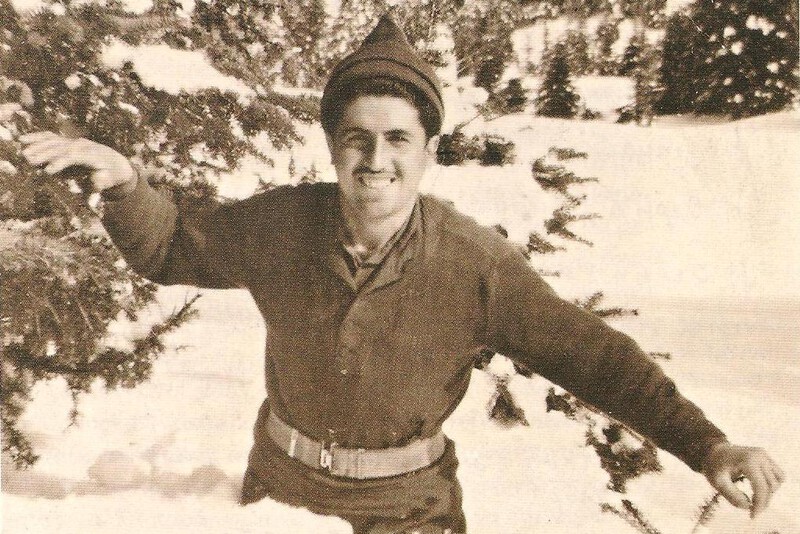
In the 1940s, amidst the chaos of the Greek Civil War, a young radio operator named Arsenios Eznepeidis was serving in the Greek army. Few knew then that he would one day become one of the most beloved saints of modern Orthodoxy—Saint Paisios of Mount Athos.
During a fierce battle near the town of Nafpaktos, Arsenios’s unit was forced to retreat under pressure from a far larger enemy force. In the confusion, one soldier, Pantelis Dzekos, was struck down—injured by his own radio equipment—and left behind.
His comrades made it back to the reserve trenches and quickly realised Pantelis was missing. Just then, they saw something astonishing. Arsenios, the radio operator, dropped his gear and ran back—straight into enemy fire.
“Leave him! He’s gone!” officers and soldiers shouted after him. But Arsenios didn’t stop.
“He ran up to me,” Pantelis later recalled, “hoisted me onto his shoulders, and dragged me back to safety.”
Their captain looked on in disbelief. “It seems some saint must love you very much,” he said to Pantelis, “to have helped you—and sent this man to save you.”
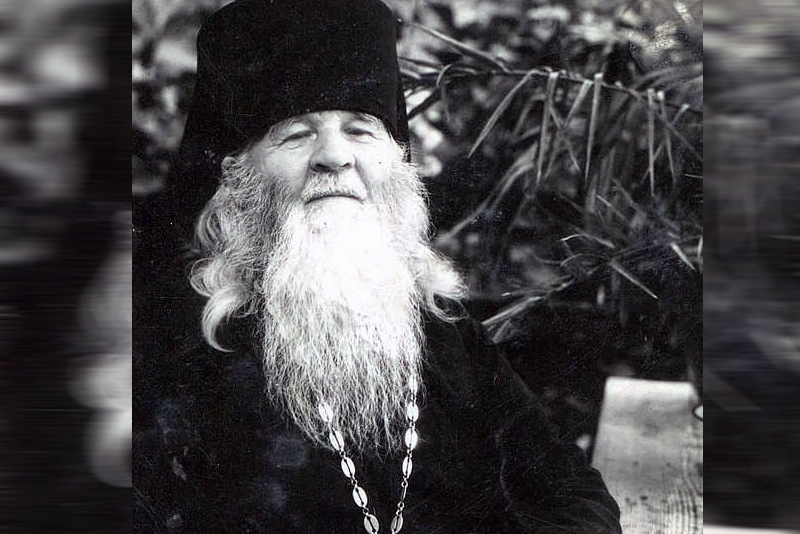
That brave young rescuer was indeed beloved by God. Years later, he would be known to the whole Orthodox world as Elder Paisios the Athonite.
Few today are aware that before entering monastic life, Elder Paisios spent nearly three and a half years in military service as a radio operator. He served during the Greco-Italian War, through the trials of the Second World War, and into the Greek Civil War.
Though his role spared him from direct combat—radio operators were generally not required to fire upon the enemy—he endured the full weight of war’s suffering.
“Once, when our food supplies ran out, we survived by eating snow,” he later recalled. “Another time, we went thirteen days without rations and lived off nothing but wild chestnuts. We were often tormented by thirst, drinking from puddles formed in horse tracks.
The cold was a fierce enemy. We would wake up buried in snowdrifts. One morning, I dug twenty-six of my fellow soldiers out of the snow with a mattock—they had all suffered frostbite.
On another occasion, we were buried under snow for three whole days. I kept sending distress signals to headquarters. My own feet were so badly frostbitten that strips of flesh peeled away like bark from a tree. Only God’s mercy spared me from amputation.”
Yet even in the midst of these harrowing circumstances, young Arsenios held fast to his childhood dream of becoming a monk. He ate only half his portion in the mess hall and spent nights in prayer, climbing to the roof of the barracks after lights out.
This is not a tale of how hardship builds resilience. It is a story of a soul yearning for heaven while walking through the valley of death—and feeling the spiritual toll such an environment exacts.
Once, he had gone five months without attending a single liturgy. There were no churches or priests near his station. When the army convoy passed by a village church where the Akathist Hymn was being chanted to the Mother of God, Arsenios wept.
“I crossed myself and kissed the icons,” he said. “Then I whispered, ‘My Most Holy Theotokos… what have I become?’”
Reflecting on those years, he would later say:
“If I had undertaken the same ascetic struggle as a monk that I endured as a soldier, I would have become a saint.”
God Helps Those Who Sacrifice Themselves
During his time at war, Arsenios consistently volunteered for the most dangerous assignments—not out of bravado, but out of a deep desire to spare others, especially those who had families waiting for them at home.
On one occasion, he dug himself a narrow trench for cover. Another soldier crawled over and asked if he might share it.
“I squeezed in and made room,” Arsenios recalled. “It was tight, but we both fit.”
Then a second soldier arrived, desperate for shelter.
“I climbed out and let him take my place.”
Moments later, a piece of shrapnel grazed Arsenios’s head. He was wearing only a hood—not a helmet.
“I reached up to feel the wound—but there was no blood. I checked again—still nothing. The shrapnel had shaved a six-centimetre-wide strip of hair clean off my scalp without leaving so much as a scratch.”
He had given up his spot in the trench without hesitation. “I did it from the heart,” he said. “I thought, Better to be killed once now than to spend the rest of my life tormented by the thought that I could have saved someone and didn’t.”
“God greatly helps those who are willing to give of themselves for the sake of others.”
Stay Connected with the Main Headquarters
Once, during a particularly perilous campaign, Arsenios’s unit became surrounded. Their half-battalion was trapped in a mountain pass by over 1,600 insurgents.
They managed to fortify themselves behind a series of jagged rock formations—natural strongholds that offered some degree of protection. Ammunition was quickly brought forward, and the commanding officer, fearing an imminent assault, ordered every man to help haul supplies.
He turned to Arsenios and barked:
“Leave the radio and get to work!”
Suspecting that Arsenios was simply trying to avoid danger, the commander even drew his pistol and threatened to shoot.
Arsenios obeyed, helping to carry crates of ammunition—but between runs, he kept sprinting back to the radio, desperately trying to establish contact with central command.
Finally, after repeated attempts, he made a connection.
“We’re surrounded,” he reported. “We need help urgently.”
The next day, as the enemy closed in so tightly that the soldiers could hear their voices echoing through the rocks, air support arrived. A fleet of Greek attack aircraft roared overhead and scattered the enemy ranks.
Years later, as a monk, Elder Paisios often returned to this memory when speaking about the power of prayer.
“Monks are the radio operators of the Church.
If they keep the lines open with God through prayer, then God rushes to help.
One extra rifle shot won’t change the outcome of a battle.
But when the aircraft arrive—that changes everything.”
Trust in God, Not in Yourself
Later in life, Elder Paisios often spoke of his wartime experiences—not to glorify violence or heroism, but to draw spiritual lessons from the battlefield. He would compare the physical struggle of war with the deeper, invisible struggle of the spiritual life.
“In our time, courage has become a rare thing,” he once said.
“People are made of water.
So if—God forbid—a war were to break out, some would die from fear alone, while others would collapse in despair.
They’ve grown too accustomed to comfort.”
Yet he also distinguished between two kinds of fear. One, he said, was useful: the fear that leads a person to turn to God. The other—fear rooted in a lack of faith—was deadly.
“That kind of fear is defeated only by courage.
The more a person fears, the more room he gives the enemy to attack.”
And how does one acquire courage?
“Cultivate self-sacrifice. Love your brother.
Strive to live in a spiritual state.
Because without spiritual grounding, a man is a coward. He loves himself too much.
Such a man may even deny Christ or betray Him.”
To the Elder, the truly courageous soldier was the one who laid down his life—not for glory, but so that others might live.
“A soldier should rejoice to die so that others don’t have to.
If you approach life that way, you have nothing to fear.
Courage is born of love—of kindness, of self-offering.
But today people don’t even want to hear the word ‘death.’”
Yet he insisted that only those who remember death can truly live.
“Those who fear death and cling to the vanity of life fall into spiritual stagnation.
But the brave—those who fix their eyes on death and think of it constantly—they overcome this vanity.
Already in this life, they begin to taste eternity and the joy of paradise.”
And to those who go to war for the sake of faith and fatherland, he offered this final word:
“Let him make the sign of the Cross and go forth without fear.
For God is with him.
And it is God—not man—who will determine whether he lives or dies.
We must place our trust in God, not in ourselves.”
Translated by the Catalogue of Good Deeds
Source: https://foma.ru/molitva-tvoya-pvo-okopnye-uroki-starcza-paisiya-svyatogorcza.html
Beautiful and Inspiring. Thank you!
JMJ
We have been watching the set of films about him. Beautifully produced and acted. Very impressed with how the actors play their parts. It is like we are flies on the walls, watching all these scenes in “real time”.