
The Bell That Rang for an Empty Church
Moscow at the end of the nineteenth century was a city caught between faith and upheaval. Revolutionary ideas were gathering strength, while for many people Christianity had become more an inherited custom than a living encounter with God. In the cities, some received Holy Communion only once a year, at Easter; even among seminarians, there were those who regarded the priesthood chiefly as a profession.
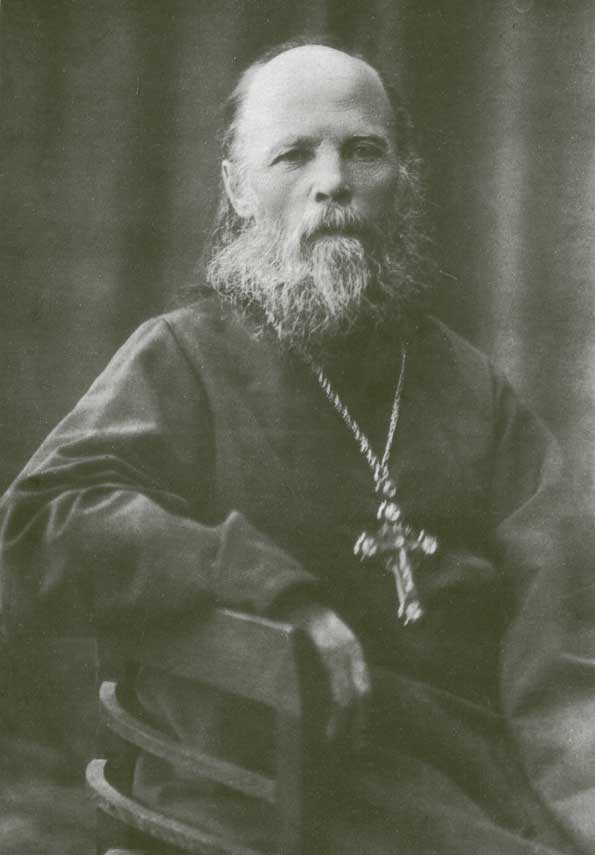
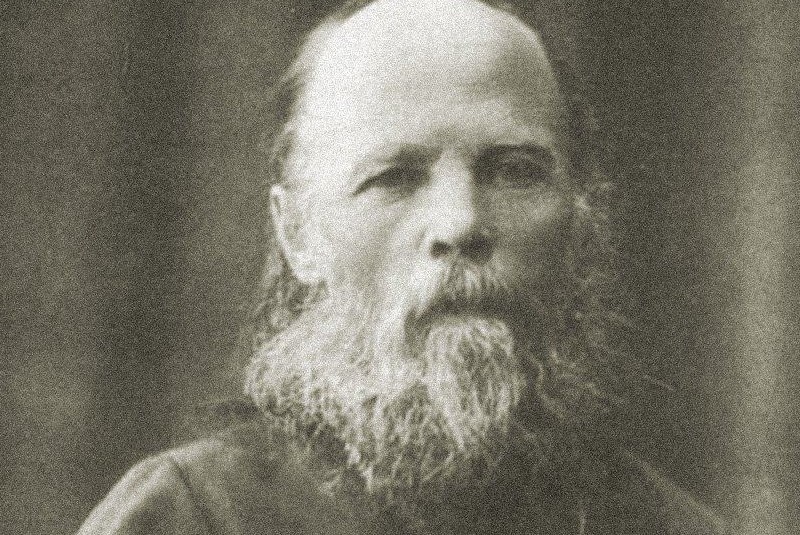
Archpriest Alexis Mechev
Yet every morning, amid the noise of central Moscow, a church bell rang.
Inside the small Church of St Nicholas in Klenniki, a short, unassuming priest opened the Holy Doors and proclaimed the beginning of the Divine Liturgy:
“Blessed is the Kingdom of the Father and of the Son and of the Holy Spirit, now and ever and unto ages of ages.”
And often there was no one there to hear him.
“Whenever I pass your church, the bells are ringing,” another priest once remarked. “But when I went inside, it was empty. Nothing will come of it. You are ringing in vain.”
Fr Alexis heard him—and continued to serve. For eight years he celebrated the daily services, often almost alone, without allowing the emptiness of the church to decide whether his ministry was worthwhile.
In time, that same little church would become home to one of the most remarkable Christian communities in twentieth-century Moscow. Crowds would come to its priest for confession, counsel and consolation. After his death, he would be glorified as St Alexis of Moscow: a pastor whose spiritual discernment was inseparable from his extraordinary attentiveness to each person before him.
But nothing in his beginnings suggested worldly greatness.
“Blessed Alyosha”
Alexis Mechev was born in Moscow in 1859 into a family closely connected with the Church. His grandfather had been an archpriest, while his father, Alexei Ivanovich Mechev, directed the choir at the Chudov Monastery in the Moscow Kremlin. From them, the young Alyosha inherited more than familiarity with worship: he received a simple and immediate trust in the Gospel.
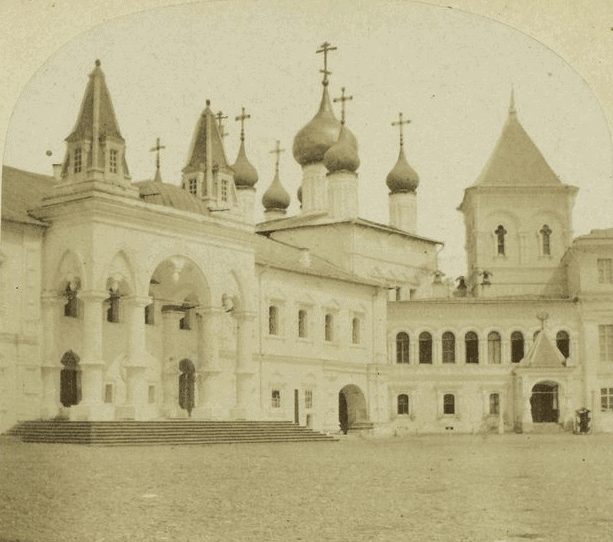 The Chudov Monastery, 1859. Source: “Retromap” (http://retromap.ru)
“God gave me a simple, childlike faith,” he would later tell his spiritual children.
His family sometimes called him “blessed Alyosha”—not as a formal title, but because there was something unusual about his inward seriousness. In the middle of lively games, he might suddenly grow quiet and withdraw somewhere by himself. The reality of God did not seem remote to him, nor did it belong only to certain hours of the day.
At the same time, there was nothing severe or forbidding about the boy. Gentle by nature, he disliked quarrels and tried either to reconcile those who were arguing or to make them laugh. This remained one of the hallmarks of his character. He wanted people to feel at ease in his presence, and later taught others to live in such a way that those around them might find warmth and encouragement rather than tension and fear.
Alexis had first learnt this generosity at home. His mother once brought her widowed sister and her three children into the family’s small two-room flat in Troitsky Lane. The Mechevs already had three children of their own. Six children and three adults now lived beneath one roof—yet somehow there proved to be room and bread for everyone.
The memory remained with Alexis throughout his life. Love, as he had seen it practised, was not merely sympathy. It meant making space: in one’s home, one’s time and one’s plans.
As a young man, he hoped to become a doctor. His compassionate nature drew him towards a calling in which he could relieve the suffering of others. His mother, Alexandra Dmitrievna, had another idea.
“You are so little—how could you be a doctor?” she would say, teasing him about his short stature. “You had better become a priest.”
Her reasoning may have been playful, but her perception was sound.
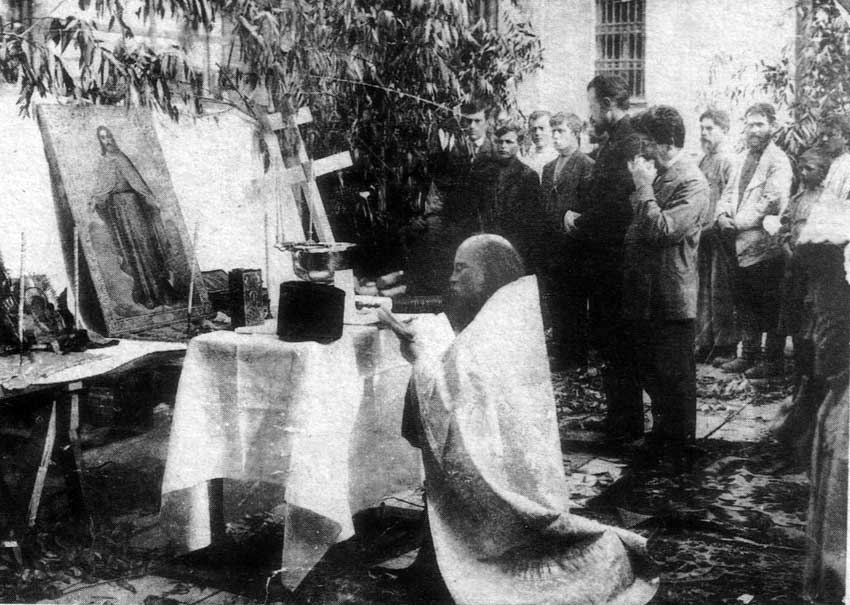 Fr Alexis Mechev serving a moleben—a service of supplication and thanksgiving
After graduating from the Moscow Theological Seminary, Alexis began serving in 1880 as a psalm-reader at the Church of the Sign on Znamenka Street. A psalm-reader was not ordained, but assisted at services by reading Scripture and prayers and undertaking other practical duties in the church.
There his gentleness was severely tested. The rector, Fr Georgy, was quick-tempered and unpredictable. He found fault with the twenty-one-year-old reader, ordered him to perform tasks far beyond his proper duties and sometimes even struck him. Alexis’s younger brother Tikhon often found him in tears.
Nothing could justify such treatment. Yet Alexis did not allow another man’s cruelty to teach him cruelty in return. He neither became embittered nor lost his tenderness towards others.
Years later, when he attended Fr Georgy’s funeral, Alexis wept again—this time with gratitude. Without intending it, the priest who had treated him so harshly had exposed the weaknesses Alexis needed to confront within himself. The ordeal had taught him patience and helped him struggle against what he considered his chief fault: self-regard.
This was to become a pattern throughout his life. Fr Alexis did not deny suffering or pretend that injustice was good. Rather, he asked what God might bring forth from it—and what within his own heart still needed to change.
“My Beautiful One…”
Saints are sometimes portrayed as though holiness had made them remote from ordinary human affection. In the case of Fr Alexis, however, his surviving letters reveal a man of striking tenderness—a husband who delighted in his wife and never took her presence for granted.
In 1884, he married Anna Petrovna Molchanova, the daughter of a church reader. His letters to her are full of affectionate names:
“My beautiful one… my precious wife, my Nyushenka… my life, take your medicine and drink more milk.”
“Forget everything else and think only of getting well. Take comfort in knowing that your husband is always thinking of you. Although he is some seventeen miles away, my precious one, he knows and feels clearly what you are thinking and doing.”
“My golden sunshine…”
Their marriage was not incidental to Fr Alexis’s spiritual formation. Anna was not merely the wife who managed a priest’s household while he attended to more important matters. She shared his life and ministry, understood his weaknesses and spoke honestly when she believed something in him needed to change.
They had five children: Alexandra, Anna, Alexei, who died in infancy, Sergei, the future hieromartyr, and Olga.
Even after years of marriage, Fr Alexis’s letters retained their warmth and spontaneity:
“My beautiful one, you left your bracelet and rings on my table. Do not worry: I have put them away and shall bring them with me on Sunday. I kiss you countless times.”
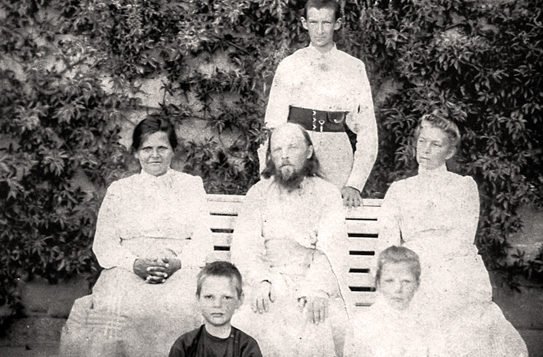 Fr Alexis Mechev with his family. His wife, Anna Petrovna, is seated to his left
What Fr Alexis admired most deeply in Anna was her lively and uncomplicated faith. Although he was already a priest and the spiritual guide of others, he could write to her without embarrassment:
“I know that you possess a deep faith. Pray for me, my angel, that I too may have such faith.”
On 19 March 1893, Fr Alexis was ordained to the priesthood and appointed to the Church of St Nicholas in Klenniki. The parish was poor and very small, and he was its only priest. Anna shared the hardships of those early years, when few could imagine what his persistence would eventually bring forth.
Fr Alexis later remembered her not only as his beloved wife, but as the friend who helped him see what he could not see in himself:
“I was very happy when your late mother noticed something and told me what she thought. I would take her words to heart and change accordingly. I do not want to remain at the freezing point. None of us sees everything in himself, and we can grow only with the help of those who are close and dear to us.”
The “freezing point” was his image for spiritual stagnation: the condition in which a person no longer listens, changes or grows. For Fr Alexis, love did not mean protecting one another from every uncomfortable truth. It meant helping one another become what God was calling them to be.
A Grief That Opened His Heart
The happiness of their marriage was overshadowed by Anna’s serious heart condition. As the years passed, she developed severe oedema and breathlessness. Her body became swollen, weakness overtook her, and even breathing could be painful.
Fr Alexis prayed fervently for her recovery. Eventually, her suffering became so great that she asked him to stop imploring God to prolong her life and allow her to depart in peace.
Anna Petrovna died on 29 August 1902 according to the calendar then used in Russia—11 September on the Gregorian calendar. It was the feast of the Beheading of St John the Baptist, a solemn day of fasting and repentance.
Her death left Fr Alexis desolate.
“The whole world grew dark for me,” he later recalled. “I shut myself in my room and did not want to go out among people. I poured out my sorrow before the Lord.”
His grief was neither brief nor restrained. He had loved his wife with his whole heart, and without her he felt profoundly alone. Yet this bereavement became the great turning point of his life—not because grief automatically sanctifies a person, but because Fr Alexis eventually allowed it to open rather than close his heart.
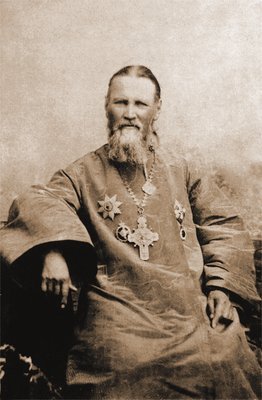 St John of Kronstadt. Photograph from the early twentieth century
That change began through an encounter with one of the best-known pastors in Russia. St John of Kronstadt was visiting Moscow when friends arranged for him to meet the bereaved priest.
“Have you come to share my sorrow?” Fr Alexis asked.
“I have not come to share your sorrow, but your joy,” Fr John replied. “The Lord is visiting you. Leave your room and go out among the people; only now will you truly begin to live.”
Then he spoke words that might initially appear severe:
“You dwell upon your own sorrow and think that there is no grief in the world greater than yours. But be with the people. Enter into the grief of others and take it upon yourself. Then you will see that your own affliction is small in comparison with the sorrow around you, and it will become easier to bear.”
Fr John was not dismissing the widower’s loss or asking him to pretend that it mattered less than it did. He was showing him a path through it. The love Fr Alexis could no longer lavish upon Anna was not to be extinguished. It was to grow wide enough to receive the suffering of many.
From that time onwards, Fr Alexis’s ministry entered a new depth. He had always cared for those around him; now he began increasingly to forget himself in order to carry the burdens of others.
This marked the beginning of what Orthodox tradition calls his eldership. Fr Alexis did not withdraw to a monastery, nor did he adopt an austere or imposing manner. He remained a parish priest who had become a widower, serving in a small church on one of Moscow’s busiest streets. Yet people began to recognise in him the gifts they sought in the great monastic elders: spiritual discernment, compassion and an ability to perceive what a person truly needed.
He became, in the fullest sense, an elder in the heart of the city.
“A Priest Must Belong to His People”
The church doors were always open. A person could come to confession, ask for advice or simply speak to someone who would listen. Fr Alexis became known throughout Moscow as a priest to whom one could turn in the most painful circumstances without fear of being dismissed or condemned.
“A priest must belong to his people,” he said.
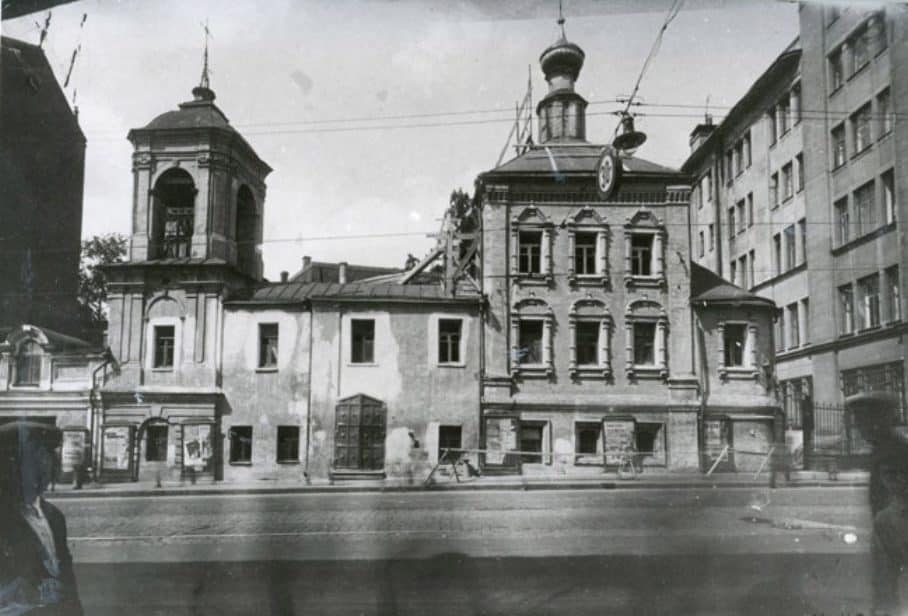 The Church of St Nicholas in Klenniki, 1920s–1930s. Source: “Retromap” (http://retromap.ru)
He meant this quite literally. His letters to his family tell of receiving visitors until late at night, sometimes going to bed at two in the morning, only to rise again for the early service. It was an exhausting life, but he did not regard those who came as intrusions upon his real work. They were his work.
“The Lord turned no one away,” he explained. “He called everyone to Himself and to salvation—and I cannot turn anyone away. As He was dying, He forgot no one: He remembered them all, saved the thief and thought of His Mother. And I cannot turn anyone away.”
Even when correction was necessary, his words retained their tenderness. Writing to a spiritual child who had sought escape from despair in drink and tobacco, he addressed him affectionately as “my dear, mischievous Petya,” assured him that the community was praying for him and added:
“Be at peace: your sorrow will turn to joy. The merciful Lord is with you.”
Fr Alexis did not confuse compassion with expecting little of people. He repeatedly urged his spiritual children to bring order into their lives, remain faithful in prayer and train their wills. A modest discipline faithfully kept was worth more than an ambitious undertaking soon abandoned.
Nor did he imagine that loving others was easy.
“To love everyone—it is easily said,” he wrote. “But learning to love everyone is the labour of a lifetime, and it requires no little experience.”
For him, however, no other task was more urgent:
“The world does not need our arguments, opinions and judgements. It is perishing for lack of love.”
Seeing What Others Could Not See
People were also drawn to Klenniki because Fr Alexis possessed an unusual gift of spiritual discernment. He carefully concealed it and never presented himself as someone able to reveal hidden things. More often, he would tell an apparently unrelated story and allow the listener gradually to understand that it concerned the very question he had come to ask.
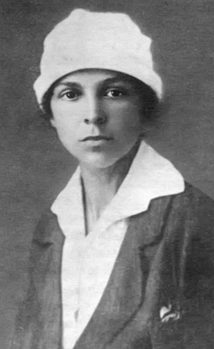 Maria Nikolaevna Sokolova in 1918
One woman travelled from Tula because her only son had disappeared. When she entered the church and joined the line to venerate the cross, Fr Alexis noticed her and reached the cross towards her over the heads of those standing in front.
“Pray for him as one who is alive,” he said.
Later he addressed her with unexpected warmth:
“Happy mother! Why are you weeping? I tell you: he is alive.”
Then, as though speaking of someone else, he added, “A mother came to me recently, terribly worried about her son—and all the while he is peacefully working at a tobacco factory in Sofia.”
Several months later, the woman received a letter from her son. He was alive and working at a tobacco factory in Sofia.
Yet Fr Alexis’s discernment was not chiefly concerned with predicting events. It helped him see what love required of a particular person.
On another occasion, two young women whom he had never met came to ask his blessing to enter monastic life. He readily blessed one, but told the other to return home. She was deeply disappointed. It later emerged that she lived with an elderly, seriously ill mother who depended upon her and was distressed by the thought of being left alone.
The desire for a visibly sacrificial life had to yield to the less conspicuous sacrifice already waiting at home.
Fr Alexis could also use humour to expose vanity. Olga Serafimovna, the director of an orphanage, once came to the Liturgy with one of her employees. As they waited to venerate the cross, Olga worried that Fr Alexis might say something embarrassing about her in front of her subordinate.
Seeing her, Fr Alexis raised the cross and proclaimed loudly:
“Olga! A wise woman!”
When she came closer, he bent towards her ear and whispered with his customary good-natured smile:
“Silly woman—that was only for the others.”
People left such encounters not humiliated, but liberated from the exhausting need to protect their own importance. Fr Alexis himself habitually deflected praise: “What am I? I am only a poor, wretched man.”
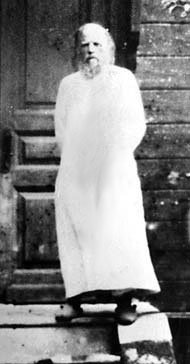 Fr Alexis Mechev
Faith Amid Revolution
The world around Klenniki was changing violently. Fr Alexis had already lamented the divisions within Russian society before the Revolution:
“In truth, not only every social class, but even every family lived apart. People did not seek the common good, but only their own.”
The promises of 1917 were followed by civil war, hunger and persecution. In 1919, amid profound uncertainty, Fr Alexis’s son Sergei was ordained to the priesthood. Firm and courageous by temperament, he served beside his father and would later continue his work at Klenniki.
The final years of Fr Alexis’s life coincided with some of Moscow’s harshest. Contemporary accounts describe streets left uncleared in winter, trams no longer running and people walking through the city with sacks on their backs, hoping to find food.
Fr Alexis continued to celebrate the daily services. As poverty deepened, the parish collected money for elderly people, large families and others in need. The community around the church grew at precisely the time when public life was becoming increasingly hostile to the Church.
The Soviet secret police summoned Fr Alexis for questioning twice—first near the end of 1922 and again on 30 March 1923—and ordered him to stop receiving visitors. By the second interrogation, he was already seriously ill. Yet as far as his strength permitted, he continued to counsel and pray for those who came to him.
The authorities could restrict his movements, but they could not undo the community formed through years of patient service.
Fr Alexis had often taught that an opportunity to help another person should itself be received as a gift:
“The chance to do someone good is God’s mercy towards us. We should therefore run, striving with our whole soul to serve another. After every act of love, such joy and peace fill the soul. Such a person has nothing to fear; no one can truly harm him.”
A Community That Survived Him
Fr Alexis died in Vereya on 22 June 1923—9 June according to the Old Calendar. He had gone there because of his failing health and died peacefully in bed.
When his coffin was brought back to the Church of St Nicholas in Klenniki, parish communities from across Moscow came with their priests to pray and bid him farewell. At his own request, the funeral was celebrated by Archbishop Theodore Pozdeevsky, abbot of the Danilov Monastery, who had been released from prison shortly before Fr Alexis’s death.
St Tikhon, Patriarch of Moscow, had likewise only just been released from confinement. He came to the Lazarev Cemetery, blessed the coffin as it was lowered into the grave and cast the first handful of earth upon it.
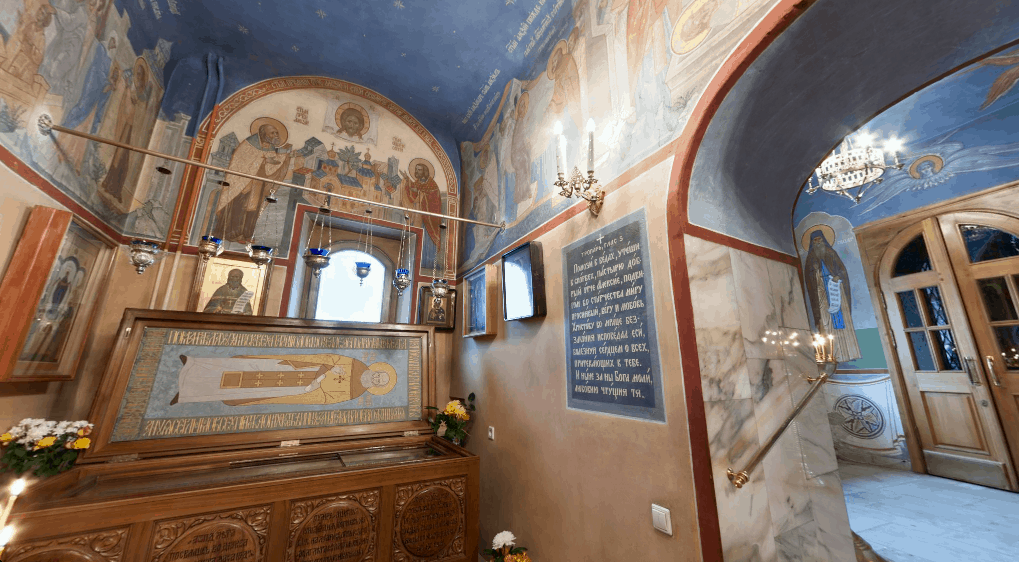 The Church of St Nicholas in Klenniki and the relics of St Alexis of Moscow. Source: “Church of St Nicholas in Klenniki” (http://www.klenniki.ru)
People continued to visit Fr Alexis’s grave, bringing the same sorrows and needs they had once carried to his little room beside the church. When the Lazarev Cemetery was closed in 1933, his remains and those of Anna Petrovna were transferred to the Vvedenskoye Cemetery. Those present testified that his body was found incorrupt.
The Church of St Nicholas was eventually closed, but the community Fr Alexis had formed did not disappear. Under the leadership of his son, Fr Sergei, it endured years of persecution and helped preserve a life of prayer, mutual responsibility and serious Christian discipleship in circumstances intended to extinguish it.
Fr Sergei was repeatedly arrested and was executed in 1942. In 2000, father and son were glorified together: Alexis as a holy and righteous priest, and Sergei as a hieromartyr.
The relics of St Alexis were returned in 2001 to the Church of St Nicholas in Klenniki, where he had served for thirty years. His principal feast is kept on 22 June—9 June according to the Old Calendar—and the transfer of his relics is commemorated on 29 September—16 September according to the Old Calendar.
Refusing to Stand Still
The most remarkable thing about Fr Alexis was not his ability to perceive hidden circumstances or foresee events. It was the use he made of every ordinary circumstance placed before him.
He could have concluded that daily services in an empty church were pointless. He could have allowed harsh treatment to make him bitter, bereavement to close him within himself, or exhaustion to make other people appear burdensome. Instead, each trial became an invitation to love more deeply.
For him, holiness was not an escape from ordinary life. It was the continual decision to receive another person, accept correction, remain faithful in prayer and refuse spiritual stagnation.
“I do not want to remain at the freezing point,” he wrote.
He did not remain there. Nor did the parish he formed. After revolution, persecution, arrests and the closing of its church, the spirit of Christian community that had grown around him survived.
The bell that once rang for an empty church had not rung in vain.
Translated by the Catalogue of Good Deeds
Source: https://foma.ru/svyatoy-aleksiy-mechyov-ya-ne-hochu-sidet-na-tochke-zamerzaniya.html