


The first Sunday of Great Lent bears a striking and solemn name: the Sunday of the Triumph of Orthodoxy. It concludes the most intense and austere week of the Fast — days marked by longer services, deeper repentance, and a heightened awareness of our spiritual frailty. That this affirmation of “triumph” stands at the close of such a week is not accidental. In the Church’s wisdom, struggle gives way to confession, and severity opens into joy.
The Historical Triumph
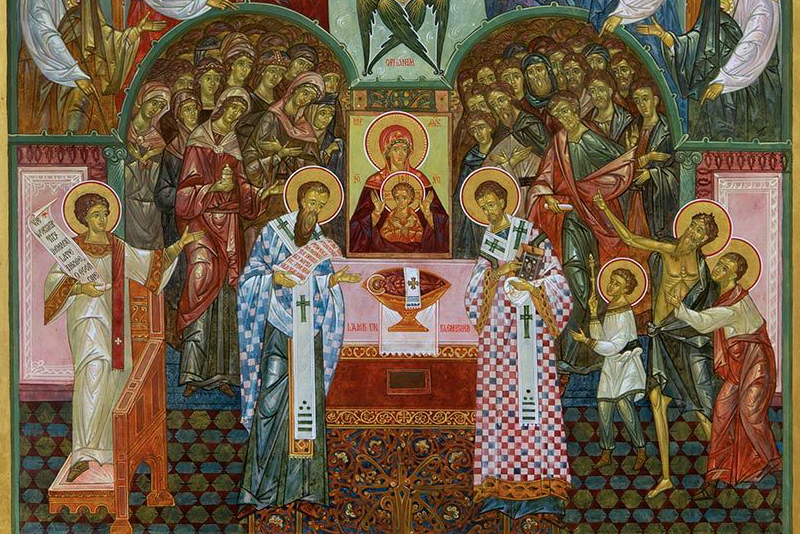
Historically, this feast commemorates the restoration of the holy icons in the year 843, after more than a century of turmoil known as the iconoclastic controversy. The Church’s veneration of icons had been fiercely contested, and at times violently suppressed.
The theological foundation for their restoration had already been laid in 787 by the Seventh Ecumenical Council, which affirmed that the veneration of icons belongs inseparably to the Church’s confession of the Incarnation. If the Son of God truly became man — if He assumed visible, tangible human flesh — then He may be depicted. To deny the icon is not merely to reject a devotional custom; it is to endanger the proclamation that God has entered history and taken on our humanity.
Thus the restoration of icons was not an aesthetic victory, nor the triumph of one party over another. It was the vindication of a truth at the very heart of the Gospel: that the Word became flesh and dwelt among us.
Because the first solemn celebration of this restoration took place on the first Sunday of Lent in 843, the Church fixed the annual commemoration on that day. From that time forward, the Sunday of the Triumph of Orthodoxy has stood at the threshold of the Fast as a proclamation that the faith of the Apostles has endured.
What “Triumph” Means
Yet the word “triumph” can easily be misunderstood. It does not signify political dominance, nor does it express hostility toward those who erred. Rather, it speaks of the endurance of truth through trial. The Church remembers that fidelity to Christ has required discernment, courage, and sometimes suffering.
In the liturgical rite appointed for this day, the Church proclaims the faith handed down through the Ecumenical Councils and gives thanks that the confession of Christ was preserved intact. The remembrance of ancient heresies is not a summons to triumphalism, but a sober acknowledgment that error can arise even within the community of believers — and that clarity of faith is a gift entrusted to us at great cost.
The Triumph of Orthodoxy is therefore, first of all, a celebration of divine faithfulness. Through weakness and human conflict, the truth of Christ was not lost.
From History to the Present
But the feast is not merely a recollection of distant theological battles. If the Church once defended the truth of the Incarnation against distortion, each believer is now called to defend that same truth within his own life.
The beginning of Great Lent often awakens a particular zeal. We pray more attentively. We attend the services of the first week. We listen to the penitential Canon of St Andrew of Crete. We examine our conscience more honestly and attempt, however imperfectly, to restrain habitual sins.
In these efforts, faith ceases to be a mere declaration of identity and begins to take on flesh in daily life. The truth confessed in the Creed seeks expression in prayer, in patience, in reconciliation, in self-restraint.
The Personal Triumph of Orthodoxy
In this sense, the first week of Lent may become a small but real “triumph of Orthodoxy” within the human heart. When a believer strives to align his life with the commandments of Christ — choosing repentance over self-justification, forgiveness over resentment, humility over pride — the truth upheld by councils and hymns ceases to be abstract. It begins to take flesh in lived experience.
This personal dimension does not replace the dogmatic meaning of the feast; it flows directly from it. The Incarnation is not only a theological affirmation but a living reality. The Son of God took flesh that human life might be healed and restored. Whenever we turn toward Him in repentance and obedience, that restoration is set in motion within us.
Yet the zeal of the first week is only a beginning. What appears as a spark must become a steady flame. When our weakness is revealed — as it inevitably is — the answer is not retreat but endurance. The Fast calls us to patient perseverance, that we may continue the struggle to its end and not lose heart along the way.
The Pattern of Lent and the Joy Set Before Us
It is therefore no accident that the Sunday of the Triumph of Orthodoxy concludes the most rigorous week of the Fast. The Church places this proclamation of truth at the outset of a longer journey. The Christian life as a whole follows the same pattern: confession of faith, ascetic labour, purification of heart, and finally joy.
The Sundays of Lent are not isolated commemorations but stages in a single, coherent ascent. From repentance we are led to the affirmation of faith; from purification to contemplation of the Cross; and from the Cross to the radiant joy of the Resurrection. The Triumph of Orthodoxy stands at the threshold of this ascent as a declaration that the truth of Christ stands firm — and that our path forward rests upon that unshakable foundation.
If we persevere — praying more deeply, restraining harsh words, seeking reconciliation, struggling faithfully in small and hidden ways — the fruit is not self-satisfaction but peace and quiet joy in the Holy Spirit. It is the first glimmer of Paschal light shining within the discipline of the Fast, a foretaste of the Resurrection toward which the entire journey is directed.
Christ, the True Triumph
In the end, the true and final Triumph is not an idea, nor even a moral improvement in ourselves. It is Christ Himself — the incarnate, crucified, and risen Lord. The Ecumenical Councils defended the truth of who He is. The holy icons proclaim that truth visibly. Our repentance during Lent prepares us to meet Him.
Thus the historical victory of the Church and the personal struggle of the believer converge in a single end: communion with the Risen Christ. The Triumph of Orthodoxy is not a celebration of the past alone, nor a mere affirmation of doctrine, but a call to live the truth that God has come among us — and to allow that truth to take flesh in our own lives.
Translated by the Catalogue of Good Deeds
Source: https://foma.ru/torzhestvo-pravoslaviya-itog-lichnoy-zhizni-vo-hriste.html