


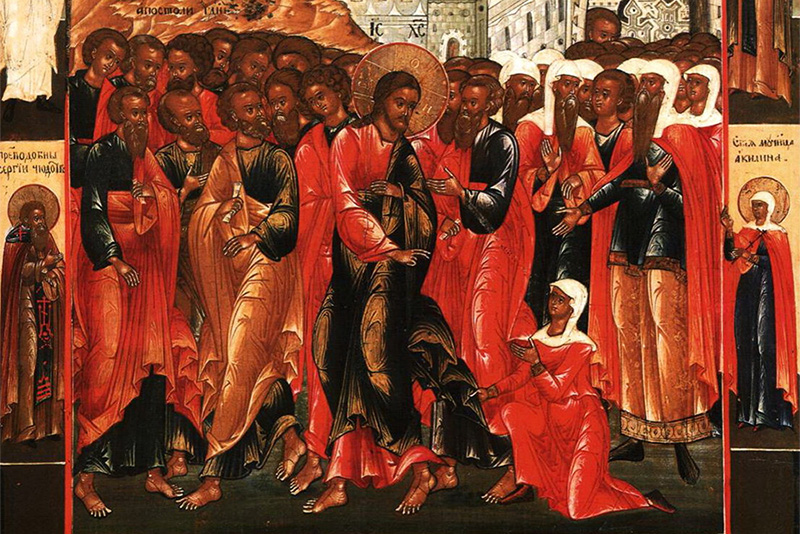
Among the Gospel readings for September (Mark 5:24–34), we encounter the familiar and deeply moving account of the healing of the woman with the issue of blood. As our Lord Jesus Christ made His way to Jairus, whose daughter lay gravely ill, this woman—having suffered for many years and spent all she possessed on physicians who could not help—came forward. With profound faith, she touched the hem of His garment and was immediately healed.
Saint Ephrem the Syrian offers a striking reflection on this moment: as long as she relied on her wealth, as long as her hands were full of money for the doctors, they were empty for faith in the Lord. But when her hands were emptied of what she might give to physicians, they were filled with faith, and with this faith she approached and touched Him. The Lord then freely bestowed what no sum could purchase. Her healing was not immediate because her trust had first been placed in human skill and in her own resources. So it is with us: while we trust in ourselves, we close ourselves to God’s work in our lives. She, however, came with unwavering faith, received what she sought, and heard the Lord console her, calling her “daughter” and praising her faith. Her healing also strengthened Jairus, who was still on the road and would soon face the news of his daughter’s death. For his sake, the Lord made this miracle manifest. Through it, the healed woman learned that Christ is not only Almighty—able to heal even through His garment—but also All-knowing, for He perceived her touch. And through this, she believed in Him as God.
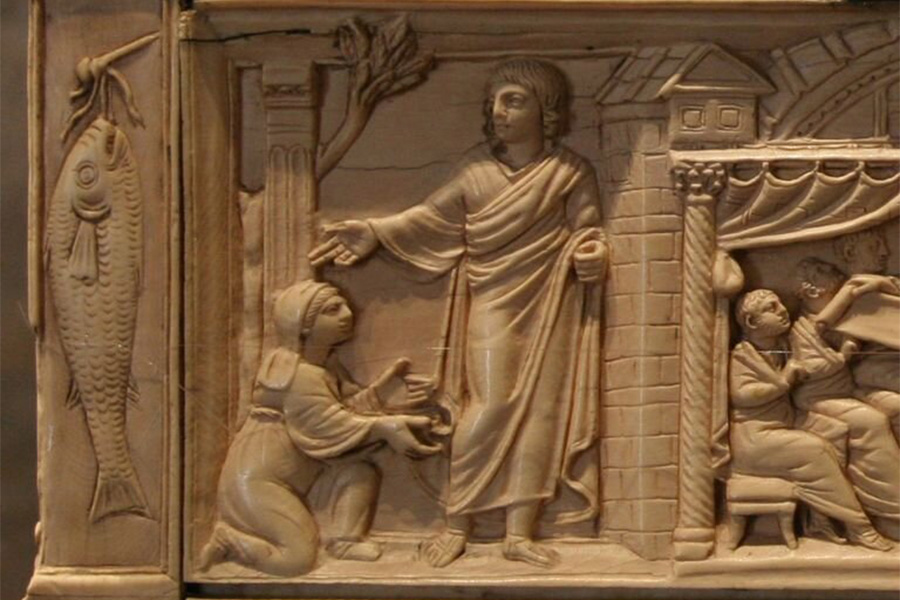
Ancient Church sources record that this woman, out of profound gratitude, caused the first image of our Lord Jesus Christ to be made. The early fourth-century historian Eusebius of Caesarea relates that she commissioned a sculptural group depicting the miracle: a statue of Christ and a statue of herself, kneeling and touching the hem of His garment. Christians preserved and venerated this image for four centuries. This witness shows that the reverent honor accorded to sacred images was known in the early Church, for an icon is an image, and this too was an image of the Lord Jesus Christ which the faithful held in honor. According to another ancient historian, Philostorgius, the statue bore an inscription recounting the healing and stating that the grateful woman had set up the image.
Tradition preserves two names for her: Veronica and Marousa. Some hold that the name was inscribed on the statue’s pedestal. It is also reported that the grass surrounding the monument had healing properties, and people came there to be cured. Eusebius writes that he himself saw the statue at Caesarea Philippi. Later, however, the emperor Julian the Apostate, a persecutor of Christians, ordered the statue to be broken and the surrounding grass uprooted so that the faithful could not venerate the place or draw strength from it. Some sources add that he intended to set up his own image there, or that of a pagan god, but this never came to pass. Julian soon died, while Christians reverently kept fragments of the broken monument; Philostorgius says he saw a piece of the head of Christ from that statue. After Julian’s death, the statue was restored and stood on that site at least until the sixth century. What became of it thereafter is unknown.
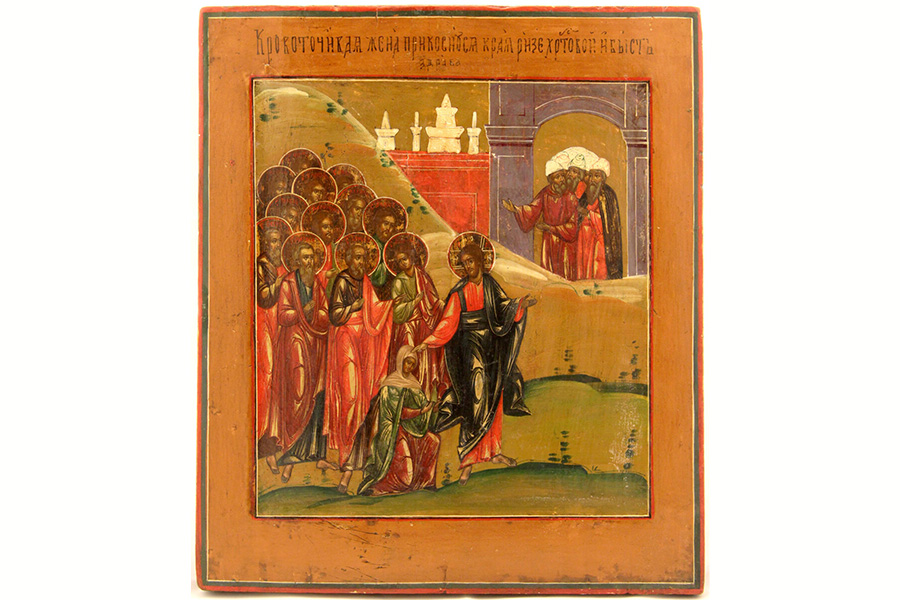
This woman teaches us to give thanks to God. Having been praised for her faith, she expressed her gratitude in a way that encouraged others for centuries. Although the statue itself has not survived, it became the foundation of the iconography of this Gospel event. Ancient representations have come down to us, and from them, the Church continues to depict the miracle of the healing of the woman with the issue of blood. In this sense, the iconographic tradition reaches back to the woman herself.
Let us, then, imitate her faith and her gratitude to God, preserving a thankful memory of all that the Lord has given us and using His gifts for the correction of our souls. May the Lord keep you.
Translated by the Catalogue of Good Deeds
Source: https://dzen.ru/a/ZdhmvRXjXn3HLhNS
Where is the beautiful icon depicted at the top of this page situated today? How wonderful it would be to venerate it!
Thank you for your question! This icon is a masterpiece from Mstera, possibly painted as a vow for the healing of a woman named Akilina. Regrettably, it is noted that the icon is currently held in a private collection.