
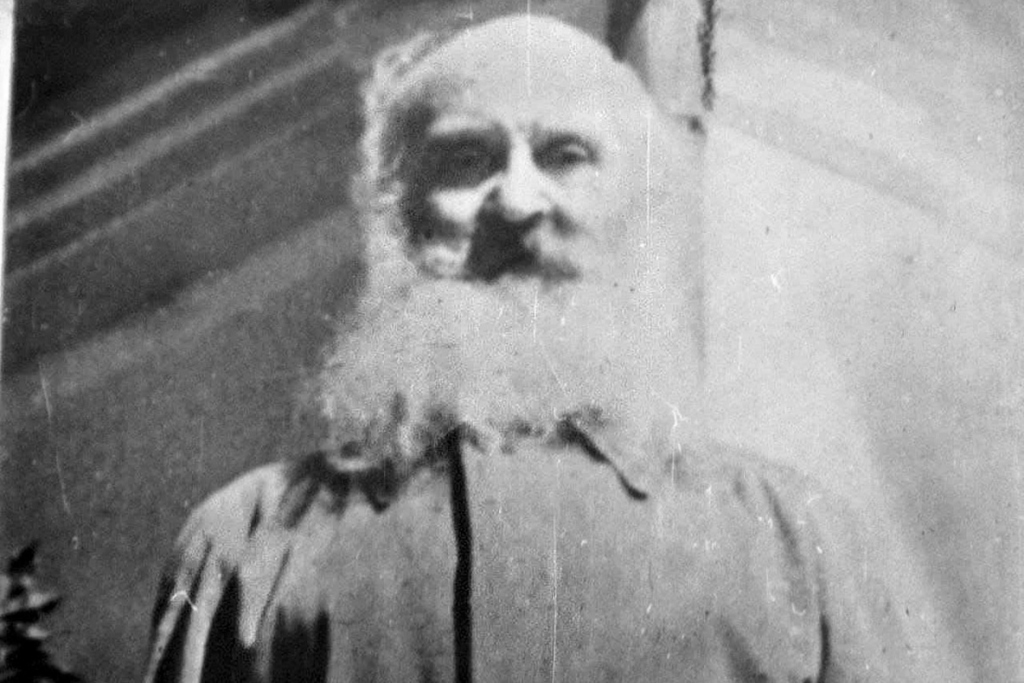
 Blessed Athanasius Sayko. Photo: patriarchia.ru.
He walked barefoot through the snow, gathered scraps from the street and called every woman “Mother”. Behind his puzzling ways, the people of Oryol came to recognise a man of prayer—one whose faith would endure years of confinement in Soviet psychiatric hospitals.
In the winter of 1921, an unfamiliar figure began appearing on the streets of Oryol, a city south of Moscow. Tall and broad-shouldered, he wore thin, shabby clothes and a white cotton towel in place of a scarf. Sometimes an alarm clock hung from a string around his neck. He would take out a tuning fork and listen to its note.
Often he walked barefoot, even in the snow. He seemed always cheerful, yet much of what he said was a riddle.
Then he would play the violin—and people would stop to listen.
His name was Athanasius, or Afanasiy, Sayko. In time, those who knew him would come to understand his strange way of life as the ascetic calling known in the Orthodox Church as “foolishness for Christ”: willingly accepting ridicule and misunderstanding while concealing a life of prayer and self-denial.
On 14 May 2026, the Holy Synod of the Russian Orthodox Church recognised him as a saint, numbering him among the confessors—those who suffered persecution for their faith without being put to death for it. For the people who had sought his prayers during his lifetime, and those who had visited his grave for decades afterwards, this was a long-awaited recognition.
Barefoot in the snow
At first, Athanasius slept in the bell tower of the Church of the Theophany. During the day he wandered through the streets, collecting pebbles, scraps of newspaper and matches. He would stuff them into his pockets, then hand them to people with the same curious instruction:
“Look for connections between things. Learn to work things out.”
Was he joking? Was he serious? It was difficult to tell.
His violin playing was another matter. There was no mistaking his gift. When people asked where he had learnt to play so beautifully, he told them that he had studied at the Warsaw Conservatoire. Warsaw was then part of the Russian Empire, but even so, it was hard to reconcile the distinguished place of study with the barefoot man before them.
Asked where he came from, he said that he was from Volhynia, a region in what is now north-western Ukraine. Why had he come to Oryol?
“This city has been allotted to me.”
That made people smile. Allotted to him, indeed!
Gradually, however, they began to notice something else about this courteous, cultivated man. He would answer a thought they had never spoken aloud. Something he said would later come to pass. Sometimes he would arrive at a house to warn its occupants of approaching trouble.
Word spread that the violinist in the bell tower was a fool for Christ with a gift of spiritual insight. Some began seeking him out. Others watched and waited, unsure what to make of him.
“I need nothing”
There was much to observe. Athanasius spoke with unfailing courtesy, even to boys in the street. Every woman or girl was “Mother” to him, even if his “mother” happened to be five years old.
He was never idle. Wherever someone needed help, he would lend a hand: tending cattle, chopping wood, carrying water or loading railway wagons. He worked conscientiously and accepted no payment. How he managed to live was a mystery.
Sometimes a kindly woman would ask, “Is there anything you need? What can we bring you?”
He would stand to attention, his arms straight at his sides, and answer firmly:
“I need nothing.”
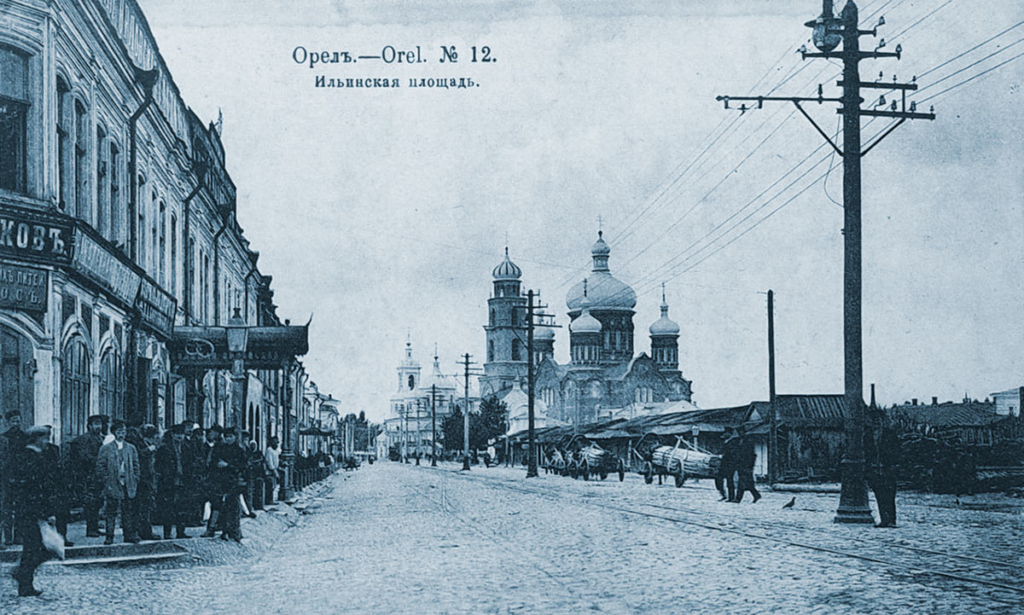 Oryol in the early twentieth century. Photo: https://www.litfund.ru/.
If someone nevertheless left him money, he would go to church, spend it all on candles and light them before the icon of the All-Merciful Saviour.
Sceptics remained unconvinced. “What sort of believer is he? It is all for show!” They never saw him praying, making the sign of the cross or bowing in worship.
Once, however, people saw him enter a wood. When he failed to return, they grew anxious, and a man went to look for him. He found Athanasius kneeling in the snow, his hands raised towards heaven, whispering a prayer. The man turned and slipped away.
Another recollection concerns a woman who saw Athanasius teaching a boy how to cross himself and bow before an icon of the Saviour. Suddenly a thought struck her. All day long he walked about the town, bending down to retrieve a discarded bottle or a scrap of paper. Could those movements be bows of prayer, hidden from everyone’s eyes?
Before she had said a word, Athanasius turned, looked straight at her and said with unexpected gravity:
“Please protect my interests. Do not disclose them.”
She kept his confidence until his death.
A hidden life
Much of Athanasius’s earlier life became known only afterwards, through personal recollections and archival records.
He was born in 1887 into a large, believing family in Volhynia. His mother died while he was still a boy, a loss he felt deeply. His father did not remarry and brought up the children himself.
Athanasius attended a school for soldiers’ sons attached to an imperial cavalry regiment in Warsaw. He had a fine voice and a sensitive musical ear; accounts of his life also recall his studies at the Warsaw Conservatoire. He later served in the army.
In July 1920 he was arrested and sent to a Bolshevik concentration camp in Oryol. Released that November, he remained in the city. It was there that he took up the life of a fool for Christ.
Father Vsevolod Kovrigin, the spiritual father of the local Convent of the Entry of the Mother of God into the Temple, heard about him and sought him out. He arranged for Athanasius to live with an elderly woman named Martha and helped him find regular work.
Accounts of Athanasius’s life also speak of a hidden monastic vocation, although the precise circumstances of his profession are uncertain. Outwardly he remained the same puzzling figure. In obedience to his spiritual father, he put his musical gifts at the service of the Church, singing in the choir without accepting payment.
He would accept food, but ate little and fasted strictly. He never ate meat or eggs. His explanation was as startling as many of his sayings: he did not eat “dead things”. Once, having accidentally broken some eggs, he became deeply distressed and kept repeating, “I am a murderer. I am a murderer.”
Father Vsevolod and other priests in Oryol treated him with great respect. When asked about him, Father Vsevolod advised people to listen carefully. If his words made little sense at first, their meaning might become clear in time.
That was what happened to a young woman named Alexandra, known to her family as Shurochka.
“A new year—a new long dress”
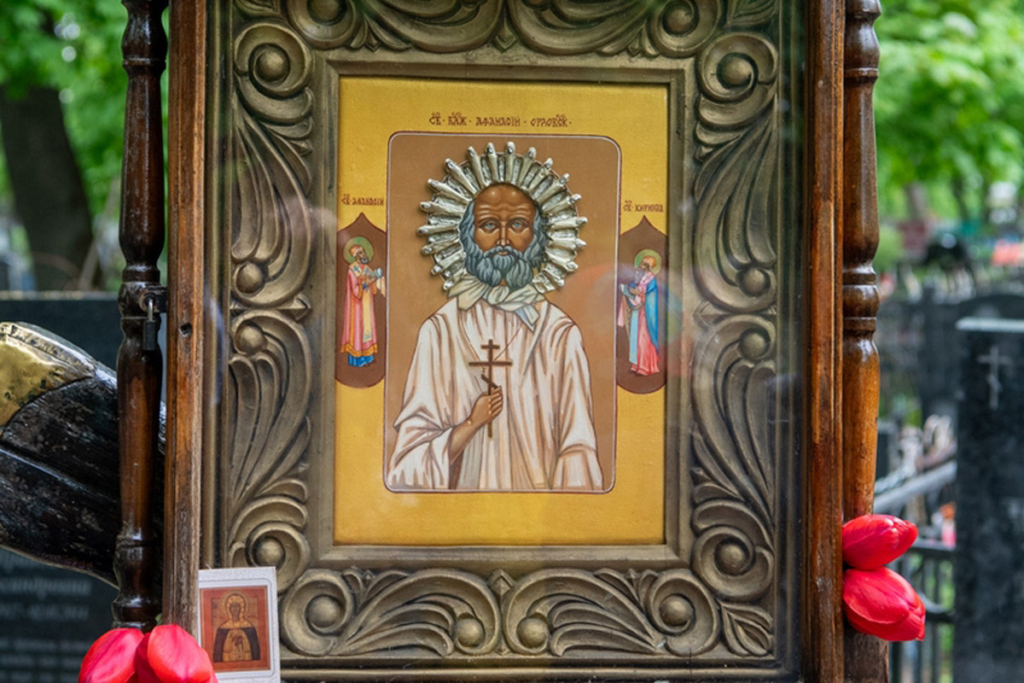
At Athanasius’s grave. This icon depicts him as the people of Oryol remembered him, with a cotton towel in place of a scarf. Photo: Information and Analysis Department of the Oryol Metropolitanate / https://www.orel-eparhia.ru/.
It was autumn, on the feast of the Kazan Icon of the Mother of God. A service of supplication was under way when Athanasius made his way through the congregation, took Alexandra by the hand and led her towards a side chapel.
Standing with her on the raised area before the icon screen, he asked:
“Mother, what is your name?”
“Alexandra.”
“You are not Alexandra. You are Maria, Maria, Maria.”
He paused, then added:
“A new year—a new long dress. Thread and needles…”
People nearby began whispering.
“Perhaps the poor girl will die in the new year. Look how thin she is! She must be ill.”
Father Gregory, the senior deacon, overheard them.
“What nonsense! She will not die. She will get married.”
Married? Alexandra could scarcely imagine it. Her mother was elderly, her brother was dying, and her sister needed help with her two children. There was no room in her life for thoughts of a husband.
Athanasius pointed to an icon of the Mother of God holding Christ.
“Do you see? The Child.”
“But that is the Saviour.”
“That is your child. Yours.”
Alexandra understood none of it. That evening she told her mother what had happened.
“Why did he call me Maria? Perhaps I am meant to enter a convent?”
Her mother understood something that Alexandra could not have known.
“You were born on the feast of St Mary of Egypt—1 April by the Church calendar, the day we now keep on 14 April by the civil calendar. I named you Maria in her honour and called you that for several days. Then Evdokia, your godmother, came. Her little daughter Alexandra had just died, and she begged me to give you the same name. In the end, I agreed. Perhaps that is what he meant.”
The next day, Alexandra met a young man at work. They were drawn to one another from the start and married the following February. A year later, they had a daughter.
The little girl did not live long. Her parents were heartbroken.
At the cemetery, Father Gregory returned to the words they had heard in church.
“Shura, we did not understand. Do you remember how Athanasius pointed to the icon and said that the child in the Mother of God’s arms was yours? He was speaking of your daughter. Your little girl is in Her arms now.”
He urged them to find consolation, and even a reason for joy, amid their sorrow: their daughter had been baptised and had received Holy Communion. Now, he told them, she was praying in heaven for all her family.
An unwelcome answer
In the spring of 1931, Athanasius visited a village near Oryol. People gathered to speak with him, many asking the same question: should they join a collective farm?
The Soviet campaign of collectivisation was forcing a profound change upon rural life, bringing individual farms under collective control. For families whose livelihood depended on their land and livestock, the question was urgent.
Athanasius advised them against joining.
“A collective farm is not your own farm; it belongs to everyone. If you join, you will lose your own holding. Keep your own farms.”
Someone reported him. He was accused of gathering people around him and turning them against the Soviet authorities. Arrested in April, he spent six months in prison. On 28 October, the case against him was dismissed for lack of sufficient evidence of a crime.
His freedom did not last. People continued to seek his counsel, and in 1932 he was confined to a psychiatric hospital.
A week beforehand, to everyone’s astonishment, he had shaved off his hair and beard. Asked why, he replied:
“From now on, they will shave me every week.”In the hospital, that was precisely the routine.
He emerged nine years later, his hair now white. His blue eyes, however, were as clear and attentive as before.
Kept apart from the people
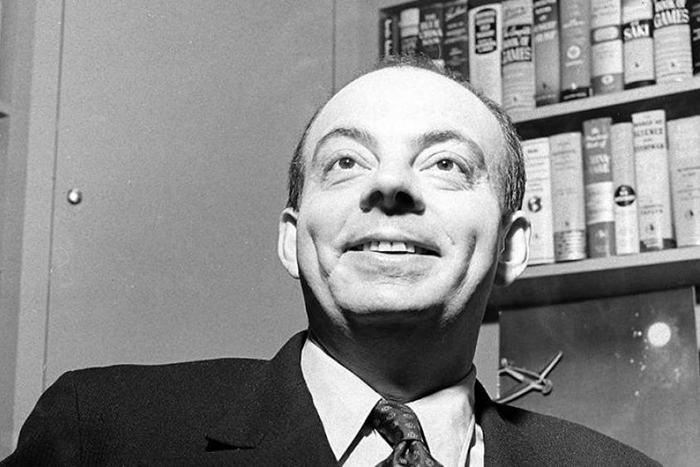
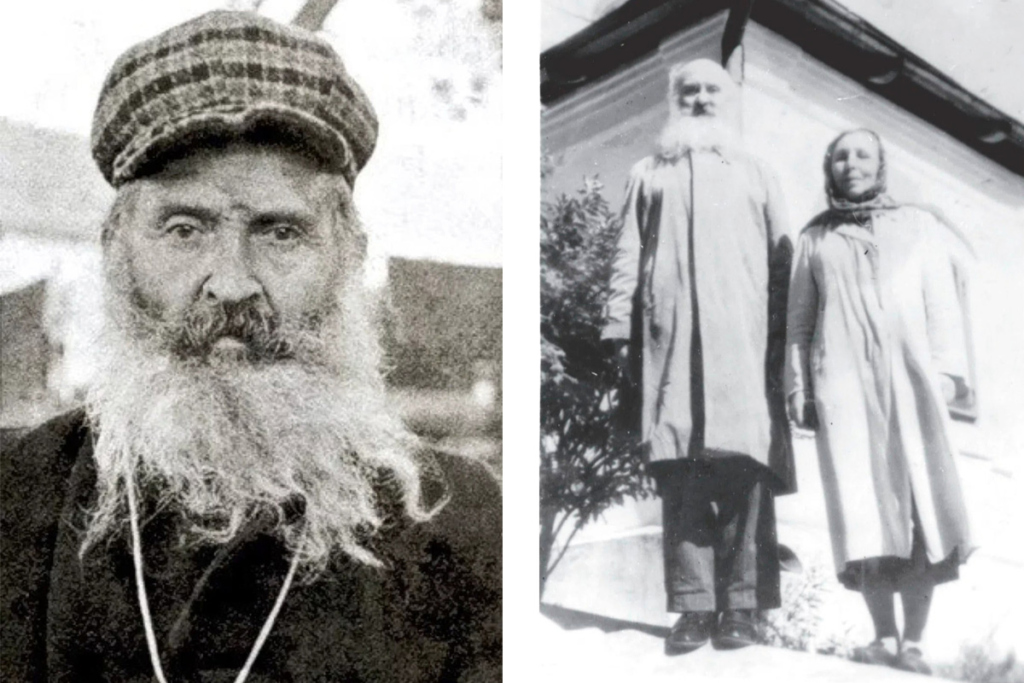 Very few photographs of Athanasius Sayko survive. Left: Athanasius in Oryol. Right: Athanasius with Angelina Vasilyevna Dmitriyevskaya.
During the war, Athanasius continued helping wherever he could. He no longer loaded railway wagons, but took on the hardest household tasks for those who needed him.
In 1948, he was once again placed in a psychiatric hospital. The surviving records, examined in connection with his canonisation, bear witness to the religious persecution behind his confinement.
Even in hospital, people found their way to him. They brought notes, asked for his prayers and sought his advice. The authorities responded by sending him farther away: first to a hospital in the Voronezh region, then to one in the Tomsk region of Siberia.
Years of his life passed in these institutions. Appeals and petitions were sent to every authority that might be able to help. At last, he was released.
Athanasius never tried to impress anyone with his intelligence. When people dismissed him as mentally ill, he accepted their judgement of him and continued his strange ways.
Among those who worked tirelessly for his release was Angelina Vasilyevna Dmitriyevskaya, an archaeologist who had become his spiritual daughter. Meeting him had changed her life. She became his legal guardian and devoted herself to caring for him.
Remaining in Oryol risked further persecution. People who knew and loved him raised enough money to buy a tiny house near Snezhetskaya railway station, outside Bryansk. Angelina moved there with him, keeping the little wooden house scrupulously clean and welcoming.
It became his home for the final years of his life.
“I shall return to Oryol”
Athanasius sometimes travelled to Moscow, Riga and Pskov. Visitors also came to see him, taking care not to attract unwanted attention. He received them joyfully, sometimes meeting them at the gate, sometimes going as far as the station to welcome them.
Throughout those years, friends in Oryol sent food every week.
Towards the end of his life, his familiar good cheer became an almost radiant joy. One day he said to an elderly woman visiting from Oryol:
“Mother, I shall soon be back in Oryol. This time for good.”
Delighted that she would no longer have to travel so far to see him, she asked where he would live.
“At St John the Baptist’s.”
He had named the cemetery. She assumed he meant a house nearby.
Only a few weeks later did she understand. A neighbour brought the news that Athanasius had died. His funeral would be held in Oryol, and he would be buried in the very cemetery he had named.
He fell asleep in the Lord on 5 May 1967, the Friday of Bright Week—the week following Orthodox Easter.
That morning, he had risen early, carried in water, heated it and washed. He put on clean underclothes and white socks, said his prayers and lay down to rest. He did not wake again.
A great crowd gathered for his funeral. Those who had loved him believed that death had not ended his care for them. They continued to seek his intercession, trusting that he would pray to God for them as he had during his life.
Among those who revered him was Father John Krestiankin, later known far beyond Russia as a beloved spiritual father. As a boy growing up in Oryol, he had received an extraordinary gift from Athanasius: his violin, complete with its case.
Years later, John had to sell the instrument to buy food and medicine for his mother. But the case remained with him, a treasured reminder of the man who had given it, until his own arrest.
Translated by the Catalogue of Good Deeds
Source: https://www.miloserdie.ru/article/afanasij-sajko-kak-yurodivyj-skripach-stal-svyatym/