

“In a world of fleeting truths and shifting sands, where can we find a rock upon which to build our lives?” This question haunts the heart of every seeker of God. For two millennia, Christians have pointed to a sacred library of books – the Holy Bible – as that unshakable foundation of truth. But how can we, in the 21st century, know that this ancient text is not just a collection of venerable stories, but the living Word of God? The Orthodox Church invites us to approach this question not merely as an intellectual puzzle, but as a sacred journey. We do not see the Bible as a standalone manual that fell from heaven; we see it as a treasure born from within the life of the Church, preserved by the Holy Spirit, and understood only in the Church’s living experience. The truth of Scripture shines forth through its divine origin, the Spirit-guided wisdom of the Church in recognizing its contents (the biblical canon), its profound internal harmony, and its miraculous power to transform human lives. Let us walk through this “library of the Kingdom” with reverence and wonder, discovering how and why the Bible is true – in what it is, how it came to be, and what it does in the hearts of the faithful.
A Divine Symphony: Who Wrote the Bible?
The Bible was written by over 40 men – kings and shepherds, physicians and fishermen, prophets and apostles – across some 1,500 years. Yet the Orthodox Church boldly confesses one ultimate Author: God Himself. The Scriptures are “God-breathed” (from Greek θεόπνευστος; 2 Tim. 3:16), written by divine-human synergy. This means that in composing the Bible, God’s Holy Spirit and the human authors worked together in a mysterious harmony. The Holy Spirit did not override the personalities of the writers or turn them into robotic scribes. Rather, as Bishop Kallistos Ware explains, “divine grace cooperates with human freedom… God does not abolish our individuality but enhances it. The authors were not just passive instruments… Each writer of Scripture contributes his particular personal gifts. Alongside the divine aspect, there is also a human element in Scripture, and we are to value both”.
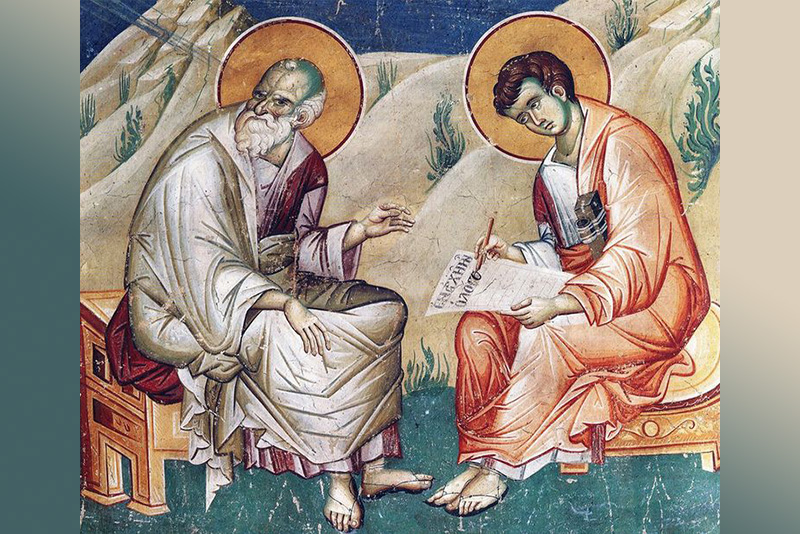
St. John Chrysostom – one of the great Church Fathers – beautifully illustrated this mystery using the image of a musical instrument. Describing how the Apostle John wrote his Gospel, Chrysostom said John had “made ready his soul as a well-fashioned and jeweled lyre… and yielded it for the utterance of something great and sublime to the Spirit.” When John wrote, “it is no longer the fisherman… but the Holy Spirit that striketh this lyre… For he will say nothing to us as a man, but what he saith, he will say from the depths of the Spirit.” In other words, each biblical author is like a master musician playing in a grand symphony. They each have their own tone, style, and context – David’s poetry differs from Luke’s history or Paul’s urgent letters – yet the Composer is the same Holy Spirit, breathing through their unique voices to produce one glorious melody of salvation. Thus, the Bible is at once 100% the Word of God and 100% the word of its human authors – a divine symphony in which heaven and earth sing together. This miracle of inspiration is our first foundation for trusting that the Bible speaks the truth: its author is Truth Himself.
The Measuring Rod of Faith: Understanding the Biblical Canon
If God inspired many books, how do we know which books truly belong in the Bible? The term “canon” itself comes from the Greek kanon, meaning a reed or measuring rod – essentially, the “rule” or list of books that are authoritative Scripture. The canonical books of the Bible did not appear as a neat table of contents from the sky. Rather, they were discerned and recognized from among many religious writings by the early Church. It is crucial to understand that the Church did not “create” the canon by her own whim; she received and confirmed it through the guidance of the Holy Spirit. The Orthodox Church, which St. Paul calls “the pillar and foundation of the truth” (1 Tim. 3:15), was the living context in which the Scriptures were preserved and authenticated.
How did the Church recognise the canonical books of the Bible?
The Church’s discernment was organic and worshipful, not merely academic. Guided by the Holy Spirit, she received the Scriptures within her life of prayer, doctrine, and worship. The criteria were applied contextually:
For the Old Testament:
- The Church received, rather than invented, the Scriptures of Israel—now read in the light of Christ. In the Septuagint (LXX), the Old Testament of the Apostles, these books entered the Church’s bloodstream: their authority rests on unbroken reception, their transparent witness to Christ, and their constant proclamation in the Liturgy.
For the New Testament:
- Apostolic origin (or close apostolic witness): A writing was authored by an Apostle or by a close associate of the Apostles, thus rooted in the eyewitness testimony to the Lord Jesus.
- Orthodoxia (Right belief): Its teaching cohered with the Rule of Faith—the apostolic doctrine living in the Church and confessed “everywhere, always, and by all.”
- Liturgical usage: The books read consistently in the Divine Liturgy and in the common prayer of the faithful were recognised as Scripture. For generations the Gospels and Apostolic Epistles were proclaimed on the Lord’s Day; these texts nourished the Church’s life and bore the recognisable voice of the Shepherd.
Taken together, these marks show that the biblical canon was not invented by committee but recognised through the Church’s lived communion with Christ. As Fr Georges Florovsky observed, Scripture is “a selection… authorised and authenticated by the community’s use (first of all liturgical) and finally by the Church’s formal authority.” The message is divine, yet it is the Church that acknowledges the Word. In short, the Church confirmed the canon through prayerful use and Spirit-guided consensus, rather than arbitrarily creating it.
Historically, by the end of the 4th century this consensus was codified. Regional councils (such as at Hippo in 393 and Carthage in 397) listed the canonical books of the Bible matching the 27 New Testament books we have today, along with the Greek Old Testament (Septuagint) books received by the Church. St. Athanasius of Alexandria, in his Paschal Letter of 367 A.D., enumerated the exact New Testament canon and declared: “These are the fountains of salvation, that they who thirst may be satisfied with the living words they contain. In these alone is proclaimed the doctrine of godliness. Let no man add to these, neither let him take aught from these.” The Church Fathers fiercely defended this “measuring rod” of true Scripture against both those who tried to subtract from it and those who tried to add spurious writings. Athanasius, for example, warned the faithful not to be deceived by “apocryphal” books, calling them “an invention of heretics who write them as they please and assign them dates, that so, using them as ancient writings, they may find occasion to lead astray the simple”. In affirming the canon, the Church was essentially saying: These are the books that from the beginning have nourished the Church’s faith, proclaimed Christ rightly, and been sealed by the Holy Spirit’s witness.
The upshot is that our confidence in the Bible’s truth is inseparable from our confidence in the Church. The canon is not a loose collection of old religious texts; it is the authoritative canon of God’s revelation—the Church’s charter of faith. It took shape within the worshipping community of the Church, and it was the Church’s bishops and saints, guided by the Spirit, who discerned the difference between inspired Scripture and ordinary religious literature. The Bible, therefore, stands true not in isolation, but within the living Apostolic Tradition that identified and upheld it. As St. Irenaeus taught in the 2nd century, the true faith and the true Scriptures live in the Church that has received the apostolic teaching and preserved it without distortion. Cut off from that ecclesial context, one can easily be led astray by private interpretations or false gospels. But within the Church, the Bible’s truth shines clear, for the same Spirit who inspired the Scriptures also dwells in the Church, guaranteeing a harmony between the Word of God and the People of God.
The Library of the Kingdom: How Many Books Are in the Bible?
It surprises many people to learn that not all Christians throughout history have used exactly the same Bible. The Orthodox biblical canon includes a number of books that are absent from the Protestant Old Testament. In total, an Eastern Orthodox Bible typically contains 76 books (49 in the Old Testament and 27 in the New Testament), in contrast to the 66-book Protestant Bible. What accounts for this difference? The answer lies in the version of the Old Testament that the early Church adopted.
Jesus and the Apostles primarily used the Septuagint (LXX) – a Greek translation of the Hebrew Scriptures made in the 3rd–2nd centuries BC. The Septuagint was the Bible of the Greek-speaking Jewish diaspora and included several books written in Greek (or in Hebrew/Aramaic but preserved only in Greek) that were not part of later rabbinical Jewish canon. These include Tobit, Judith, Wisdom of Solomon, Sirach (Ecclesiasticus), Baruch, the Maccabees, and some additional portions to Esther and Daniel, among others. The early Church accepted these Deuterocanonical books as Scripture, since they were used in liturgy and passed the same criteria of apostolic use and Orthodox teaching. When one examines the New Testament, one finds the Apostles quoting extensively from the Septuagint (even when it differs from the Hebrew text), and even alluding to those extra books. For example, the Epistle of Jude references details found in the Book of Enoch – indicating the broader canonical awareness of the early Christians.
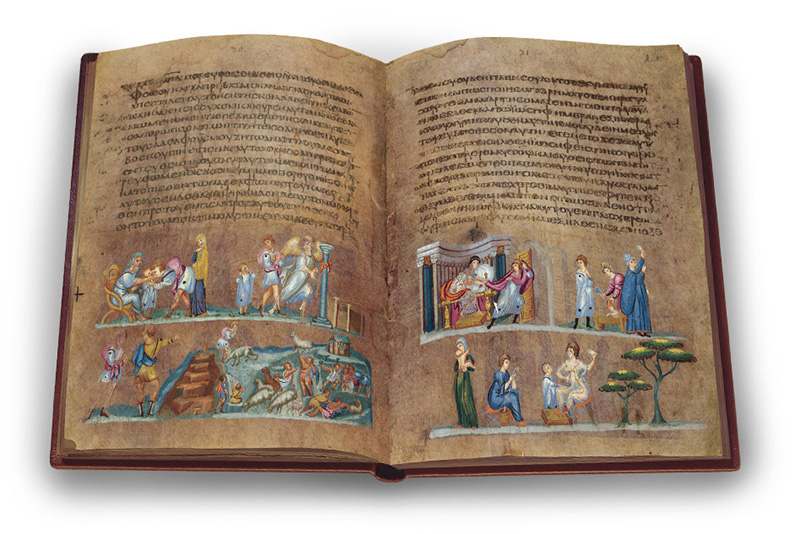
It was not until the Protestant Reformation (16th century) that these books were removed from certain Bibles, being termed “Apocrypha” by Protestants. The Orthodox, however, never st
opped reading these books as part of Scripture. We prefer the term “Deuterocanonical” (meaning “belonging to the second canon”) over “Apocrypha” (“hidden away”) – because these texts were never hidden in the life of the ancient Church. They were read openly for instruction of the faithful (as Athanasius notes, some were appointed to be read by new converts) even if a few were disputed at times. Thus, an Orthodox Bible includes all the books found in a Roman Catholic Bible (73 books) plus a few additional texts that were preserved in Greek usage – such as 3 Maccabees, 1 Esdras, Psalm 151, and in some traditions 4 Maccabees – bringing the total to 76. This broader canon reflects the full Septuagint inheritance of the original Church. It is important to stress that Orthodox Christians regard the Deuterocanonical books as fully inspired and edifying. They are not “extra bonus material” tacked on, but integral parts of the biblical witness, containing prophecies and wisdom that point to Christ. For instance, the Wisdom of Solomon clearly foreshadows Christ’s Passion, and 2 Maccabees teaches about the resurrection of the dead. When we realize the Bible is not a single book but a library, we can appreciate that the Orthodox Church chose to keep the library complete, as received from the earliest Christians, rather than trimming it down later. In affirming these 76 books, the Orthodox Church again relies on the continuous guidance of the Holy Spirit in the Church’s life to know which books belong. And it was in the unity of that same Spirit that the Church could declare these books canonical while setting aside other writings as non-canonical.
To be continued…


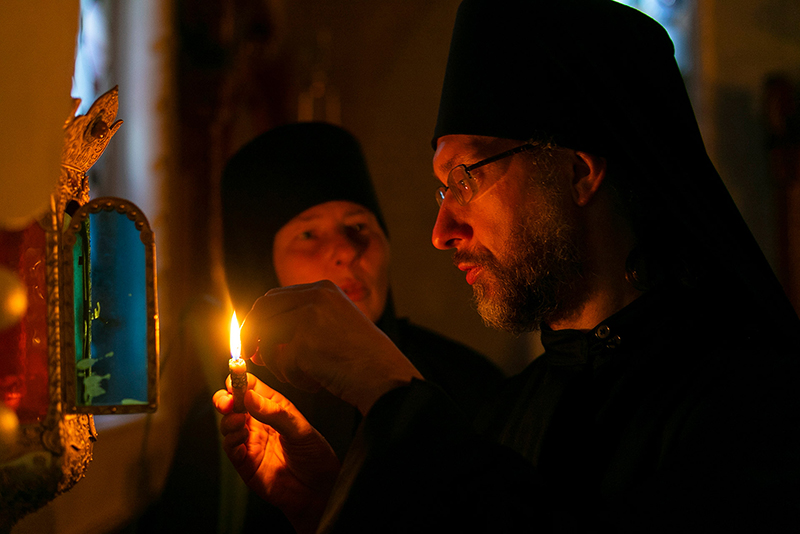
With gratitude to God for the Monasterial help of your Sisters and clergy. We were blessed by the recent visit of your Sister Ilaria in Montreal Canada – nourishing food for our soul