

 If we are careless or unaware of an image’s sanctity, then the image does not suddenly become unholy or “just a picture”: instead we end up profaning the image of a holy one, whether a Saint, an angel, or Jesus Christ Himself.
Holy images in ordinary places
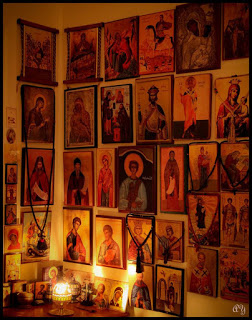
Usually it is relatively easy to pay proper respect to icons of Christ and His Saints when they are particular places: in churches, on icon stands, or our own prayer corners at home. Such places predispose us to a prayerful attitude, so we will look upon a picture of Christ, and will naturally pray to Him. Yet icons can be placed elsewhere, away from places set aside for prayer or worship. It is common for pious Orthodox Christians to place icons throughout their house: in the living room, the kitchen, and by the side of the door. One reason behind this is so that in all aspects of our lives we are reminded of God and the Saints. However, what happens when, despite the icons’ presence, we forget the Holy Ones and behave as though their image is not with us? An illustrative story of the Icon of the Mother of God “She Who is Quick to Hear”:
of the brothers had spoken to him, he wentback quickly to his cell, passing on as before. A voice came to him a second time from the icon, saying, “Monk, unworthy of this name! Will you go on much longer carelessly and shamelessly blackening my Image?” At these words, the Steward went blind, and then only did he understand whose words these were; and, sincerely confessing his sin, he deemed himself worthy of such punishment for his inattention to the words of the Most Holy Virgin Theotokos. The brothers of the Monastery learned what had happened, and consequently they placed a sanctuary lamp before the icon, and had it censed every night, while praying diligently that Nilos might receive back his sight. One day, while he was praying and weeping before the holy icon, he heard a voice: “Nilos! Your prayer has been heard. I forgive you and shall give back sight to your eyes…. for which reason My icon shall be called “She Who Is Quick To Hear;” for I shall speedily show mercy and fulfill the petitions of all who hasten to it.” Following these joyful words, Nilos received back his sight.
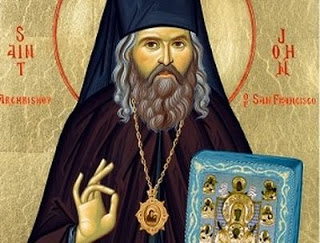 In what way should we honour icons hung in corridors, kitchens, utility rooms etc? St John the Wonderworker of San Francisco did indeed venerate all the icons he could see upon entering a house, even doing so before addressing the occupants! This displays a proper understanding of holy images, as their prototype – Christ and His Saints – are indeed worthy of attention before anything else. Nevertheless, in the example of the “She Who is Quick to Hear” icon, punishment came because of neglect that was damaging the image of Mary and Jesus, rather than because the steward failed to bow and kiss the icon each time he passed. Therefore it is enough to say that being aware of the holy images around us, wherever we may be, is enough – as awareness of the icon leads to awareness of the Saints, and a right heart, should, come from this.
Care of paper icons
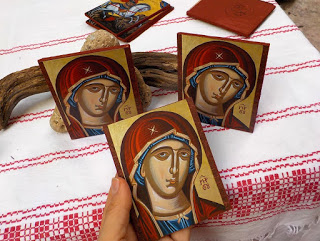
Early on as an Orthodox Christian, I was under the false notion that printed icons were not “as good” as icons painted onto wood. This was because I felt that holy images that had been produced after hours and hours of painstaking care, using the “proper” materials, were somehow holier than images that are printed en masse. This is false, of course. The ascetic care taken by an iconographer is a greater labour of love on her part, and when producing “new” images such care ensures the image is a true one, but otherwise the way in which an icon is produced does not effect its holiness: the “content” of the image does.
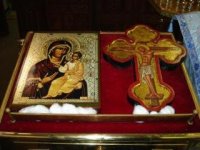 As if to demonstrate this, in modern times God has granted that a number of printed icons be revealed as wonder-working. Paper icons, particularly prints mounted on thin pieces of wood, are produced in vast quantities, allowing anyone to have their own holy image for a relatively small cost. Among the printed icons revealed to be miracle working (usually myrrh-streaming) are the Iveron Icon from Hawaii, an icon of St Nicholas the Wonderworker, and one of his namesake, the Royal-Martyr Nicholas II.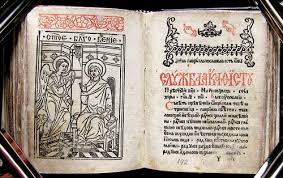
In the case of books, which increasingly have icons printed on the front, then care should be taken so as the images are not neglected as the Mother of God’s image was by the torch-bearing steward. This means not using them as doorstop, or as a coaster for our cup of tea etc. Indeed, such respect should be shown to all holy books (e.g. writings of the Holy Fathers; not just the Bible) regardless of their front cover, as the content of the book is holy and worthy of respect. Where it is difficult to keep the front cover in good condition, then the whole book can be covered in paper (wrapping paper, wall-paper, brown paper…) as exercise books at school used to be covered; and for the same reason: to protect them.
Disposal of holy images
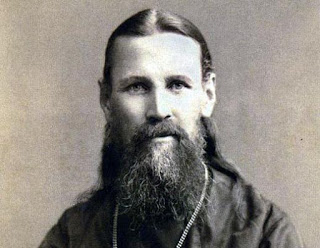 The above is not intended to make any believers beholden to rules and regulations regarding icons. The actual intention can be summed up the words of St John of Krondstadt: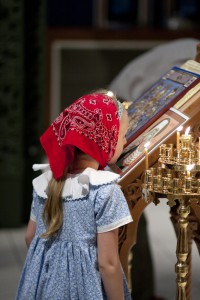
The holy icons remind us of the intimate closeness of those represented in them. Therefore seeing all images of the holy as Icons, regardless of where they are or what they’re made from, means we are more often reminded of the presence of Christ and His Saints in our midst. Our respect for holy images benefits us more than it benefits them, or those represented in them.